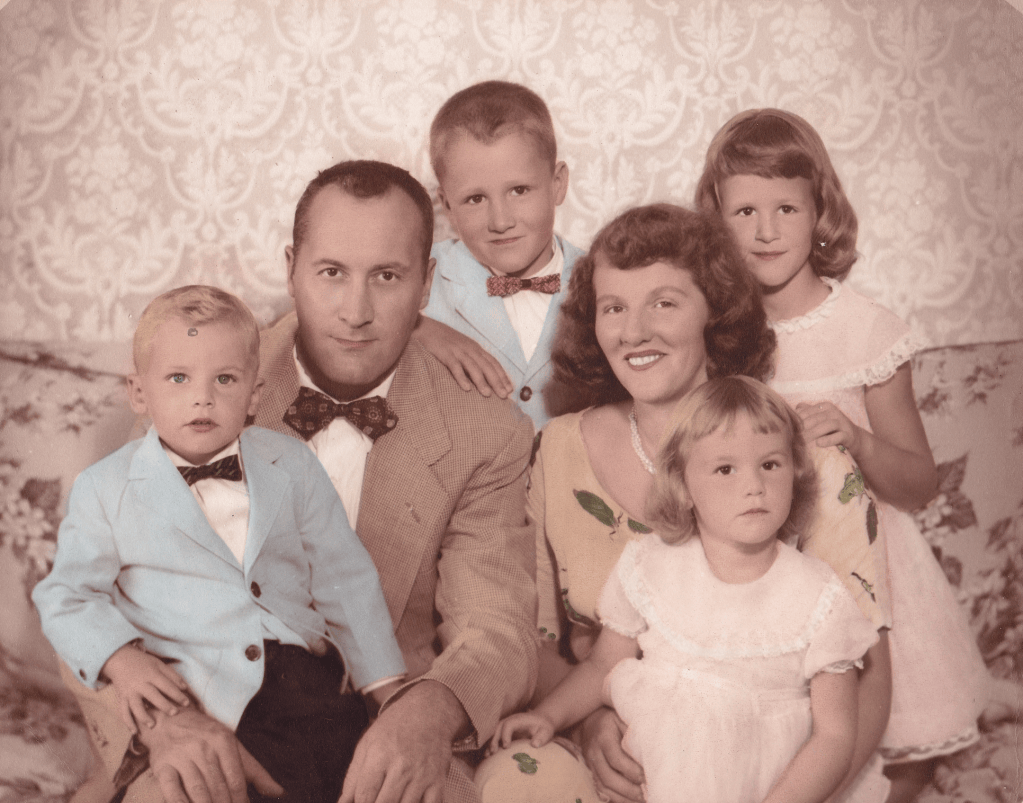
William James (Hughes) Brown (1951-2026) arrived in Vanceboro in 1954 when he was just three, his sister Susan, two. His mother, Diane (Main) Hughes, came home to live with her mother, Louise (Hodgkins) Main, after Louise purchased what was once the Roger Hale farmhouse to run a sporting camp. As a girl, Diane spent summers in Vanceboro and, once home, reconnected with Lindy Brown. In 1955, they married and moved into the Mansfield-Brown house on High Street. Diane and Lindy had two more children, Lyn and David. Lindy was a locomotive engineer for Maine Central and, with railroad jobs increasingly on the chopping block, the family moved to Calais in 1962. But life “up home” remained vivid for Bill and he loved telling Vanceboro stories to his own three boys. These memories were shared over the last years of his life with his sister, Lyn.
VANCEBORO LIFE
Most all of the men and boys in Vanceboro had a nickname. I chalk it up to small town America back in the day. In the Deep South they would be names like “Gomer,” “Scooter,” etc. In Vanceboro they were “Nibs” Russell, the town sheriff, and Tiddly (Tid) Sears, who owned the small food store beside the RR tracks crossing (Dad worked there when his union was on strike). There was Pearly Russell, who owned a gas station. Four of the Beers boys: Fuzzy, Holly, Zeke, and Babe. “Sonny” Christenson, another gas station owner. And, of course, dad, “Brownie.”
There was Peanut Howland and Pickle Cleary. I liked Fuzzy Beers. I actually knew him and played little league baseball with his sons. Close friend of Dad’s. They played on the Vanceboro town team together. I think Pickle has to do with alcohol, being drunk. “He was pickled.” Always liked that word. So small town Maine. Never heard it outside of the state.
There were several stores in town where you could buy food and gas up your car. The main food store was Tid Sear’s store, where you could buy cut meats, some vegetables, and canned goods. It was a squat little red building beside the tracks. Tid looked like a Tid. Short and chubby with glasses. I always thought that he was Santa Claus, running his off-season business. It was a cozy store. No pot belly stove, though. He had a cheesecake girlie calendar hanging on a post beside the counter. He got a new calendar every January.
Mom would occasionally buy Sue and me a popsicle. Tid would take out his big meat cleaver and cut it in half for us to share. One of my first life goals was to have a whole popsicle. Tid would hire Dad to work behind the counter when his union went on strike. With Mom working as the school nurse, they could make do during lean times.
When Mom needed a food item she would send me down to Tid’s. Trouble was, it was on the other side of the tracks. Occasionally I’d get cut off by a long train with 100+ cars. And it would be going very slow as the customs guys did a rolling check to see if the door seals were intact. 20-30 minutes waiting time.
There were a few other stores but they carried mainly canned, dry goods, and beer. Holly Beers, Monk’s, and a place down near the dam that catered to the Spednic Lake camp crowd. The three gas stations were Sonny Christenson’s, Pearly Russell’s and Monk’s. Dad liked to hang out with the boys at Pearly’s place. He had a bad habit of going inside to get something and leaving us out in the car waiting.
Thanks to returnable beer bottles, kids in Vanceboro had a source of income. Canadians would drive over the border to buy beer after the provincial liquor store in McAdam was closed. They would head down Salmon Brook Rd. and pull off into a sandpit to drink, throwing the bottles out of the car. We would ride our bikes there and pick them up. $.02 a bottle. A good haul would be 5 bottles but occasionally you’d hit the jackpot and find a couple of six packs. We would take them to Holly’s to cash in. My preferred place to spend my loot was Christenson’s gas station. Popsicles were 5 cents, ice cream sandwiches were 10 cents. And they had the best selection of penny candy. Ten cents could buy a lot, 25 cents was a fortune. Fire balls, candy cigarettes, bubble gum.
A couple of times, some of us would walk the side of the road to Lambert Lake, “bottling” as we walked. It was a 12 mile round trip walk.
Dad told me there used to be a silent movie theater across from Pearly’s gas station when he was a kid. The occasional small circus would come to town. I remember Gabby Hayes Wild West Show. It was one big tent with Gabby Hayes as the star attraction. He asked for a volunteer from the audience and I was chosen. He asked me to pull his beard to see if it was real. When I did he fired his six shooter behind me. I think I jumped about six feet in the air. Everyone had a good laugh and he gave me the cartridge.
The elder Mr. MacDonald, Gene’s dad, would give me a quarter and have me run down to Pearly Russell’s gas station to buy him a plug of Day’s Work chewing tobacco. He would give me a quarter, $.15 for the tobacco and $.10 for my trouble. Side story, while playing Little League baseball for the Vanceboro Blue Jays, I was told that all ball players chewed tobacco. So I bought a plug of tobacco, ripped off a mouthful, and started chewing. After about a minute of doing this, I had an impulse to swallow. And I did. I turned green and only ate bubblegum after that.
THE RAILROAD
The Vanceboro bunk house was beside the old water tower, catty-corner from Holly’s store. Every Thanksgiving and Christmas Eve Dad would walk down and invite whoever was there up to our house for dinner, and for drinks on New Year’s Eve. I remember the Christmas where I got my first electric train set. I lay awake in my bed listening to Dad and his railroad buddies putting it together and playing with it, acting like it was their real jobs. All fueled by a bottle of rye whiskey, of course.
In Bangor, in high school, I wanted to stay a couple of days to watch the Eastern Maine HS basketball tournament with some friends. Dad arranged it so that we could stay in the bunkhouse, which was in the old rail yard a short distance from downtown and the arena. It was good size, with a small kitchen. We had the whole place to ourselves. This is where Dad stayed when we lived in Vanceboro and he was breaking in as a new engineer. He would take the passenger train to Bangor on Sunday night and return on Friday. I think this was the main catalyst for our move out of Vanceboro. He seemed proud that he was finally an engineer but at same time it must have been tough on him to be away from his family and Vanceboro for so long, being the “homer” that he was.
The trestle bridge was the quickest way to the spot in St. Croix where logs were pushed into the river in the springtime to be driven down to the Woodland mill. Dad worked the river drives when he was younger. You could see the river below as you walked on the ties holding the tracks but it wasn’t dangerous. I also used to play on the parked boxcars in the rail yard. You could climb to the top of the boxcars and jump from car to car for long distances. There was a degree of danger there and Dad told me to stay away (I didn’t).
The rail yard was fascinating to me. There was a large ice house that stored ice cut from the lake, used to refrigerate box cars. The large slabs were covered in sawdust to insulate them. The locals would go there in the summer to whack off large chunks for picnics and cooling beer. There was a small stock yard to quarantine animals. And a shed with rock salt for winter de-icing. My favorite were the putt-putt cars, small two-person rail cars that were used by work crews. They were light enough for two people to pick up and turn around. There was also the roundhouse, where locomotives were worked on and stored. It was massive. And of course the station. Good size for a town like Vanceboro. It’s a shame they tore it down.
The area between the river and the road was another world to me, starting at the dam and ending down near Sonny Christenson’s house on Salmon Brook Rd. Mathias Kelly’s place was beside the dam. It was a small, green colored, windowless shack. I never did get the whole story on him. I saw him around often but never spoke with him. I remember someone telling me that he was a millionaire who chose to live that way. And that he was a war hero with PTSD. And a hermit who kept to himself. He was a source of fascination to me but I never got up the nerve to approach him.
There was also a small hand-operated cable car over the river, to measure water height and volume. I really wanted to try it out. The tannery was located on the flats on both sides of the track, beside the trestle. Many of the old building foundations were still there, making it dangerous to walk around. This is where our dog Duchess fell into a water-filled cellar and spent most of a night treading water. Some old boards helped keep her afloat. Someone heard her howling and got word to Mom and Dad. Dad went down and somehow fished her out. I still remember her the next morning, on the kitchen floor wrapped up in blankets, completely exhausted.
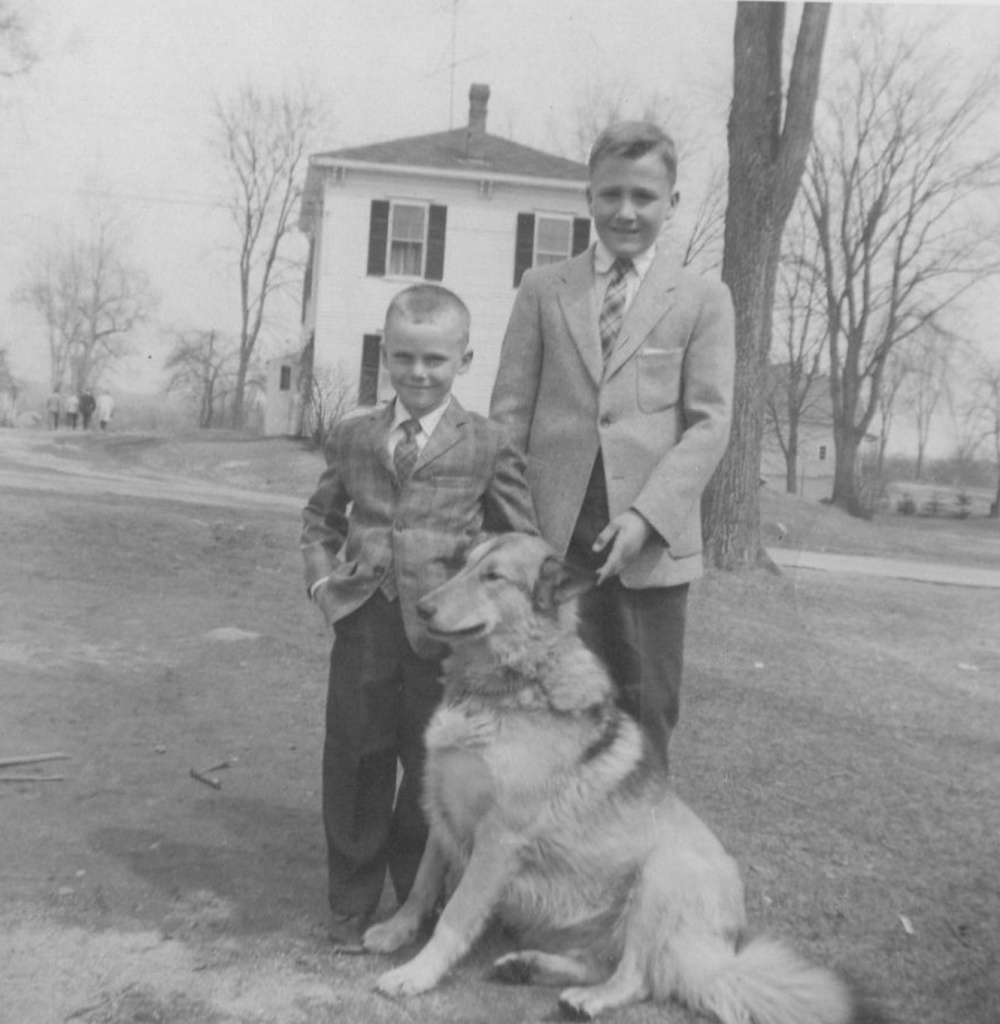
Heading down Salmon Brook Rd, towards the cemetery, you turn left across from Powell’s house, towards the river. There were a couple of large sandpits, then a small cove on the river with a flat area beside it. This is where the ball field was. I imagine it’s all grown back in with trees now. I used to play with my classmates, Richard Coyne and Raymond Hanson, down here. Ray was a great tree climber. After his dad transferred to Waterville with the Maine Central RR, he became a state champion on the rings for Waterville High School. There was also a long string of boom logs chained together in the cove (used for keeping logs together). I kept trying to walk across them, falling into the water and getting soaked every time.
Vanceboro is built on a very large esker, the largest in Maine I believe. You can gauge its size where the railroad tracks cut through it. Comprised mainly of sand, that’s the reason why Vanceboro has so many large sandpits. And the water wells have trouble holding water. Every summer the town fire engine would get a load of lake water and empty it into our dry well.
EVERYDAY LIFE
I remember Dad being an avid reader of the Bangor Daily News (“that Republican paper”). This was back in the day, of course, before the Internet and 24/7 news cycles. Each small town had a correspondent who would write all the news tidbits that people would call or write in (relatives in town for a visit, someone over for dinner, someone in the hospital, etc.). And when they moved to Florida, they subscribed online just to get all the hometown news (yes, they did read other town’s news, just to stay in touch).
We didn’t have a phone (or a car, come to think of it) until the late ’50s. It was a two-piece crank phone, with a wooden box that had the ringer, attached to the living room wall. The black phone, that had no dial, sat on top of the box. You “dialed” the phone by picking up the receiver/mouthpiece and then turning the crank on the side of the box. One long crank to get an operator and an out of town line. Everyone in Vanceboro was given a 3 ring “number”. Ours was two longs and a short. There were only two party lines for the entire town. If someone was talking on your line, you had to wait your turn. And you could hear a click from someone else’s phone when they would pick up to listen in on your conversation. But I was just in awe of it all. Definitely an “…everything’s up to date in Kansas City…” moment for me when it was installed.
Pre-internet, no cable TV, no newsstands, etc. Basically, just over the air TV. Radio stations were hard to tune in, even at night. Unlike Calais, we could get the three Bangor channels, plus CBC in St. John. Even so, we watched a lot of Canadian TV. “Don Messer,” “Time For Juniors,” the weather report and news, “Wayne and Shuster Hour,” “Hockey Night in Canada,” etc.
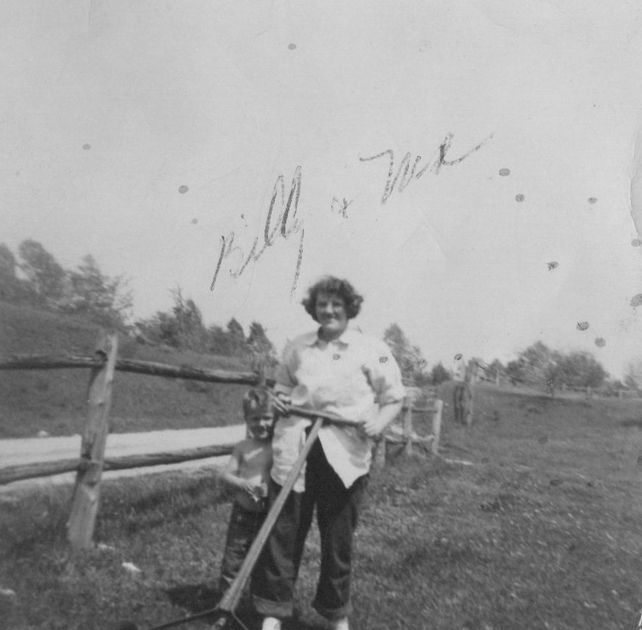
Bill and Mom on the farm, once owned by the Hales.
The newspaper, of course, was the Bangor Daily News, delivered by train. Reverend Bird pumped out a 4 page mimeographed paper called the “Vanceboro Views” for a couple of years. Before Mom married Dad, my name was Billy Hughes. (I actually lived on the farm while I was in first grade.) I remember being teased by some of the kids. “Billy Hughes blew his fuse and put it in the Vanceboro Views.” Mom had a subscription to the Reader’s Digest. And Dad got the Legion magazine. That was it. No Time, no Newsweek, no Life. We had no encyclopedias and very few other books. My salvation was the Maine state bookmobile that came to town once a month, with one stop at the school and the other in the lot beside the post office. I would go to both.
Movies were mainly a television event. It was a big deal when the Wizard of Oz was on once a year. The nearest movie theater was in McAdam. I saw my first movie there, Darby O’Gill and the Little People. With the death coach and the banshees, it scared the hell out of me. I was spending a few days in McAdam at Aunt Dot’s house with Harold.
One summer on Spednic Lake, Chris Crandlemire and I were able to pick up a rock and roll station out of Fredericton on the radio. It was my introduction to the devil’s music, “Vacation” by Connie Francis. The nearest Red Sox broadcast station was WQDY but it didn’t reach us. (And the ball games ended late at night, so the BDN didn’t have the scores. Word of mouth came in on the Bangor train each day.) That’s why Dad is a Yankees fan. The only station he could pick up aired the Yankees game. His radio ran on batteries. He told me that he had to hold the set up to his ear while in bed as the batteries ran low. By the way, the Red Sox were not a good team back then, even with Ted Williams.
I did have opportunities to see how folks entertained themselves before TV and radio. There would be beer and someone would have a bottle. There would be singing, storytelling, and poetry. Sometimes there were musical instruments (Dad’s harmonica for one). Jigs and reels prevailed. There was one parade a year on July 4th. From the Legion Hall to the cemetery and then back to the hall for refreshments.
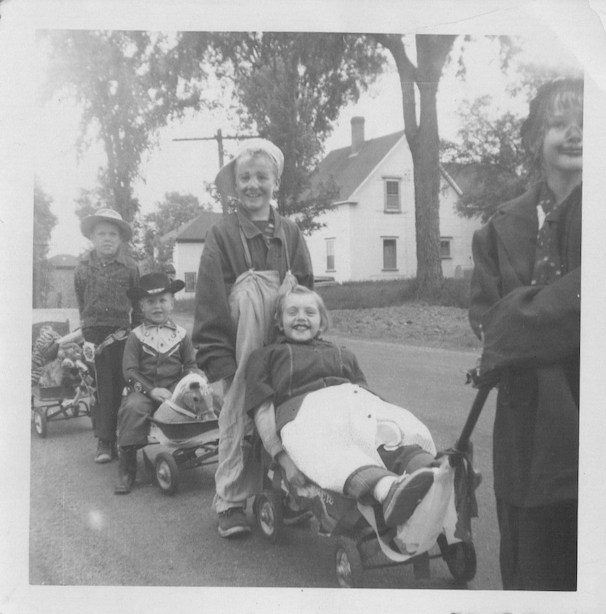
The churches, Catholic and Methodist, had entertainment events. The Methodists had numerous potluck dinners. Good food and good company.
Tourists would come up for the lake every summer. It was a window on the outside world for me. New people wearing big city clothes, with big city ideas. Flashy cars and lots of money. When I was 10, I saw my first black person at Christenson’s gas station. I just stood there staring at him, motionless.
As far as school, I enjoyed Mrs. Blanchard’s grammar class in 4th grade. There were two classes per teacher. You could listen to the higher class if what you were doing was boring. Twelve grades, 1st-6th downstairs, 7th-12th upstairs.
All in all, I’d say that living in and around nature stimulated me the most. To be able to just walk into the woods by yourself or be on the lake. My own Walden Pond. It was magical.
THE GARDEN
Mom maintained a relatively large garden in Vanceboro. It was behind the house, up against the Pratt’s property line. Pratt’s house was between us, stretching for several acres alongside the esker and the woods. They had two huge gardens that seemed like they could have been commercial in nature. You could walk to the RR yard on their very long driveway, after stepping down the stairs in back of Crandlemire’s.
Mom put a lot of work into her garden. All she had to prepare it with every spring was a hoe and shovel. She planted a good variety of vegetables. Lots of green and wax beans (good for preserving) and several pole’s worth of pole beans (very long string beans). All the regulars were there, tomatoes (started in the kitchen), cucumbers, carrots, beets, turnips. Lots of lettuce, Swiss chard, cabbage. No kale that I can remember. Squash and pumpkins. No potatoes. I enjoyed helping as much as I could. I don’t think she trusted me with weeding early in the season, though. One of my greatest joys in Vanceboro was picking and eating raw veggies right out of the garden.
Mom used to preserve a large amount of what she grew. I remember the whole operation, the cutting and washing, the boiling, the packing. Lots of cut wax beans, bread and butter pickles, dill pickles, green tomato relish. She had her larder downstairs in the basement. It was a typical old Maine house cellar. Rock walls, damp, cold, low ceiling. Right out of a Stephen King novel.
Berrying was also a big part of summertime food gathering. It started with wild strawberries (my favorite). Loved the intense flavor those small berries gave off. Then came the raspberries. Easy to pick on the old logging road bushes. Then the season-ending blueberries. They were not easy to find around Vanceboro. And our neighbors across the street, the Coynes, also had a very large blackberry bramble. I ate a lot of them.
There was a cranberry bush between us and the Blanchard’s house, but not enough to bother with. We had no apple trees, although my friends and I scoured the town for old, forgotten trees that were still bearing apples. I ate a lot of green apples. And in the springtime there was another favorite of mine, rhubarb. There were forgotten patches all around town. They’re a perennial so they would pop up like clockwork every spring. Mom would make the occasional strawberry rhubarb pie/cobbler with them. And I never did see any fiddleheads being picked in Vanceboro. With all the swampy land nearby, that was a lost opportunity.
I would tell the Boys that I never ate store bought jam or jelly until we moved to Calais. I was surprised that you could just open the jar and eat the jam without removing the paraffin plug first.
BASEBALL
Some of my first memories in Vanceboro were baseball related. After we moved into Dad’s house, I remember him taking me to one of his games in McAdam, which was in the semi-pro league covering New Brunswick. Dad said that many U.S. college players would come up to New Brunswick every summer to play. Looking back, it strikes me that this was a way for him to measure himself against the “college boys.” As he was playing (outfield and catcher), I was more interested in playing on the metal bars underneath the bleachers. But I was happy when I got to go with him.
I only got to see him play a couple of games in Vanceboro. The field was off Salmon Brook Rd., on the flat area down by the river and the sandpits, turning off half way between the cemetery and Route 6 that goes through town. It wasn’t being played on much and needed some work. I’ve seen photos from the 20s and 30s. The field looked very sharp, with a well-maintained grass infield. I was also told that the flat area was Vanceboro’s de facto airplane landing strip. The only airplanes that I recall were George Buchanan buzzing our house and a twin-engine plane crisscrossing the area doing aerial magnetic surveys, looking for metal deposits. I really only got to hear stories about the old town team. I hear that they were very good. This was when Vanceboro had a tanning mill and a large, active rail yard. I think as many as 1,500 people lived there at its peak? And every little town throughout the area had a ball team. Lambert Lake had one. Topsfield, Danforth, and so on. Codyville had one. I think there’s only a couple of houses left there today.
I loved hearing stories about the old baseball days. All the Beers boys played. Fuzzy was the catcher. Dad said that they had a pitcher who threw so hard that Fuzzy had to put a piece of steak inside his catcher’s mitt for padding. Percy McPhee was their 2nd baseman. Dad said that he was the fastest player on the team, with many stolen bases. Percy’s problem, though, was that he had trouble stealing 1st base (couldn’t hit). And I remember the story when The House of David team came to town. They had long beards and hair down to their belts, wearing heavy woolen uniforms.
I remember Dad’s old glove. I wish that I had it today. No pocket or webbing to speak of. Basically, just a flat piece of padded leather. And he swung a heavy bat, 38 ozs I believe. He was a very good ball player, a natural. I’m sure that if there hadn’t been a war and he didn’t have to take care of Carrie, he could have played pro ball. He was very much like Ted Williams. Swung from the left side, a contact hitter with power. He had some speed running until he injured his knee. And he had a good arm from the outfield and behind the plate. Like many players back then, he knew all the dirty tricks. Freeze the game balls overnight so that when you hit them they go nowhere. Or step on the 1st baseman’s foot if it’s on top of the bag. One fond memory is the annual oiling of the gloves every spring with neatsfoot oil.
I remember Dad and his friends getting together to drink some beer and watch the World Series. The Yankees in the 50s and early 60s were in the series almost every year. And Dad loved his Yankees. I told you the story how he became a Yankees fan. I wonder how much different it would have been for him if his father had been alive.
I started playing ball at a young age. It began with playing catch with the three Coyne boys across the street. Dad wasn’t around that much but their father, Jim Coyne, was always up for throwing the ball around. He was a big Irish guy who worked on the bridge. One of my favorite movies is Field of Dreams. The scene where Costner asks his dad if he’d like to play catch gets me every time.
There was always a pickup game going on somewhere. Usually all we had was one beat up ball and a cracked bat with a couple of screws in it. Any field/lawn would do. More than one window was broken. I started playing Little League ball when I was 8 years old (8-12). We had one team. The coach was the Methodist minister, Lance Bird. We were called the Chickadees, then the Blue Jays (get it?). Bird was a fundamentalist but a good coach. We had a good team, although I heard that Bird fudged the ages of a couple of the older players.
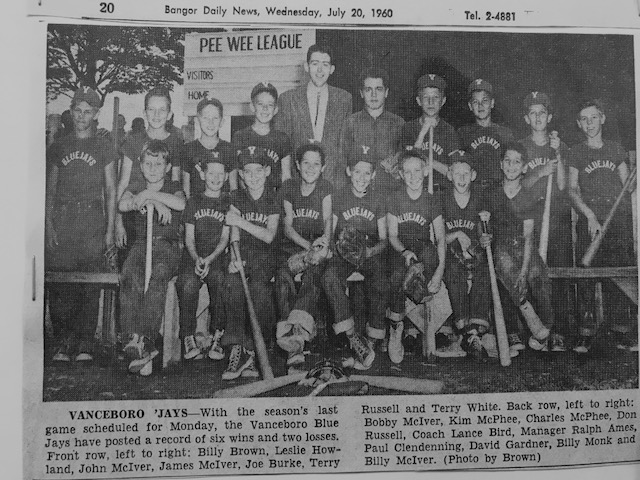
Our playing field was between the church and Keef’s house. The dads would come out every spring to mow the grass and fix it up. Cars would pull in off the street and honk their horns whenever someone made a good play. (Of course Mom never needed a horn.) We had to travel to other towns to play. Robbinston, Woodland, Pembroke, Winn, etc. Many memories. For one trip, I remember Dad giving me his last dollar so that I could eat lunch when we stopped after the game. That meant a lot to me then and now.
Speaking of which, I remember getting up at dawn to walk across the trestle to see Ted Williams, his daughter, together with a fishing party led by Bangor TV outdoorsman Bud Levitt. He had just retired from the Red Sox and was the outdoor sports spokesman for Sears and Roebuck. They were going to canoe and fish down the St. Croix. He made time for me, answering a few of my questions and giving me his autograph. Nice guy. It’s been said that John Wayne used Williams as his acting role model. He was the real deal. I later got Bill Monbouquette’s autograph at the boat landing. He was a relief pitcher for the Red Sox. See, little Vanceboro had some star power.
THE HOUSE
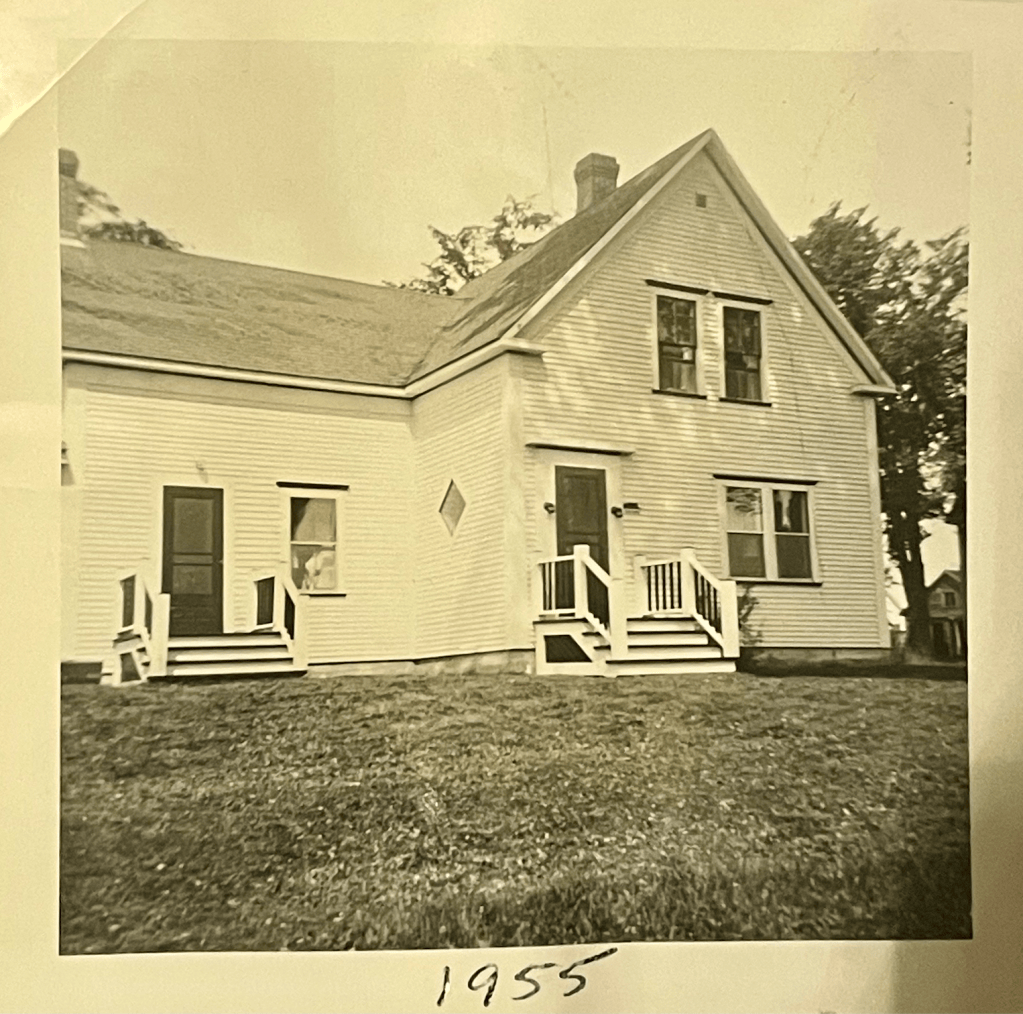
So, the house on High Street in Vanceboro. Where to start. It wasn’t where I had my first memories. That was at Sunrise Farm. My first memory at the house was when we moved there after the wedding. I was still Billy Hughes.
I thought the house itself was huge, being two stories and all. I believe it was built the same time in the 1800s when many other houses in town were built. I remember someone telling me that there was a sawmill down by the river that cut the boards and dimensional lumber. There were still many old growth trees to be had. Someone told me it was mainly hemlock.
I do remember the inside of the house when we moved in. In retrospect, I don’t think much of the interior had been upgraded since it was built. But Dad had a good paying job and started making upgrades for his new bride and family. The kitchen was very basic. Large kerosene cooking stove, small hand pump by the sink for well water, plain cupboards, worn linoleum floor, metal kitchen table (where we ate every night except Sunday). There was also a large walk-in pantry on the east wall. This would become the new bathroom, complete with indoor plumbing.
Virtually none of the walls or ceilings in the house were insulated. When the kitchen was upgraded with new cupboards, sink, and stove, the new copper water lines from the well were put inside the north wall. Big mistake, considering that there was no insulation. Every winter, after a big freeze, the pipes would freeze solid. I remember Dad cutting open the wall to thaw them out with a butane torch.
Mom did all the laundry in the kitchen, using a wringer washer. I still remember how humid it would get inside during wash day. And, of course, there was no dryer. Everything would go outside onto the clotheslines, year-round. The bedsheets would freeze solid during the winter months. It was like bringing thin sheets of plywood back into the house.
Having a reliable source of water from the well was problematic. The well was hand dug, about 12-15′ deep. The water table would rise and fall throughout the year. Vanceboro is mainly located on a glacial esker, I believe the largest one in Maine. Eskers are ancient streambeds that were formed inside continental glaciers. They are comprised of massive sand deposits. Our house was located on top of the esker. In the summertime, the water table would drop, drying up the wells in the neighborhood. Every summer, the town fire engine would bring up loads of water from the lake to the wells in town and fill them up. It was a fond memory of mine because they let us climb all over the truck.
The outhouse (two holer) was located at the far end of the attached shed. Before we left for Calais, Mom and Dad signed up for a food delivery service, which forced them to buy a large freezer that they kept in the shed. A truck would deliver packaged food every 3 months. And with the freezer, Mom could freeze her garden produce and berries.
The big upgrade was the bathroom. The kitchen entry to the pantry was sealed off and a new door opening up into the hallway was built. The bathroom had a sink, toilet, and tub. I can’t remember there being a shower. Mom gave Susan and me crayons to draw on the new drywall before it was painted while we were taking baths together.
The dining room was in the northeast corner. It had a large gravity fed kerosene furnace, with a large metal grate, in the floor. It heated the entire house. During a large blizzard, I think in the late 50s, Vanceboro’s electricity was cut off for over one week. But because the furnace had no electric parts to keep it running, we stayed warm. Dad was very proud of that. The living room and dining rooms had wood floors, made out of thick, local rock maple flooring. I remember when it was installed. No prebuilt flooring there. Thick tongue and groove strips, sanded and painted with a clear lacquer. A crank phone was installed in the northwest corner. A large, thick wooden table with padded chairs was in the center, over the furnace. We ate all our big Sunday meals there. And a new window was installed in the north wall to let in more light.
The living room was my favorite room. It was large and sunny, with two windows facing south. When we moved in (’55?) there was already a television set setup in the southeast corner. It was a large set in a wooden cabinet. We could pull in 4 channels, 3 from Bangor and 1 from St. John. It was my window to the world. Sunday nights were the best. Disney, Ed Sullivan, Bonanza, and also all the Canadian shows. The weatherman with that huge piece of white chalk, The Friendly Giant, Time For Juniors, Hockey Night in Canada, Wayne and Shuster, and, of course, Don Messer. True story, Dad gave me a jackknife for one of my birthdays (what was he thinking!?). So I thought I’d just trim up those sharp wooden edges on the TV set. He was very pissed off. Oh yeah, and a special shout out to the wallpaper. Those large floral prints seemed pretty cool at the time.
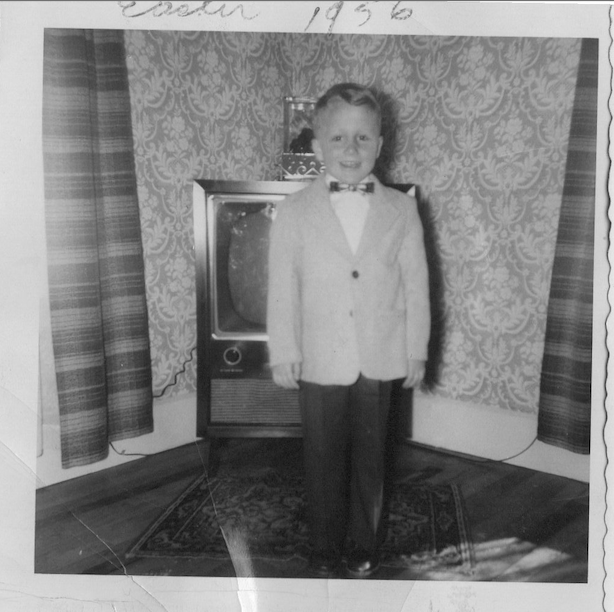
Bill, 1956, in front of the TV and the “pretty cool” floral wallpaper.
I felt comfortable upstairs. Lyn and Susan had Carrie’s old room. David and I were in the large room over the kitchen, with one window facing west. Mom and Dad’s room was the best, though, with a window facing south.
The cellar was a classic old house set-up. Low ceiling, damp, cool, dirt floor. The walls were original, stacked, flat rock construction with no concrete. Mom kept her preserves here, from her large garden and all the jams and jellies. No windows, either. Great setting for a Stephen King novel.
LEAVING VANCEBORO
I think it was several different things. At the time, Dad was working his way up the Maine Central seniority ladder. More time with the company allowed you to be at the head of the line for certain jobs. Dad had transitioned from being a fireman (#2 in the engine cab, formally the coal shoveler) to engineer. But he was low on the seniority ladder and had to take jobs in Bangor. I remember him being gone for a week at a time, living in the bunkhouse and eating at McDonald’s to save money. When I was around 11, the plan was to move our family to Bangor. The city was growing and I remember all new housing brochures, with floor plans, he would bring home. All these brand new split level houses with modern this and modern that (it was 1962). I was pumped up, thinking we were going from a small, woods town to living like the Jetsons.
But sometime during the next year, the Calais/Woodland mill job came up. I think this really appealed to Dad. Still in Washington County, not so big city, but with all the modern conveniences (and just 50 miles from the old hometown). And it was a secure, steady job in one location. No one could “bump” him to another location, although he did occasionally do the Eastport and Bangor runs. I think the other thing that played into his decision was talk of the school closing. And he could see the town slowly disintegrating around him. He talked about that often and I think it made him very sad. I mean, he was a social guy and all his friends were either moving away or dying off. And Mom was more than ready. She had abandoned her nursing career to live in Vanceboro and I think she wanted to give it another go. Everything happened rather rapidly. I remember moving less than a month or so after he got the job.