On Saturday, July 20th Vanceboro will celebrate the town’s 150th Anniversary. The sesquicentennial celebration will include a short program –“Vanceboro: Past, Present, and Future” – along with music, a lunch version of your favorite Saturday bean supper, and the grand reopening of the Vanceboro Historical Society. There will be a chance to recall memories and tell stories of Vanceboro to be included in the historical society archives, tours of the museum, tables with old photographs yet to be identified, and a chance to include your favorite local recipe in the 150th Anniversary Vanceboro Historical Society Cookbook.
Georgia Crandlemire’s Camp de Bass fish chowder
Poke around your family recipe box and send us your favorite – the one that brings you home, reminds you of your grandmother’s love, the warmth of the kitchen on a winter’s night, the bright lights around the Christmas tree. We don’t always consider how recipes passed down through our families preserve local traditions. But more than a taste of home, they’re windows into the culture of those who came before us: bean hole beans baked on the river drives, thick molasses cookies packed in railroad worker’s lunch boxes, fish chowders eaten on cool spring evenings up lake. Vanceboro area recipes hold the delicious stories of our Maine and New Brunswick history.
There are multiple ways to submit your recipe:
Submit electronically: Click here to download a digital version to fill out on your computer/laptop. Then, please email the completed form to cluppi161@gmail.com.
Submit handwritten by mail: Click here to download a recipe form to be printed and completed by hand. Please send printed form and pictures to: Carol Luppi, 161 Quincy Avenue, Winthrop, MA 02152
Submit handwritten at the celebration: You can even bring a recipe and photos with you to the celebration on July 20th. We will also have forms to handwrite recipes available at the celebration.
Check out this sample submission, if just to get the juices flowing.
Story told by Genevieve Gatcomb Smith (Around 1900-1920’s). Written up by her son Raymond Smith
Armstrong’s Picture House was on the second floor of Stillman Armstrong Co. The protruding box above the stairs is the film projection room.
A major attraction in Vanceboro was the movie theater. Pooch Ross1 and Stillman Armstrong started the theater in Armstrong’s old moccasin factory where I had worked. The theater was on the second floor of the building one block south of the railroad tracks at the intersection of Water Street and Holbrook Street.2 This was just about the center of town and just across the street from the Hunter’s home. The railroad station was one block north and one block west.
My brother Frank worked for Mr. Ross and one of his jobs was to run the movie theater. Later, he bought it from Ross and Armstrong and ran it until talking pictures made the old silent movies obsolete. The movies were on Wednesday evening and Saturday afternoon and evening. The Saturday movies were the big event of the week. The town wouldn’t have been the same without them. There were very few radios in town in the early twenties and the roads out of Vanceboro were gravel. In the spring, they were virtually impassable because of the thaw and resulting frost heaves and mud. As unrealistic as they were, the movies gave us a touch of the outside world.
I sold the tickets except on Saturday afternoon when Mama took over the job. They were ten cents for children and twenty-five cents for adults. Frank ran the projector which was powered by a generator run by Frank’s car after the powerhouse fire. He simply jacked it up and attached a drive belt from the rear wheel to the spindle of the generator. Since the movies were silent, there was a piano on stage to the right of the screen and a pianist played the music which had been scripted to the film and sent with it. Maude Dickinson, the piano teacher, was the first person to hold this job. She taught Flo to play the piano and tried without much success to teach Ray. Lucy Farnum took over the musician’s job at the theater after Maude left and then Florence.
The movie consisted of several individual reels so Frank always had slides to show while he was changing the reels. The movies would start with a slide showing a lady with a huge hat and the title, “Ladies, please remove your hats.” That would be followed by a slide or two of oncoming attractions. First there was a comedy short followed by some advertising slides while Frank rigged up the next reel. His advertising slides were sometimes hilarious because Frank made them himself and was a terrible speller. He might have something like, “Holbrooks Store For A Fine Gift Of Julery.” After the comedy, he would either have a news reel or a serial episode. The news might be two months old but to us it was news. Today’s soap operas are an outgrowth of the movie serial. The average movie consisted of four reels.
Ralph took the tickets and when Frank put on a local stage production, he was one of the lead singers. Ralph had a wonderful voice. He and Flo were the musical ones in the family. Les and Ray sold cracker jacks and popcorn, which we popped at home. I can still see them between reels, walking down the isles with their wares in a box supported by a strap around their neck. Les and Ray also cleaned out the theater. After a show, it was an awful mess. One of Frank’s slides that went up after every reel read, “Please Don’t Spit on the Floor!” That was a waste of time because there were lots of tobacco chewers and they spit copious amounts of Spearhead juice during the course of a movie. It was especially bad in the back row.
There were certain regular customers who insisted on the same seat each time. They would come early to get them and surprisingly enough, on the whole, people would honor their unwritten desire and avoid taking, for example, Mrs. Crocker’s or Mrs. Hunter’s seat. In fact, there was usually a jostling to get a seat near Mrs. Crocker. If she happened to be a bit late, her favorite spot would be open and all the seats around it taken up. Keep in mind that the movies were titled as the action went on but not all adults could read. Allie Crocker was in that fix, but she loved the movies and got very vocal and excited. She was a fairly good yard stick on which to measure how good a movie was. If the villain would sneak up behind the heroine to grab her, Allie couldn’t contain herself and might shout, “Watch out! The bastard’s right behind you!”
If someone missed a show, they would want to know what Mrs. Crocker told the actors.
There wasn’t a toilet associated with the theater so every one had to hold their water. Some of the kids would pee down the steam pipes by the walls. There was a combination of individual seats and long benches. So, on the benches, you could always get a seat by just squeezing everyone a bit more. On the whole, the crowd was well behaved because they were truly interested in the films. The children loved Tom Mix, Jack Hickox, Ernest Torrance and the westerns. The adults drooled over Mary Pickford, Lillian Gish, Douglas Fairbanks or William S. Hart and everyone went wild over Charlie Chaplin.
The silent movies gave the children a great incentive to learn to read. Some adults like Fred Mills couldn’t read, so he needed a reader. Elmer Swaney sometimes read the words for Fred that appeared on the screen. Fred was very smart in other ways. He worked on the railroad and knew the number of every train that came in just by the looks of it. This encouraged the kids even more to want to read.
Footnotes:
Pooch, a Vanceboro nickname given to George W. Ross, the town’s deputy sheriff, perhaps because he was a short squat man with ample white hair and sideburns or maybe because of his dogged determination. ↩︎
Holbrook Street, in this reference, is now Route 6, known historically as Railroad Street, The Old Codyville Road and The Lambert Lake Road. ↩︎
In August 1945, according to the Maine Central Employees Magazine, the 56 miles of jointly operated Maine Central and Canadian Pacific rail line between Vanceboro and Mattawamkeag was maybe the hottest single track in America. Twenty-four or more trains a day traveled from Vanceboro to Mattawamkeag and on to Megantic, Quebec. That’s a train every hour – at least. On March 15th of that year “32 trains were run, including eight passenger trains and 24 freight trains.”1 Each Canadian Pacific freight heading east toward Vanceboro averaged 40 cars. Maine Central running west averaged 69.
The freight trains were heavy and traveled steep grades through all kinds of weather. This meant double heading or using two locomotives at the front of the train, each operated by its own crew. The men were experienced, the track well cared for and though accidents were rare, they sometimes happened and with devastating effects. The accident in Lambert Lake was especially tragic.
It was December 12, 1950 and Canadian Pacific train #951 was hauling general merchandise west from McAdam to Brownville Junction. It had been raining for days, so much so that a Penobscot River rise at Mattawamkeag halted travel on the Boston-Halifax, Nova Scotia line.2
Danny McCracken of McAdam recalls the horrific early morning scene as it unfolded:
“December 12th was very dark and wet when shortly after 6:15 am the shop whistle with a series of long blasts alerted McAdam that there had been a wreck on the CPR. Immediately men rushed to work, those working alerted a train crew & made an engine ready to take the auxiliary to the scene. A local store keeper went to his store and got ready a list of foods to be picked up for the crew of carmen who would be away for a number of days. My Dad was contacted and directed to go to the scene of the wreck instead of his normal 8am operator’s job at the station. Train #951 with 2 steam engines, #2597 & #5166 had hit a track washout 3571 feet East of the Lambert Lake Station. The 3 men in 2597 suffered injuries, but the 2 men in 5166 were killed. The 2 engines and first 16 cars of the 34 car & 2 Vans (cabooses) derailed.”
The crash was the result of a series of unexpected and unprecedented events. According to the Interstate Commerce Commission Report, there was no initial cause for alarm.3 The engineer and the fireman of Extra 5332 East, an east-bound CP freight train that passed through about about an hour and a half earlier, said that it was raining hard but the engine rode smoothly. They noticed no water on the track nor anything unusual.
And everyone had done their jobs. “Because of the heavy rain, the track was being patrolled ahead of all passenger trains. The section foreman had inspected the track about 4pm the previous day and had assigned two employees to patrol the track during the night. One patrolman had inspected the track and observed conditions in the vicinity of the point of accident…2 hours 15 minutes before the derailment occurred. He examined both ditches and did not consider the flow of water to be excessive. At that time there were no indications of scouring and he saw no condition which he considered abnormal or dangerous.”4
The crash occurred at 5:15am. The Commission Report describes in detail what happened:
“As No, 951 was approaching the point where the accident occurred the speed was about 35 miles per hour. The brakes of this train, which were being controlled by the engineer of the first engine, had been tested and had functioned properly when used en route. The headlight of the first engine was lighted brightly. The engineer and the fireman of the first engine and the front brakeman were in the cab of the first engine and were maintaining a lookout ahead. The engineer and the fireman of the second engine were in the cab of that engine and the conductor and the flagman were in the caboose. The engineer of the first engine said that It was raining hard as the train approached signal 2464 and that water was running down the side of the cut with considerable force, a condition he had never before observed. He was watching the track closely and after the engine passed signal 2464, which indicated Proceed, he observed that the ballast had been washed from under the north end of the ties. He Immediately made an emergency application of the brakes and the speed was reduced to about 30 miles per hour when the derailment occurred.”5
Interstate Commerce Commission Report, map of the accident
The Waterville Morning Sentinel described it as a “spectacular derailment.” The engineer, fireman, and the brakemen in the first engine were injured when they jumped to safety. Engineer Joseph Doiron and fireman Colin M. McKay in the second engine, died at the scene. Both of Brownville Junction, Doiron was the father of four sons and a daughter, McKay the father of a young son.
The Bangor Daily News, Dec 13, 1950: Trainmen who escaped serious injury in the “tangled mass of wreckage,” left to right: Bert McDermott, Brownville Junction, engineer on first engine. Clayton White, Danforth fireman on first engine and George Madore, Brownville Junction brakeman on first engine, all of whom leaped to safety. Edward Murray, Brownville Junction rear brakeman on first train, and Manners Wansink, Brownville Junction conductor on first train.
After careful consideration, a veteran track supervisor determined that debris had formed a temporary dam across a ravine on the slope and when it broke the surge of water overflowed the dike and undermined the track structure. In the end, the Commission report concluded, the accident was caused by a washout.
Newspapers across the state reported the derailment, the tragic deaths, offered weather-related theories. They published photos of the crash aftermath, engines on their sides, the sheer force of a stop that piled freight cars one on top of the other like a falling row of dominos. But history is not only the description of events and their causes, not just the newsworthy facts. As important, or perhaps more so, history is the way such events land in communities, the way people remember and respond and care for one another in the moment.
Those living in Lambert Lake who awakened that cold rainy morning to the sound of car slamming into car after car, recall something deeper, more personal than what the papers report. They remember the faces of shocked, injured trainmen knocking on their doors in the early morning, recall parents taking the men in, calling out for help. They remember stories of the scene, the sadness of losing two men. They remember a storeowner opening his doors, readying and delivering food to those off to clear the line. As children, they recall walking from their homes the next day to look at the mangled wreck, thinking maybe for the first time in their lives how dangerous a job their father, uncle, cousin had and how fortunate they were to have them home and safe.
Because it is the culture of the area to hold memories of loss and sorrow in song, local balladeer Eldon Yeo of St. Croix captured the tragic event for posterity.
An official report is one thing, useful as an historic document, but Yeo’s song and the many local memories of that December morning paint a richer picture of a border community tied by rail and deep relationships, a close-up view of the care and concern people had for one another.
“‘Hottest’ Single Track in America?” Maine Central Employee Mag, Aug. 1945. ↩︎
Interstate Commerce Commission, Washington, DC. Report no. 3381, Maine Central Railroad Company re Accident Near Lambert Lake, Maine on December 12, 1950. ↩︎
In 1987, Judson Hale’s memoir, The Education of a Yankee, hit the bookshelves. The son of New England Brahmin,1 Roger Hale and Marian (Sagendorph) Hale, herself from a wealthy Philadelphia family, Hale’s early life was spent on an experimental farm his parents built in Vanceboro, just outside the town proper. Though young Hale would go on to succeed his father-in-law as the editor of the Old Farmer’s Almanac and Yankee Magazine, much of his memoir tells the colorful story of life at Sunrise Farm.
Beginnings
Each summer during the 1920s and 30s, Jane Sagendorph, Marian’s mother, traveled from Philadelphia to Vanceboro and then by boat to her log cabin retreat on Star Island in the middle of Palfry Lake. When she could no longer make the trip, she left the island and cabin to Marian and son-in-law, Roger Hale.
Roger’s father, Frank, was a hardworking rags to riches sort, a textile magnate worth millions. Roger and Marian, benefitting from Frank’s largesse, living in upscale Chestnut Hill, just west of Boston. They were so wealthy, Roger didn’t need to work. “Life was one big, long picnic,” his son Judson writes.2 The couple entertained, went to elegant parties and traveled. Roger played polo and tooled around on his 42-foot sailboat.
From The Education of a Yankee. After their three-month honeymoon in Europe, Roger and Marian Hale on their sailboat, Marianette.
When Roger and Marian’s first son, Drake, began experiencing unpredictable spells and violent behavior, they sought medical help. With few answers, they found their way to the Rudolph Steiner School in Switzerland. Steiner, an Austrian scientist and philosopher, was the founder of anthroposophy, an approach to physical and mental health that emphasized the spiritual benefits of the natural world and the arts. Their son responded positively to the school and so, after a time, they left the boy in Switzerland.
The Hales dreamed of building their own experimental anthroposophy center, a place to explore Steiner’s theory and its relationship to nature, education, medicine, the visual and performing arts. Marian was an opera singer and especially attracted to the Steiner philosophy. Their familiarity with Star Island made Vanceboro the obvious choice. In 1936, using a million dollar trust fund his father set up, Roger Hale purchased 12 thousand acres, most from Eastern Pulpwood Co., some from local landowners. The purchased land surrounded the entire town and included over ten miles of lake and river front property.
The Hales began their project in earnest. In addition to buying Stillman Armstrong’s spool mill on Spednic Lake, Roger Hale hired local men to construct two sawmills and then to build nearly fifty structures, including a seventeen room house, a school, greenhouses, a woodworking shop, barns, a lab, and a theater.
Harold Kelly pulling logs into Spednic right before dam. Background far left is spool mill with stack, center is workshop, right is saw mill and far right farm. Edgar Barry collection
The Hales gathered “a veritable herd of horses” for work and play(they trailered riding horses for Marian and Roger from Santa Fe, New Mexico).3 They hired local horse whisperer, Frank Smith, as their main teamster and Carl Hanson as their blacksmith. Teachers for their Mainewoods School, a Waldorf school for 1st-8th grade, came from Switzerland. They hired a couple from New York to chauffeur and run the kitchen. The Hales lavishly furnished their new house with silver wallpaper, original paintings, and a grand piano. Sunrise Farm as they called the entire enterprise would became a spiritual beacon, an educational experiment, a destination for artists and performers, educators and doctors.
Sunrise Farm, just after 1936. The house to the left, barns to the right. Early days, before the school, theater, labs and mills.
And for a time it was all of this. The Hales hosted famous opera singers, artists, and doctors, shuttling them to and from the farm to Star Island on their 26-foot cabin-cruiser, the Milky Way. Marian gave performances and wrote, directed, and produced a series of plays, the most ambitious being a theatrical production of Cinderella staged outdoors with a real coach and horses driven by Frank Smith and casting students from Mainewoods School in the main roles.
Cinderella, presented by students at the Mainewoods School at Sunrise Farm. Ferne Cropley as Cinderella arrived at the ball in a real coach driven by Frank Smith, seen in the background in top hat and tails. Over 150 local people attended.
But it didn’t last, couldn’t last. Roger Hale, his son suggests, built too much, too quickly; spent too much and ran out of money. Hale’s father continued to support the farm for a time but in the end, facing debt, agreed to bail Roger out only if he sold Sunrise Farm. And so, just eleven years after purchasing the property, The Hale family moved back to Chestnut Hill. In 1949 Roger Hale hired Henry. S. Anthony & Co. to auction off the farm.
The Miseducation of Judson Hale
Judson Hale was just three years old in 1936 when the family first moved to Star Island and buildings began to go up at Sunrise Farm. He was still a boy when the family returned to Chestnut Hill. Age and memory are a funny thing, but neither fully account for the inaccurate and sometimes patronizing way he describes Vanceboro and the people living there at the time of his parents’ experiment.
Judson Hale tells his readers that Vanceboro, at the time of the family’s arrival, was “a two-class society: poor and dirt poor.”4 If you weren’t working for customs or the railroad, the saying went, you were working for Hale. That wasn’t entirely true, of course. There were roughly 700 people living in the village at the time the Hales arrived. Local folks owned and ran shops and general stories and gas stations. There was a fairly new school with a principal and well-educated teachers, a post office, a town sheriff. There was WPA work and lumbering and river drives and sporting camps. It was true, the Depression lingered and families welcomed the extra income. Some found full time work at Sunrise Farm. Local men farmed the Hale property, worked in the mills and built the Hale’s buildings. Others cared for the herd of dairy cows and other livestock. Local women cooked and cleaned. But Vanceboro was an active railroad hub and international border crossing at the time and doing just fine before the Hales arrived.
In a chapter fittingly called “Audacity,” Judson Hale describes the shock of arriving in a place so remote “there were no inns, hotels, motels…no drug store, no golf courses, no tennis courts, no swimming pools, no summer people, no library, and no organizations like Lions, Rotary, Women’s Club, Historical Society.”5 Their shock says more about the rarified air the Hales breathed than Vanceboro, itself. In fact, there was a station restaurant and hotel. There was an active Knights of Pythias fraternity, Masonic Lodges in McAdam and Danforth, each with an active Order of the Eastern Star. There were sporting camps and lodges with world-class hunting and fishing. The entire lake region was a swimming pool. There was a beautiful well-maintained baseball field and a successful town team. There were lively school events and Catholic and Methodist churches where parishioners planned annual picnics, spring socials, and bingo nights.
The people of Vanceboro provide a kind of comic relief for Judson Hale. He gives them a dialect more likely to be found in Jonesport than a town bordering New Brunswick, where no one says bahgain for bargain or ayuh for yes. In bits of dialogue good for a laugh but most certainly never uttered, local people sound uneducated and, well, stupid. For example, Hale recounts an acquaintance’s report of an overheard exchange between a customer and local storeowner, Aubrey Tague (misspelling Teague throughout the book).
Customer: “Y’aint got no eggs today, has yuh?”
Mr. Teague: “I ain’t said I ain’t, did I?”
Customer: “I ain’t asked yuh is y’aint–I asked yuh ain’t yuh is, is yuh?”
Mr. Teague: “Ayuh.”
Anyone who knew the well-spoken Mr. Tague, himself originally from New Brunswick, would never, for a minute, believe it.
The man with the glass eye was, in fact, John (Jack) Rankin Grant from St Croix, New Brunswick, himself unlikely to speak in such a dialect.6
On many occasions, Judson Hale positions his mother, Marian — her training as a opera singer, her sophisticated upbringing, her clothing and manners, “her cultured Boston accent”7 — against the uncouth, uncultured townspeople. She was a lady, unlike a local woman with her “small, snuffling, raggedy” children.8 Vanceboro people, he wrote, were in awe of Marian Hale and her efforts, a “first step in bringing culture and the arts” to backwoods Vanceboro.9 To be sure, by the time the Hale’s arrived, The Armstrong Picture House had closed, along with the other productions offered there. But of course, there was the movie house in McAdam and a variety of performances came through town on the railroad. Families could take the train to St. John, Calais, Bangor or Boston for events and they did. And while opera may not have been on the Vanceboro docket before the Hales arrived, there was a lot of local music and art, a rich cultural heritage, with fiddlers and singers and poets and dancers. Vanceboro and neighboring towns across the border shared a unique way of life and culture seemingly lost on the Hale family.
In the end, Judson Hale writes, their venture brought out “the best and worse in Vanceboro.”10 The best, Hale implies, was the townspeople’s initial embrace of his family, their appreciation and compliance, their hard work in the service of Roger Hale’s vision.
The worst was twofold. First, the local suspicion of the German-speaking visitors to the farm and the Swiss teachers the Hales hired. Though not a full excuse — there was some nasty behavior11— in truth, it was a scary time. Hitler was on the rise in 1936. Canada entered the war in 1939; the US in 1941. The two countries shared a fear of Hitler’s army. Yet, had the Hales protected themselves less from “backwards Maine living”12 and built a deeper trust and connection with the community, such suspicions may never have taken hold.
Second were Hale’s accusations that he had been “stolen blind” by his workers.13 Roger Hale, his son suggests, was just too honest, an easy mark, someone who paid too much for local work and in the end fell victim to unscrupulous employees. But Hale held the purse strings and was in full charge of all operations. There may have been some light-fingered laborers or wasted lumber or equipment, but the suggestion that this accounts for a million dollar foundering fails the sniff test.
Epilogue
Sunrise Farm went on the auction block on Oct. 26, 1949. Everything went, from land to buildings to farm and lab and mill equipment. In an echo of the earlier land purchase, building construction, and failure of F. Shaw and Bros. tannery, dozens of local folks like Paul Susee, Frank Gatcomb, Daniel and Philip McIver, bought back land and buildings. Like many current and seasonal residents, the Luppi (Crandlemire) family and Alaine and Christopher Hinshaw can trace their camp property to Roger Hale. My grandmother, Louise (Hodgkins) Main, brought up on High Street, bought the Hale farmhouse with its seventeen rooms and six bathrooms and opened a fishing and hunting lodge. Her sister, Muriel (Hodgkins) Kegin, helped cooked for the lodgers and soon after, my mother, Diane (Main) Brown, newly divorced, moved in with her children, my brother and sister.
My father, Lindy Brown, was a Vanceboro teenager when the Hales arrived, one of the local boys who chose the railroad over working for Sunrise Farm. Years later, when The Education of a Yankee was published, he gave a copy of the book to my mother as a Christmas present, a reminder of her time on The Farm, as our family called it. The two of them read and talked about Judson Hale’s version of Vanceboro and his off-kilter descriptions of people they knew so well. As was often the case, my mother struggled more with inaccuracies than my father. She wrote Hale a letter informing him that he’d confused Aub Tague with someone else and let him know her mother bought the farmhouse. It’s safe to say, his response — his misrepresentation of her name, continued use of Teague for Tague and pleasant lack of accountability — did not delight her.
In his novel, This is Happiness, Niall Williams writes, “A hundred books could not capture a single village.” We all have our stories and family histories of Vanceboro. But we can and should take care not to cast personal memory and family loyalty as fact, as truth. There are, no doubt, bits and pieces of Sunrise Farm sitting on dusty barn shelves and tucked in garage and basement boxes, no denying the significance of the Hale’s presence and its impact on Vanceboro. There’s also, we know, another version of the story.
Footnotes
A Brahmin refers to a socially or culturally superior person, especially one from New England. ↩︎
Judson Hale, The Education of a Yankee, Harper & Row, 1987, p. 33. ↩︎
Frontier Week Fishing Tournament, St. Stephen-Calais, July 3-7, 1961 Photo taken at Loon Bay Lodge (St. Croix River) Back row, l to r: Charles Vaughn (Philadelphia Inquirer), W. G. Hreenaway (Bedford, NS), Dave Roberts (Cincinnati Inquirer), Milton Lounder (guide), Bud Leavitt (Bangor Daily News), Julian T. Crandall (Ashaway Lines), “Happy Jack” Felton (Philadelphia), Horace Tapley (Field & Stream), Jack Keddy (guide), Ted Williams, Elmo Wright (guide). Front row: Fred Brisley (guide), Frank Lounder (guide), unknown, Henry Lounder (forest Ranger and guide), Beecher Scott (guide), unknown, David Scott (guide), Norman Hatheway (Brewer, Maine and winner of fishing tournament), Owen Clendenning (guide).
In the thirties and forties, the only radio station local folks could pick up aired the Yankees games, so a good many baseball fans grew up rooting for Babe Ruth, Lou Gehrig, and Micky Mantle. Still, when Red Sox star Ted Williams started showing up with his fishing buddy, Bangor Daily News sports editor and outdoor columnist Bud Leavitt, people were excited to see him.
Vanceboro, where Spednic Lake feeds into the St. Croix River, is pretty much a perfect fishing spot, and Ted Williams loved to fish. He met Leavitt early in his career and together during the off-season they headed north. People from around town remember seeing Williams come and go. He’d stay at local camps, drop into Monk’s store for supplies, and take in an occasional fishing derby. Bill Kaine remembers when Red Sox pitcher Bill Monbouquette came up with Williams a few times and they stayed at the Hilltop Inn. Bill Smith and his friends would go up to the inn and watch them play catch.
Williams had a camp in New Brunswick, up on the Miramichi River, and Jean Hogan recalls working the border when he came through in the early 1990’s. He was also a familiar figure in Grand Lake Stream, where he stayed at Weatherby’s and fished for landlocked salmon in both the lake and the stream.
Williams had a few favorite guides while in town. Milton Lounder from McAdam would take him up lake to stay at Loafer’s Lodge. Elmo Wright, considered one of the best whitewater guides on the St. Croix, would take Williams down the river to Loon Bay.
Guides at Loon Bay: From left, Eddie Scott, Elmo Wright, Beecher Scott, Jack Keddy, Milton Lounder, and Fred Brisley
If he was not fishing with lifelong pal, Leavitt, “the last of the 400 hitters” spent hours casting a line in solitude, no doubt enjoying time away from the limelight.
But in a baseball town like Vanceboro, it’s no surprise that every boy with a glove would do his damnedest to chance a meeting with Williams. Richard Monk tells of the time he and his brother skipped school to sneak up lake, only to receive a chilly reception. “The Kid” was on vacation and wanted nothing to do with them. Richard was so upset he went home and cut up all his Ted William’s baseball cards.
Richard might be happy to know that Williams, as they say, could get a little ugly. Jack Gartside, a noted fly-tier, remembered standing around the Fenway Park entrance as a boy, hoping to catch sight of arriving ballplayers. His friend who got there before him said, “You’ll never believe this, but Ted Williams talked to me before he talked to anyone else.”
“No kidding. What did he say?”
“He said, ‘Get out of my way, kid.'”
A ten-year-old Bill Brown remembers meeting Williams in 1961, the year the ballplayer retired. “I had a chance to meet him in St. Croix. He was in a fishing group with Bud Leavitt, his daughter, and others. They put in just on the other side of the trestle and canoed down to Loon Bay. I got up early, walked across the trestle and got his autograph before they put in.”
When he was sixteen, Gary Beers and a bunch of his friends “trekked through the woods to a camp (might have been Christensen’s) on the lake to see if we could meet him. When we got to the ridge overlooking, we saw his daughter Barbara (about 14 then) on the dock, casting a fly into what appeared to be an 18″ tube thing.. .. at about 40′. No teen-aged boy I’ve ever known would walk up to that. We slunk away quietly.”
Williams’ connections to Maine were long-lasting—from promoting Moxie during his playing days to Nissen bread in his retirement.
Considered one of the greatest hitters of all time, Ted Williams was inducted into the Baseball Hall of Fame in 1966. Also considered one of the greatest fly-fishers, he was inducted into the Fishing Hall of Fame in 2000. The latter is an accomplishment Vanceboro townspeople, guides, and sports camp owners can feel part of.
A newspaper ad created for J. J. Nissen Bread in Portland, featuring sports journalist Bud Leavitt, Jr. and baseball great Ted Williams.
Addie and Stillman with Stillman’s brother, George, in New Hampshire’s White Mountains
Stillman R. Armstrong (1879-1938) was Vanceboro’s version of a Renaissance man. At various points in his relatively short life, he was a taxidermist, a shoe manufacturer, an inventor, the co-owner of Vanceboro’s silent movie house, a fire insurance agent, the owner of a lumber mill, and the proprietor of the town’s first electrical plant.
Armstrong was more than an astute businessman, though. As former Vanceboro resident Herb Gallison wrote in his memoir, The Long Life and Pretty Good Times of Herb Gallison, Armstrong was beloved in Vanceboro for his creative energy and commitment to the well-being of the community.
“More than any of his contemporaries he was altruistically civic-minded, too honorable to ever be politically inclined. Everything he developed improved the living conditions in our community. He made jobs for and paid good wages to local people who weren’t on the MCRR payroll. He provided [the town] with our first household electric power, enabling us to have useful appliances and retire our smoky kerosene lamps. He introduced us to our first moving pictures.”1
Armstrong was born on February 6, 1879 in Perth, New Brunswick, a village located just across the St. John River from Fort Fairfield, Maine. In 1899, at the age of twenty, Stillman co-owned Hill & Armstrong’s Taxidermy Shop in Fort Fairfield. In 1903, he married Adele “Addie” Marion Levesque from Grand Isle, Maine, an Acadie village just north on the St. John River. Perhaps realizing the importance of the US Canada railway to an emerging entrepreneur and businessman, the couple moved to Vanceboro.
In February of 1904, Stillman purchased a house on the corner of Railroad St. and Salmon Brook Road from Charles Hunter, E.A. Holbrook, and E.T. Holbrook. The following August he bought the Railroad Street property next door, from Horace Kellogg. There he constructed a two story building and began manufacturing shoes under the business name Stillman Armstrong Co. The next year, he and Addie welcomed a son, Vose, their first of twelve children.
Armstrong was, by then, also operating a taxidermy shop. As a newspaper article of the time reports, the shop employed two part-time workers and did “very fine work” mounting moose, deer, and caribou heads sent to him from as far away as Alaska and Newfoundland.”
S. Armstrong Taxidermist advertisement on the side of his business at the corner of Railroad and Salmon Brook Road. This building burned and was replaced by the larger building in the photo below.
Armstrong Moccasins: Yours from Maine
Stillman Armstrong Co’s specialty and most popular shoe was the moccasin and he advertised them widely.
“Here is a Moccasin that fits; it’s clean, stylish and restful to the foot” the ad claims. “They wear forever — are forever worn….Yours from Maine”
He studied the moccasin’s construction and on Feb. 21, 1909, filed a patent with the U.S. Patent Office:
“Be it known that I, STILLMAN ARMSTRONG, a citizen of the United States, residing at Vanceboro, in the county of Washington and State of ‘Maine, have invented new and useful Improvements in Moccasins….”
The invention, he continues, “has for its object the provision of a moccasin of the ‘low quarter” style, in which the disposition of the lacing flaps insures the secure fastening of the moccasin against looseness and slip; and, furthermore, such lacing flaps, together with the tongue, when arranged in accordance with my invention, afford a complete protection for the instep of the wearer; these results being accomplished without adding materially to the weight or cost of the moccasin, and without detracting from its appearance or comfort.”
“In order that the invention may be understood by those skilled in the art I have illustrated in the drawings herewith one embodiment of my invention….”
Armstrong’s “new and useful improvements” were popular and the patent, it would seem from his subsequent land purchases and businesses, was quite profitable. His design remains a fundamental reference for other patent applications. A search for Armstrong’s patent number takes us to a 2012 design application submitted by Croc, Inc. The earliest listed reference, distinguishing their filing from any other, is “March 1909, Armstrong.”
Over the years, Stillman Armstrong became a wealthy land and business owner. In 1913, he bought the spool mill and all associated buildings and machinery on the shore of Spednic Lake from King Maxwell (one acre of land). In 1924, he bought property, including “the mill, the dam across the river, and the water power thereto belonging, known as the Vanceboro Tannery land and bounded on the north by the Maine Central Railroad, east by St. Croix River, south by line of pasture land and house lot, west by Salmon Brook St.” On this property, utilizing the dam and river, he built an electric plant that brought light and energy to Vanceboro in 1925.
In 1937, Armstrong sold the spool mill to Roger Hale of Chestnut Hill, MA. The mill then became part of Sunrise Farm, the anthroposophy center run by Roger Hale and his wife, Marion.2
Even with all this success, it was Armstrong’s earlier 1916 venture with deputy sheriff and state detective George W. Ross to bring silent movies to Vanceboro that made him a truly popular fellow.
The Armstrong Picture House was located on the top floor of Stillman Armstrong Co shoe factory.
Armstrong’s shoe manufacturing plant, movie theater and office. The protruding box above the stairs is the film projection room.
Again, we look to Herb Gallison for a full description of the theater:
“The main entrance was in the south end of the building at the top of a rugged wooden outside stairway (seen above) . Another stairway and exit door on the opposite end provided a fire escape. The picture screen was mounted on the north wall of the long, narrow room. In front of and below the screen was a small stage, about ten feet deep and four feet high. A piano rested on the floor, backed up against the front of the stage. It provided the melodic accompaniment for the silent pictures.
An enclosed mezzanine about ten feet square in the south end of the hall, above the main entrance and the ticket booth, was the projection room. The little room had one carbon arc projector and a work table with film rewinding equipment. At the end of each reel of film a slide was flashed on the screen reading, “ONE MOMENT PLEASE FOR CHANGE OF REELS.” During reel changing another slide showing some gay nineties millinery suggested, “LADIES PLEASE REMOVE YOUR HATS.” Other slides were hand-printed announcements, covering everything from LOST AND FOUND to MISS COBB’S LINE OF NEW BONNETS….
The movie changed every week and was shown only on Wednesday and Saturday, matinee and evening….Saturday afternoons were for us kids. Every youngster in town who could conjure up fifteen cents was there, as far down front as possible. We had to arrive pretty early to get a front row seat. To miss the next episode of the current serial would create nothing less than a trauma. A very popular one was Stingaree. One of the principal characters wore a monocle. In our homes many old spectacles turned up with missing lenses. Young spies were seen lurking around corners and behind shade trees, wearing a glass in one eye, brandishing hand-whittled pistols and shouting “Bang! Bang!”3
Stillman and Addie’s many children can be seen in all variety of school photos over the years. Herman and John played football and later, Herman attended Blessed Electric School in Washington, DC. Marion played basketball. Vose studied Forestry at the University of Maine, where he landed the nickname, Beaver.
1928 VHS Hockey Team
Back, l to r: Vance Johnston, Don Crandlemire, Earl Crandlemire, Don Vernon, Theron Crandlemire.
Front: Roland Tibbets, Hubert Vernon, Hermon Armstrong (Pres.)
1931 Girls Basketball Team Constance Beers, Ruth Beers, Dorothy Watt, Marion Armstrong, Margaret Beers
Vose Armstrong’s UMaine yearbook photo: “Beaver demonstrated to boys in camp how to cross thin ice on a beaver pond without getting wet. The method was all right but the weight was too great. All the same though “Beaver” is just what the name implies when it comes to work.”
Most of the Armstrong children left Vanceboro. Some married, had children of their own, built lives elsewhere. But Stillman and Addie remain with us, here in the Vanceboro cemetery just down the road from where the shoe factory and the picture house stood, anchoring a life well lived during a prosperous era in the life of the town.
Gallison, Herb. (1992). The Long Life and Pretty Good Times of Herb Gallison. Edited by Kate Gallison. Lambertville, N.J. Mystic Dog Press. [University of Maine, Raymond H. Fogler Library]. ↩︎
Hale, Judson (1987). The Education of a Yankee: An American Memoir. New York: Harper & Row. ↩︎
Nurses are often called “unsung heroes” and this is especially true of the nurses who offered health care to the people of Vanceboro and surrounding areas. Over an extended number of decades, they served their community to the very best of their abilities, rising to challenges posed by limited resources and distance. Some worked in paid contracts, but most just volunteered, dedicated as they were to serving others and offering their time and skills. They provided kindness and compassion to those in need and were loved in return. To some they were Earth Angels, with a calling to serve. All were highly respected and took great pride and joy in providing expert nursing care to improve the health and well-being of those in their community.
These are a few of the nurses who worked in Vanceboro, though the list is far from complete:
The following memories have been told by the living, so no doubt many stories have been lost by those who are no longer with us, and some are too difficult to share. My hope is to capture part of the great work these nurses did, as told by the people who lived in Vanceboro. Sharing these memories helps to recognize their valuable contribution to the health and wellness of the community.
These nurses:
responded to medical emergencies day and night; delivered babies and, in one case, saved the life of a women experiencing a difficult labour; set splints to immobilize fractured limbs, performed CPR, treated a bee sting that caused severe allergy reaction, responded to diabetic emergencies, applied dressings to bleeding wounds, removed fishhooks, treated burns and more
accompanied ambulance staff during transport to hospital
made home visits
worked in clinics in the Vanceboro School and as school nurses
ran flu clinics; gave vaccines
checked blood pressure and made recommendations for follow-up medical care
provided health education to help people better understand their disease and treatment
supported families of children with health care concerns
cared for the critically ill and dying patients with compassion, dignity and respect
Chrissie Beers, Diane Brown, Priscilla Clark and Kay Kneeland cared for persons with the Asian flu during the late 1950’s. These nurses risked their lives to care for critically ill and dying patients.
Kay Kneeland provided nursing care to the Vanceboro Community in the 50’s. She married Asher Kneeland, Immigration Officer in Vanceboro. They were parents to four children; Asher Jr., Jack, Donny and Ann. Kay travelled to Calais where she worked as a nurse at the Calais Hospital. In 1957, Chrissie Beers and Kay cared for an acutely ill person with pneumonia, day and night for a week.
Priscilla Clark moved to Vanceboro in 1948 with her husband, Donald Clark, Customs Officer. They lived next door to the Methodist church in the 1960s and sold their home in 1978 to Al and Jeanne Hogan. They had two sons, Alfred and Donald Jr. Priscilla is well recognized for the expert nursing care provided to people living in Vanceboro.
World War II Nurses
Three nurses and good friends from Vanceboro joined the war effort; Chrissie (Clendenning) Beers, Jo (Johnson) Boehm and Reitha (Hodgkins) Blais Scribner (Jo and Reitha were half-sisters).
Lieutenant Clendenning completed her basic training at Fort Devens, Mass., and was stationed at Camp Edwards, Mass., in the Army Nurse Corps. She served in the front lines in WWII in France caring for wounded soldiers. She once told her niece, Sandra Clendenning, “The only thing we could do was cry or get drunk, we didn’t cry” (and she did not drink).”
Chrissie (Clendenning) Beers as remembered by Danny Beers (nephew)
Chrissie Clendenning (1922-2000) grew up in Vanceboro and was the daughter of Mr. and Mrs. William Clendenning. She returned to Vanceboro after WWII ended in 1945. Chrissie married Raymond “Fuzzy” Beers in 1947 and raised two sons, Robert and James. She moved with her family to Brewer in 1955.
Chrissie quickly responded to a range of medical emergencies: she accompanied ambulance staff during transport to the hospital in Bangor for a person having a stroke and to Harvey Hospital for a person with fractured arm. She administered vaccines in the church, school and homes.
On Christmas morning (1954) she accompanied a high-risk pregnant woman to the hospital for a safe delivery. She also delivered babies at home; her first solo delivery was a breach baby girl.
Danny Beers describes Chrissie as a nice, friendly, helpful and outgoing person. Chrissie was Danny’s aunt and enjoyed traveling with his mother, Helen to Hawaii and California. Chrissie worked in a supervisory position at Eastern Maine Medical Center’s Emergency Department and Danny remembers her vivid descriptions of motorcycle accident victims she cared for. It was enough to convince Danny to sell his own motorcycle. Danny has a fond memory of Chrissie taking a sterile sewing needle and puncturing his thumbnail to help relieve the pain after he injured his hand cutting wood as a teenager.
Lieutenant (Hodgkins) Blais Scribner served in the U.S. Army Nursing Corps and was among the first wave of nurses in Normandy. She was a charter member of the Frederick Mills American Legion Post in Vanceboro.
Lieutenant Jo (Johnson) Boehm was stationed at the U.S. Naval Receiving Hospital in San Francisco. She acted as a liaison between the Navy/Marine Corps and civilian “rest homes,” coordinating care for wounded Vets in their respective hometowns. In 1954, Jo was one of the first Calais Regional Hospital O.R. nurses.
Elaine (McDougall)MacDonald
Elaine grew up in McAdam and moved to Vanceboro after marrying Gene MacDonald in 1963. She graduated in 1965 from Charlotte County Hospital’s Nursing School in St. Stephen and worked in Vanceboro until 1980. As part of her training, Elaine studied psychiatry at Douglas Hospital and pediatrics at the Montreal Children’s Hospital.
Graduation notes from her yearbook, The Blue and the Gold, describe Elaine:
“In residence you would find Elaine in deep conversation with some of the others or you wouldn’t see her for scurrying around her room trying to get ready before Gene came, and do you think she would make it? Your guess would be about the best answer.
Elaine has been successful in all her courses during her training…. She received the Stanley Granville award for being the most efficient in her bedside nursing during her first year of training. “
Dorothy Alice (Tingley) Fisher as remembered by Andrea Fisher (daughter)
Dorothy (Dot) grew up in Millinocket, Maine and graduated from Millinocket High School (1952), and the School of Nursing at Eastern Maine General Hospital, Bangor (1955). She married Roger Fisher in 1958 and moved to Vanceboro in 1963. She lived in Vanceboro for the rest of her life.
I have many fond memories growing up and watching my mother, (Town Nurse in 1970s & 1980s) providing nursing care. In fact, she inspired me to become a nurse and I am proud to have followed in her footsteps.
I recognized from an early age that pounding on our front door usually meant a medical emergency. One early morning, a friend came to get my mother to respond to a cardiac arrest. My mother left our home in her nightie and provided CPR to an elderly woman. Fortunately, the woman survived, and they were all able to enjoy a cup of tea together.
The locals would often come to our home with fishhooks in their fingers. If my mother could not safely remove the hooks she would make appointments with Dr. Lam, at the McAdam Hospital to remove them the next day. She provided a young mother with diabetes care and got up early in the morning for many weeks to teach her how to give herself insulin and make changes to her diet. Many people would consult with my mother to gain a better understanding of the information they received from the doctor and to raise questions about the accuracy of the information they received.
When I was young there was often a kick ball game in the evening in our yard that many children would play. My mother took great pride in feeding the children homemade chocolate chip cookies and Kool-Aid with fluoride (believed at this time to help prevent cavities).
My family has more than one memory of people arriving at our front door with severely bleeding wounds. My mother would do her best to stop the bleeding and apply bandages (for many years there was a permanent blood stain near the front door). She shared with me that her main concern was that she did “too good” a job with the dressings and that the persons would not seek the medical care needed to get stitches.
She enjoyed making mince meat pies with deer meat during the holidays and was so thankful to receive gifts of deer necks to make her pies in appreciation for the nursing care she provided.
Diane Arlene Main Brown as remembered by Lyn Mikel Brown (daughter) and Bill Brown (son)
Diane Brown Main Hughes (1926-2013) trained to be an RN at Whidden Memorial Hospital outside of Boston. In 1944, she joined the WWII Cadet Nursing Corp. Her 1947 nursing school graduating class bequeathed to the incoming students “Miss Main’s disposition and her will to finish training.”
Diane and her two young children, Billy and Susan, moved to Vanceboro to live with her mother, Louise Hodgkins Main, in 1954. She reconnected with Linwood (Lindy) Brown and they were married a year later. They lived with Lindy’s mother, Carrie Mansfield Brown, on High Street and had two more children, Lyn and David. Diane soon began working informally as a Vanceboro community nurse. She offered care and gave shots to people in town, including those who needed insulin. But community nursing was so much more, she told us.
“I was the only nurse in town then, and the hospital and the doctor were thirty miles away through Canada or sixty miles through the states, so when anybody had any problem with their kids or anything, they would bring them to me. And I didn’t mind. I loved it. When a young man burned his hands, they didn’t take him to Calais, they came to me. If anybody went into labor and they thought they would have problems getting to a hospital, they would come to the house and say, Diane go with us.”
Dawn Lathrop recalls Diane as her Nana Crandlemire’s nurse back in 1957. She remembers watching her “comb Nana’s long hair every day and put it in a pug. She was with her when she passed away.” Diane also cared for Carrie, her mother-in-law, who died at home in the family house on High Street.
Diane was hired as the school nurse providing health education, giving immunization shots, and caring for sick children. “I was paid $50 a year,” she said. “Not a lot, but I mean, I was going to do it anyway.”
Bill Brown remembers seeing his mother in school.
“It was at the height of vaccinations with the new vaccines for polio and so on. We had our shots done room by room, two classes per room. You can imagine the shock on my face when I saw Mom giving the shots! All I could think was, please don’t make a fuss over me. But, aside from calling me William, she was cool. I’ve never had a fear of needles and I give credit to Mom for that. And when we came down with the mumps, chicken pox, or the flu, we had our own private nurse, who had her own thermometer.”
HEALTH CARE TODAY: THE VANCEBORO FIRE DEPARTMENT
Curtis Scott has been the Chief of Vanceboro’s Fire Department for the past 40 years and a member of the department for 42. He works closely with a team of volunteers who are certified in CPR, have received first aid training and assist in responding to all 911 calls.
The Vanceboro team are the community’s first responders to medical emergencies, fires in the forest and homes, car and snowmobile accidents, hurricanes and natural disasters, and more. They provide assessment and safe transport of elderly persons who are ill or have fallen in their homes.
The reduction of open hours at the US Customs and Border Station in Vanceboro (September 2022) has created new challenges for the Fire Department. Curtis and five additional members of the Fire Department are permitted to open the gates at the US border to allow the ambulance from Calais and Fire Department from McAdam to respond to medical emergencies and fires, 8 pm to 8 am.
An incomplete list of previous Vanceboro Fire Chiefs:
John Kane
Banty Russell
Carl Hanson
Ronnie Howland
Leon Vienneau
Steve Bost
The residents of Vanceboro are fortunate to have this dedicated group of first responders. In 1984, it took Curtis and members of the Fire Department under ten minutes to respond to a fire in the home of Aubrey and Sadie Raye. The fire was most likely caused by the overuse of electrical appliances in an upstairs bed room and flames had reached the ceiling on two walls when members of the Fire Department arrived. The firefighters contained the blaze to one room and within an hour had the fire safely out. Family members were not injured.
By Joy (Raye) Leech & Moe Raye
“I only have a few things to say about the Vanceboro Fire Department and that is a big thank you for all you do for the community of Vanceboro, Saint Croix and McAdam. Curtis, David Frank and many other members have aided my parents, Moe and Helen Raye with ambulance calls. They have helped with transfers to medical facilities and stayed with my parents and family until the EMTs arrived. Their presence made my parents feel comfortable while they waited. David Frank responded to the 911 call when my dad fell and fractured his hip. He helped dad to be comfortable and made calls to family to tell us what happened and where dad would be transferred to. He also took the time to secure the home so the family could go directly to the Calais Hospital to meet our dad. So thank you all so much for your kindness and consideration to members of the community.”
Years ago when Vanceboro was a much larger town, resident and then visiting doctors from McAdam cared for local families. Once doctors left, local nurses provided expert health care with a strong sense of community and duty. Currently the town looks to the Fire Department to provide emergency care. All are recognized leaders. All have made a difference in the lives of the people of Vanceboro. All are deeply appreciated. Their efforts and their memories will live on with the important work of the Vanceboro Historical Society.
The authors of these stories have strived to present the history of health care in Vanceboro as accurately as possible. Additional content or corrections can be added with your input. Please reach out to us via the Vanceboro Historical Society Facebook page with any information that you feel may be important to include.
A special thank you to members of the V’boro ME Community Facebook (September & October 2023) who contributed beautiful and moving stories from their personal experiences.↩︎
Part 1: Vanceboro Doctors by Alaine Peaslee-Hinshaw1
Vanceboro, Maine, and McAdam, New Brunswick, Canada have long been good neighbors. There was once a time when Vanceboro was the larger of the two, with village doctors who travelled to McAdam when needed. Then the tides turned.
When McAdam was first settled between 1857 and 1869 as a collective of lumbering camps alongside the Canadian railroad line, there were no roads into the settlement, so if a doctor was needed it was necessary to take a section handcar and pump the six miles to Vanceboro, then a much larger place.2 By 1871 the village of Vanceboro had grown to include thirty-six frame houses, fifteen log dwellings, two hotels, two stores, a schoolhouse and a public hall.3 The population of Vanceboro in 1880 was 381, and 870 in 1890.4
For many years, Vanceboro had resident, medical practitioners. Several doctors’ names have surfaced although their exact dates of practice remain incomplete. An 1881 town map shows Dr. Beatty’s residence on Salmon Brook Road, where Curtis & Cindy (Crandlemire) Scott live today.5Dr. Gregory Arvide Martin, “Doc Martin,” born 1842 in Quebec, Canada, married to Rachel A. Mitchell, was living and working in Vanceboro in 1910. He died in Massachusetts in 1915, at the age of 85.6 A Dr. Green is also mentioned as a resident doctor of Vanceboro.7
The 1907, the Maine State Legislature Board of Health Secretary’s Report indicates Dr. Melvin L. Young practiced in Vanceboro in 1905. Dr. Young was from Oak Bay, N.B., Canada, and his obituary states that he “came to Vanceboro and at Lambert Lake to practice about 56 years ago, being highly esteemed in this village and at Lambert Lake. He was also interested in public affairs, was a trustee of the Methodist Church, and served capably as superintendent of schools.”8
Dr. Young married Mina Johnston and eventually practiced medicine with her nephew Dr. Stillwell Johnston. Lyn Mikel Brown, grandaughter of Carrie Mansfield Brown, who lived across the street from the Johnston home, has a watercolor of three roses painted by Mina Johnston Young and given to Carrie as a gift.
After Mina’s death, Dr. Young practiced in Wisconsin during his later years. He died in Ashland, Wisconsin at age 85.9 In 1906, Dr. Young was appointed a health/medical related inspector to the inspection station during the 1907 small pox outbreaks in Maine and New Brunswick, Canada.10
Dr. Melvin L. Young is quoted as saying that 300 people a day were crossing the border. Doctor Johnston was cited in the 1907 Maine State Legislature’s annual report as also working in Vanceboro alongside Dr. Young during the small pox epidemic. This meant he and Dr. Johnston were on duty every day. 11
Dr. David Hunter provided medical care to the Vanceboro railroad staff in the 1940s. His office was located beside what was known as Val La Blanc’s garage, on the corner of Water and Salmonbrook Road. As part of his job, he also offered medical care to prisoners that were traveling on the train as requested by Immigration Officers. In addition, Dr. Hunter saw residents living in Vanceboro as needed (personal communication by Joy Leech as communicated by Moe Raye, father, December 2023).
Dr. Hunter is also recorded as having operated a Children’s vaccination clinic in Vanceboro in 1941. Records indicate he moved his family and practice to Mattawamkeag in 1948 but continued patient visits to Vanceboro for a time. He was married to Sarah Smith and died in 1949.12 Former Vanceboro resident, Sandra Clendenning La Brecque, recalls her mother quoting Dr. Hunter as saying, “You take this pill, you see, you see, and if it don’t do you any good it won’t hurt you.”
Dr. Francis O’Keefe began his practice in McAdam in 1952 and was the last local doctor to attend Vanceboro residents on a regular basis. Like those before him, he was respected and provided expert compassionate medical care. Removing fishhooks was a speciality, a valuable skill to both the community and visitors. During one home visit to an elderly person, Dr. O’Keefe asked a family member for two shots of brandy – one to cure the person and one for himself.13
Dr. O’Keefe’s blood pressure device, on display at the Vanceboro Historical Society.
The Society also has a draft of Dr. Keefe’s January 1962 retirement letter announcing the discontinuation of his service visits to Vanceboro and Lambert Lake just after he retired from his McAdam practice and before joining the Department of Health Hospital Service. The letter, transcribed below, expresses what we imagine so many of the doctors before him felt about the good people of Vanceboro:
Dear friends across the border,
This letter to you on the occasion of leaving McAdam is prompted by just over nine years of personal and medical associations that will remain more that just mere memories in my busy life.
In the distant December 1952 I found that the Western line of my practice was demarcated by Spednic Lake and the St. Croix River. However, I was soon to discover that this line had disappeared for you and me, except as a crossing point. This was manifested by both your welcome at all times and the aways genial and courteous attention by both the U.S. Immigration and Customs Personnel and our Canadian counterpart at St. Croix. (If all Border Points between the U.S.A. and Canada were manned, and I hope they are, by the same brand of efficient yet courteous personnel, then we should not worry about good neighborliness between our respective countries).
For me, my practice was in McAdam; but you in Vanceboro and Lambert Lake, by virtue of your proximity and lacking near physicians, became a part of my practice. As you well know my practice has always been a busy and large one, and if any medical neglect was ever observed, it was most certainly due to pressure of medical urgency in McAdam and environs. A doctor is a funny fellow – he can only be in one place at any given time, no matter what the neighbors say. I know that there have been times when I just couldn’t be present and I trust you understood. No doubt, each of you has experienced this same thing in your private and business lives; but I realize well suffering transcends all other demands at times for it is personal and family concern of the highest order.
My medical work has brought me into contact with almost every one of you personally in things of minor concern to ones demanding a doctor’s critical judgment. All these incidents become a part of the doctor’s memory and life as it is part of yours.
The lives of my family and myself have been enriched by your personal associations and kindnesses. (For out little John we shall have to find other adventures to match his trips to Sonny’s and Charlie’s).
To close, I wish to thank you on behalf of my family and myself for all the personal kindnesses and the courtesies of your Business Houses, your Sheriff, your Town Officials, the Maine Central Railroad, and the ones who let me through – your U.S. Immigration and Customs Officials.
Sincerely.
THE DOCTORS, MCADAM – HOME VISITS by Joy Leech
My grandfather, Aubrey T. Raye was born in Vanceboro on July 21, 1910. He grew up on a farm on the Farm Road. His family consisted of his parents, Frank and Icy and four other siblings. He told me stories of what living in Vanceboro was like and these two stories have always remained memorable to me.
When my grandfather was a young boy, one of his siblings became ill and was in need of a doctor. He was the one to try to get the doctor from McAdam to come to his home. He hitched up the horse and sleigh, as it was winter, and set off for McAdam, six miles away. He got the doctor who came with him to care for his sick sibling.
The other story was when he was a boy attending school in Vanceboro. In the spring and fall a doctor would come to the school and set up an operating table in a classroom by pushing desks together. The doctor would do minor procedures like tonsillectomies or any other minor surgery. Once the procedure was done, the children would be taken outside to lie on the school lawn to recover. The teachers would help in providing care. He would often say many children would not have survived without the doctors who would come to your home and treat their patients.
Dr. Stillwell Johnston & the “Lying-In” House
Stillwell Johnston was born in Sebec, Maine, December, 23, 1876. He came to Vanceboro with his parents in 1886 when he was ten years old. He died December 2, 1929 (age 52) and is buried in the Vanceboro Cemetery. Stillwell married Annie Geneva White, from Forest City, Maine, in 1901. She was born in 1881 & died in 1919 of influenza. It is not clear if their son, Llewellyn, also died of the flu in 1919. Dr. Johnston remarried Ethel Dewitt in 1920.14
At one time, Dr. Johnston owned and lived in what was, until recently, referred to as The Powell house. The house was sold recently to Bart & Jen Kasten, friends of the Stillsons & Camelis, who are Susee descendants living in the circa 1875 house across the street. The house has two distinctions. One, it has an unusual, curved wall, and two, it was once a “Lying-In” house – a maternity ward of sorts, a house for women who had just given birth to rest and recuperate.
The Lying-In House. Approximate ownership: Johnston, Medeiros, Burns (c. 1928-1942), Powell (1944-2023), now Kasten House. [Photos by Alaine Peaslee-Hinshaw]
Lying-in
The word “midwife” originates from the old English word mid “with” & wife “woman.”15 When labor started, a call went out to summon the midwife and “gossips,” a small group of women who supported the mother and midwife through the birthing process. Nowadays “to gossip” means to make idle talk or spread rumors, but the term originates in the birthing room.
Lying-in time ranged from two weeks to two months. As a practice, a pregnant woman limited her movement before or after birth in order to reduce risk of pregnancy or postpartum complications. Lying-in, or postpartum confinement, was considered an essential component of the postpartum period. We do not know how long Dr. Johnston operated the Lying-In house. We do not know if there was a town midwife.
Christine Sewell Stillson reports that while her mother, Frances Susee, grew up across the street in the older but almost identical “Susee house,” Frances was actually born in the lying-in house across the street.Frances Susee‘s birth certificate was signed by Dr. Stillwell Johnston who may have lived in the house at that time. Dr. Johnston is linked to another house on High Street in Vanceboro at a later date.
Sadly, and tragically, Dr. Johnston and his daughter, Natalie Maxine, 22, both of Vanceboro, died December 2, 1929, in Chipman Hospital, Stephen, N.B. from injuries received when their car was wrecked by a northbound Canadian Pacific freight train at Valley Road crossing near St. Stephen, N.B. Maxine just recently graduated as a nurse from Chipman Hospital. Dr. Johnston was 52, Maxine 22.16 Both are buried in the Vanceboro cemetery. Dr. Johnston’s obituary, Vanceboro, December 16, 1929, reveals how beloved and esteemed he was as a hometown physician:17
The tides had turned. By 1911 McAdam, Canada, was the larger town of 1,111 people. The population peaked in 1956 at 2,803.18 By 1950, Vanceboro’s population was 497 and rapidly decreasing to 300, then 200, then 100 residents at present, 2023. Vanceboro’s nurses became the town’s only medical practitioners and childbirth took place in hospitals in McAdam or in Calais, Maine.19
Footnotes:
Special thanks to Dorothy Amero Cummings & Lyn Mikel Brown of the Vanceboro Historical Society, and to Gary Beers of V’boro, Maine Community Facebook group. ↩︎
Redstone, W.A., The History of McAdam (1871-1977), McAdam Senior Citizens Historical and Recreational Club, 1979., p. 85. ↩︎
Faye E. Luppi, & Marcella L. Sorge. Vanceboro, Maine, 1870-1900: A Hinterland Community, p.132. Maine History 25, 2(1885):88-113. ↩︎
Donham, Maine Register State Yearbook, No.36-June 1905, p.1005. ↩︎
George, N. Colby & Co., Atlas of Washington County Maine, 1881, p. 39. ↩︎
V’boro, ME Community Facebook page obituary section shared by Dorothy Amero Cummings. ↩︎
Redstone, W.A., The History of McAdam (1871-1977), p. 85. ↩︎↩︎
V’boro, ME Community Facebook page obituary section shared by Dorothy Amero Cummings. ↩︎
Ancestory.com; an obituary posted by Michelle Johnson. ↩︎
Maine State Legislature State Board of Health of Maine Office of the Secretary’s Report, 1907, p.30. Maine Legislature(.gov), http://lldc.mainelegislature.org. ↩︎
V’boro, ME Community Facebook page obituary section shared by Dorothy Amero Cummings. ↩︎
V’boro, ME Community Facebook page obituary section shared by Dorothy Amero Cummings. ↩︎
Rootsweb.com: Croix Courier Journey Through Time, Good Times, Hard Times,1926-1945, and, Ancestory.com; an obituary posted by Michelle Johnston. ↩︎
Rootsweb.com: Croix Courier Journey Through Time, Good Times, Hard Times,1926-1945. St. Croix Courier Journey Through Time…..1926-1945 and 8V’boro, ME Community Facebook page obituary section shared by Dorothy Amero Cummings., and Ancestory.com; an obituary posted by Michelle Johnson. ↩︎
Ancestory.com; an excerpt of obituary posted by Michelle Johnson. ↩︎
Dr. Thelma Louise Kellogg was born in Vanceboro on January 18, 1894, the youngest of Horace Kellogg’s four children. Her mother was Alice Cobb Kellogg, Horace’s second wife. Like her three siblings, she was likely born in the Kellogg family house on High Street. Her parents later bought and moved the family into what is still regarded as the Thaxter Shaw House, off First Street.
Thelma graduated from Vanceboro High School and, in what was very unusual for young women in 1914, went off to college to study English at the University of Maine at Orono.
At UMaine, Thelma compiled an impressive academic record. She was a member of the prestigious honor society, Phi Beta Kappa and, as a senior, served as an assistant instructor in English. Politically active on campus, she was Secretary of the College Equal Suffrage League, (CESL), an organization founded in 1900 as a way to attract younger Americans to the women’s rights movement. And she had fun as a member of Delta Delta Delta Sorority, Glee Club and Mandolin Club.
Her senior yearbook profile offers hints to her lively personality and political passions: “Who’s that, snickering and giggling? Can’t be any other person than “Kay” Kellogg, our movie friend and disloyal American. Kay averages six trips a week to the movies (only shortness of the week keeps her average so low). O, you may think her a very demure young miss about Campus, but there are people who could tell many a tale of “Tuggy,” “Charlie,” “Jack,” or “Dickie.”
Following her graduation in 1918, Thelma taught for the next five years while enrolled in graduate studies at UMaine–she received her Master of Arts in 1923. Her thesis, “The Life and Works of John Davis 1774-1853,” an English writer known for popularizing the story of Pocahontas, was later turned into a book, “the first to be published of a series of such studies by graduate students in the University of Maine.”1
Thelma then attended Radcliffe College where she taught for six years, earned a second A.M. in Philology (the history of languages, especially through literature) and a Ph.D. in English. Her dissertation, “American Social Satire before 1800,” completed in 1929, was an ambitious study of satire in newspapers, magazines and early American almanacs. It was an exhaustive analysis: two volumes and 577 pages. Below is a photo of her dissertation housed in the Harvard archives and, next, the signature of her advisor, Harvard English Professor, Dr. Kenneth Murdock, certifying the dissertation. Both photos are courtesy of the Harvard University Archives.
The summer after graduation from Radcliffe, Dr. Kellogg studied at Oxford University in England. She then accepted an appointment, fall of 1929, teaching English at Southern Illinois Normal University (SINU) in Carbondale, Illinois.
In 1933, according to the SINU school newspaper, The Egyptian, Thelma received her retroactive invitation to Phi Beta Kappa because at the time she was a student at the University of Maine the honor society did not exist on campus. “Dr. Kellogg was elected to the national honorary scholastic fraternity when she returned to UMaine for her fifteen reunion.”
The paper continues, “Her election to membership in Phi Beta Kappa is the second distinction which has been conferred upon Dr. Kellogg…. during the several years she has spent here…as a member of the faculty of the English Department. In 1931 she was chosen to membership in the exclusive organization, All Maine Women. Each year one or two persons are elected to membership in this organization which is composed of members representative of the ideal woman student of the University of Maine….”2
Unfortunately, poor health forced Dr. Kellogg to relinquish her duties as Professor of English in 1946, a year before SINU became Southern Illinois University. She returned home to Vanceboro, spending her final days in her beloved community, living in her family home. She died in the St. Stephen, New Brunswick hospital on December 7, 1946 at the age of 52.
The Bangor Daily News announced Thelma Kellogg’s death, recounting her academic history and activities, including her love of horticulture.
Thelma Louise Kellogg was buried with her brother Harold in the Vanceboro Cemetery.
Dr. Kellogg was described by her colleagues at SINU as a “dynamic, suburb teacher,” interested not only in the welfare of the student, but also of the community.”3
“Southern mourns the death of one of its favorite, professors,” the campus newspaper reports.4 “Dr. Kellogg…might have been the student’s conception of an ideal person and teacher. A witty and cleaver conversationalist, Dr. Kellogg told infinite streams of anecdotes about people she had met and places she had visited. Miss Kellogg was vivacious, congenial; she contributed much to the life of every party she attended. One of her favorite pastimes was playing jokes and pranks on her friends.”
Dr. Kellogg was “intellectually stimulating” and “demanding” and also accessible — a teacher who “saw life from the standpoint of the student.”
Thelma Louise Kellogg was, also, deeply connected to her family and beloved hometown — caring for ill and aging family members over the years, preaching at the Methodist church, a horticulturalist and avid member of the Vanceboro Gardening Club.
After more than 25 years of devoted service as a teacher, It was natural that in disposing of her estate Thelma Kellogg should think of how to support the next generation. Her will provided that each of the three institutions with which she was affiliated would receive almost $30,000 (approximately $500,000 in today’s dollars), to establish scholarships in her name. Her largesse enabled many deserving students and scholars to pursue their educational ambitions. The Thelma Louise Kellogg scholarship to the University of Maine and Southern Illinois University, which specifically designated for “one or more deserving and needy students majoring in English,” continue to this day. Radcliffe merged with Harvard University in 1999. Thelma’s gifts enabled deserving students and scholars to pursue their educational ambitions. What better legacy for a scholar and gardener than planting seeds for the future.
Kellogg, Thelma Louise. 1926. The Life and Works of John Davis 1774-1853; Forward by editor H.M.Ellis. University Press: Orono, ME. ↩︎
Dr. Thelma Kellogg Recently Elected to Phi Beta Kappa, The Egyptian, Feb. 22, 1933. ↩︎
Gifts Administered By SIU Foundation, The Egyptian, August 11, 1964. ↩︎
Cook, Julia. Southern Mourns Death of Dr. Thelma Kellogg, The Egyptian, January 10, 1947. ↩︎
When Teresa and Richard Monk moved into their house in 1970, they discovered two big brass horns in the cellar. They’d bought the house from Lloyd Day, a customs inspector, but the instruments, they soon discovered, came from another house Mr. Day owned, once Perley Blanchard’s, a member of the Vanceboro town band. The Monks donated both horns to the Vanceboro Historial Society, where they now sit under a photo that includes Blanchard and the rest of the twenty-two uniformed band members.
The Vanceboro Brass Band was organized and directed in 1922 by Harold Bonneau, a U.S. Customs officer who played and taught violin and clarinet. By 1925, the group was in high demand, playing for parades, at home and away ball games, offering concerts on Memorial Day and the joint celebration of Canada’s Dominion Day, July 1st, in McAdam and U.S. Independence Day, July 4th, in Vanceboro.
Vanceboro’s marching band, 1923.
Every September the band traveled to the St. Stephen Exhibition, a popular county fair, complete with harness racing, stage shows, agricultural displays, and carnival rides. Bands from the surrounding area were invited, a different one on display each day of the week. The band of the day would parade from the international boundary halfway across the Ferry Point Bridge and proceed to St. Stephen, down Water Street, left onto King Street and on to the exhibition grounds.
Herb Gallison, in his memoir, The Life and Pretty Good Times of Herb Gallison writes about Vanceboro’s turn to parade on September 1925. To appreciate the story one needs to know that, prior to their departure for St. Stephen, a number of the band members had a taste of the good stuff.
On the Vanceboro Band’s day, the members assembled at the Knights of Pythias Hall, mostly bright and generally early. Uniforms pressed, white caps gleaming, duck trousers chalk white, black shoes shined, and instruments mirror-bright, except for the clarinets and drums, which were naturally dull. The members boarded various privately owned automobiles and went bumping down the old Woodstock Road with chins held high by the choker collars….Squeezing the tuba into the trunk didn’t appear to be easy. Someone was heard to remark, “That car is loaded to the gills.” It was never determined whether the remark was actually directed at the occupants.
Somewhere along the route the five-passenger sedan containing seven uniformed musicians got separated from the caravan. They finally showed up on the bridge just before the band was due to step out. Most of the musicians were not immediately aware that they had detoured through Milltown, where a certain apothecary was reputed to be dispensing the much-sought-after elixir.
The band assumed parade formation in the middle of the bridge. The command was issued and it moved out toward Canada. As it made the right-angle turn down Water Street the band was playing “The Gladiator” by Himself, John Philip Sousa. It is a difficult enough number to play while seated in a concert hall. Near the Canadian Pacific Depot the band made the sharp left turn up King Street.
In front of Burns’ Restaurant, with the thoughts of delicious boiled lobster dripping melted butter causing general salivation, the band struck up “Invercargill,” an old favorite it could play by memory in the dark. Suddenly a trolley car on the rails in the middle of the street came rattling from the direction of the band’s destination.
Something had to give, and the car coming downgrade wasn’t fixing to stop. With the old familiar march tune blaring forth, the band took a starboard tack toward Cliff Hanley’s meat market—all but the tuba player. From the front row on the extreme port quarter he swerved left and marched along the gutter in front of Johnson’s drug store, never missing a note, while the streetcar passed between him and the rest of the band. As the car creaked on by, the marchers swung back to the middle of the street and the tuba left the ditch to join formation, still Oompa-oomping those resonant bass notes.
Thanks to the Monks, the Vanceboro Historical Society has that rogue tuba. We don’t know if the tuba player had a bit to drink or if he simply made the safest maneuver. Either way, if you think it’s easy playing the Invercargill March side-stepping a trolley, give a listen.


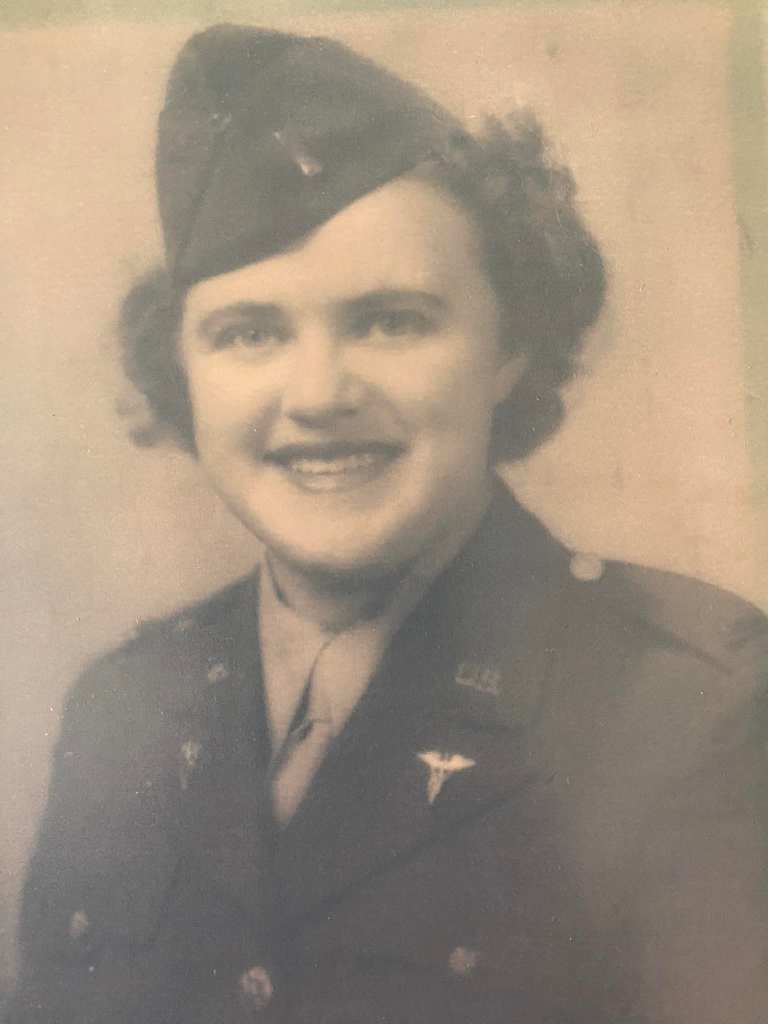
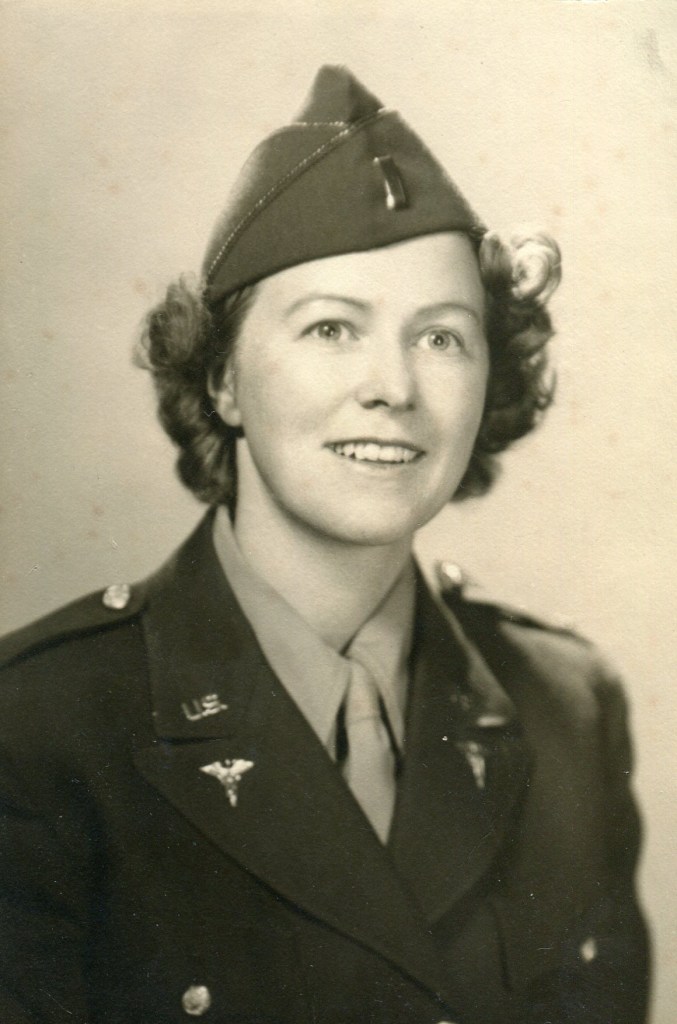

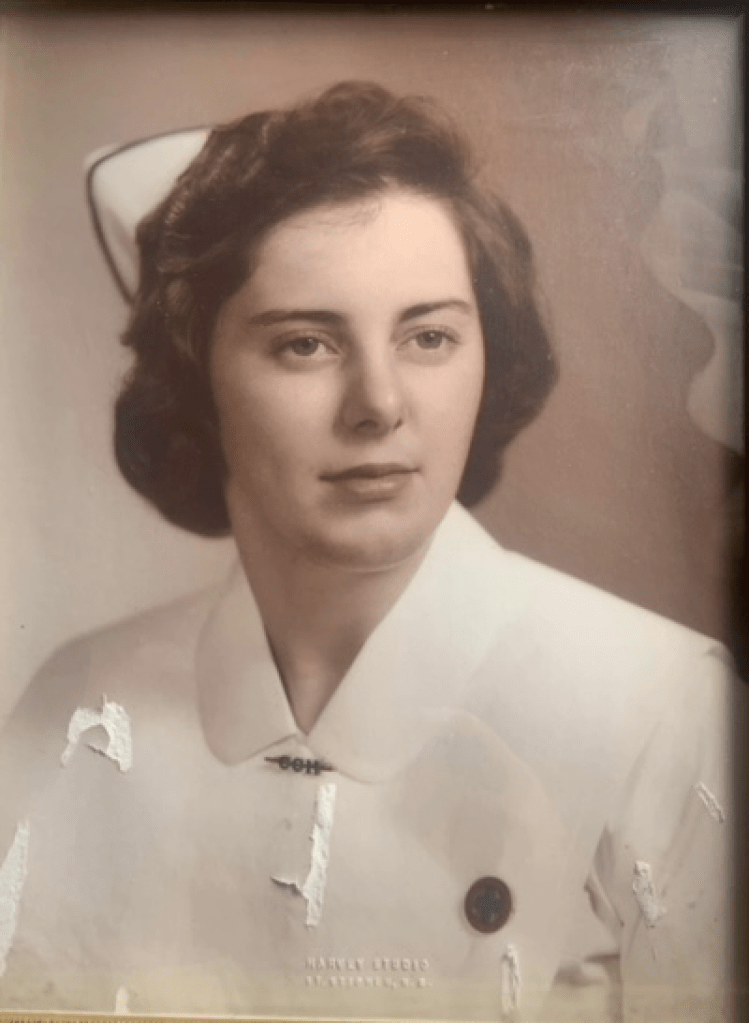
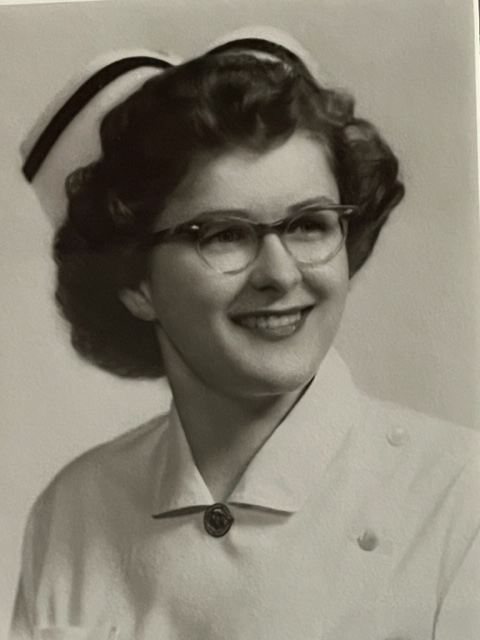
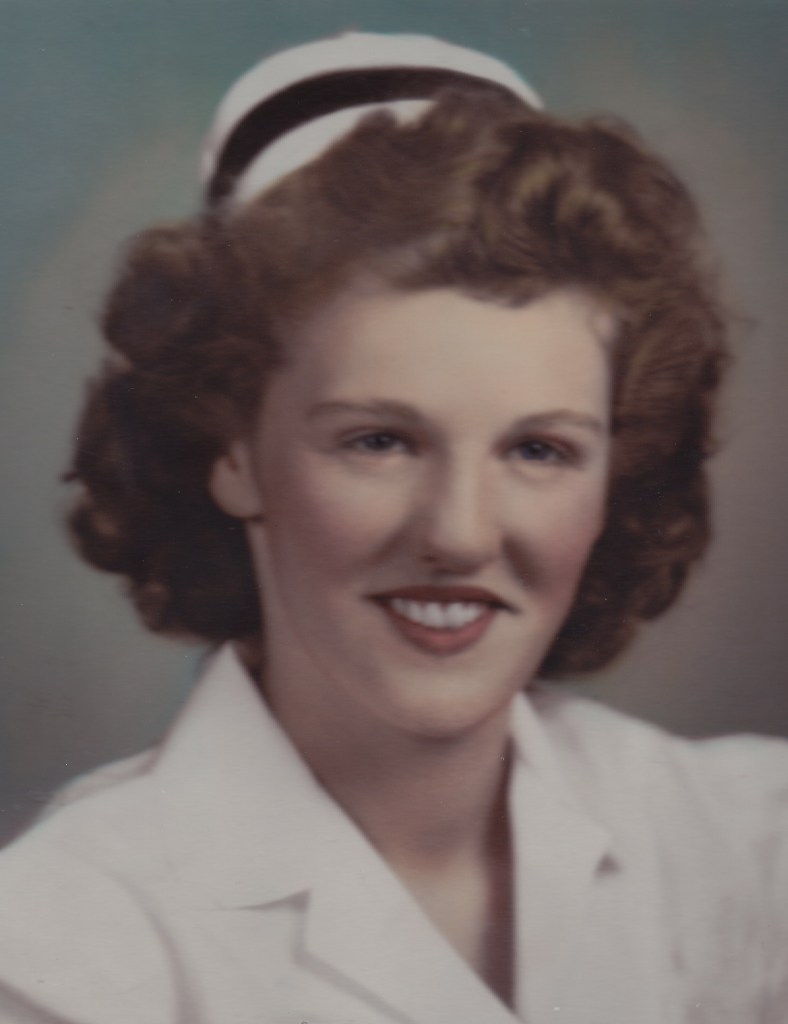
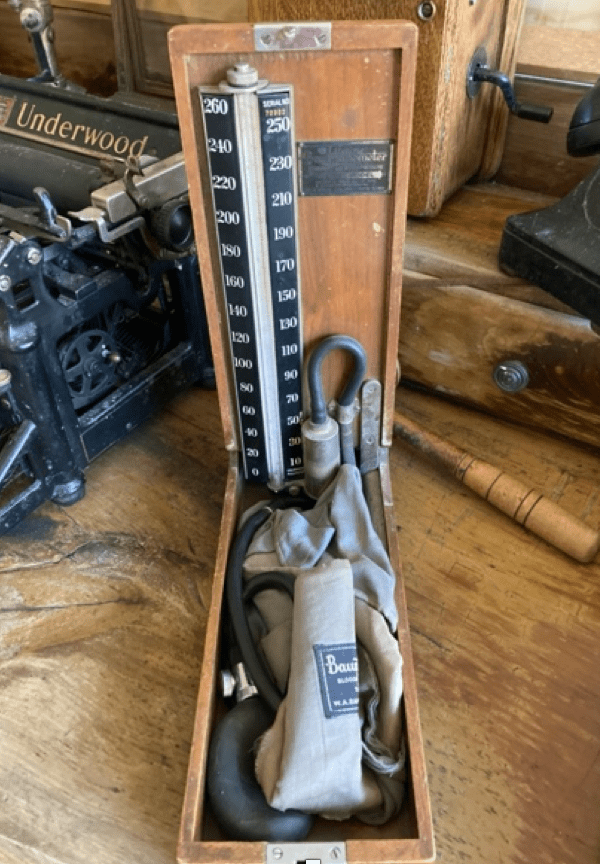
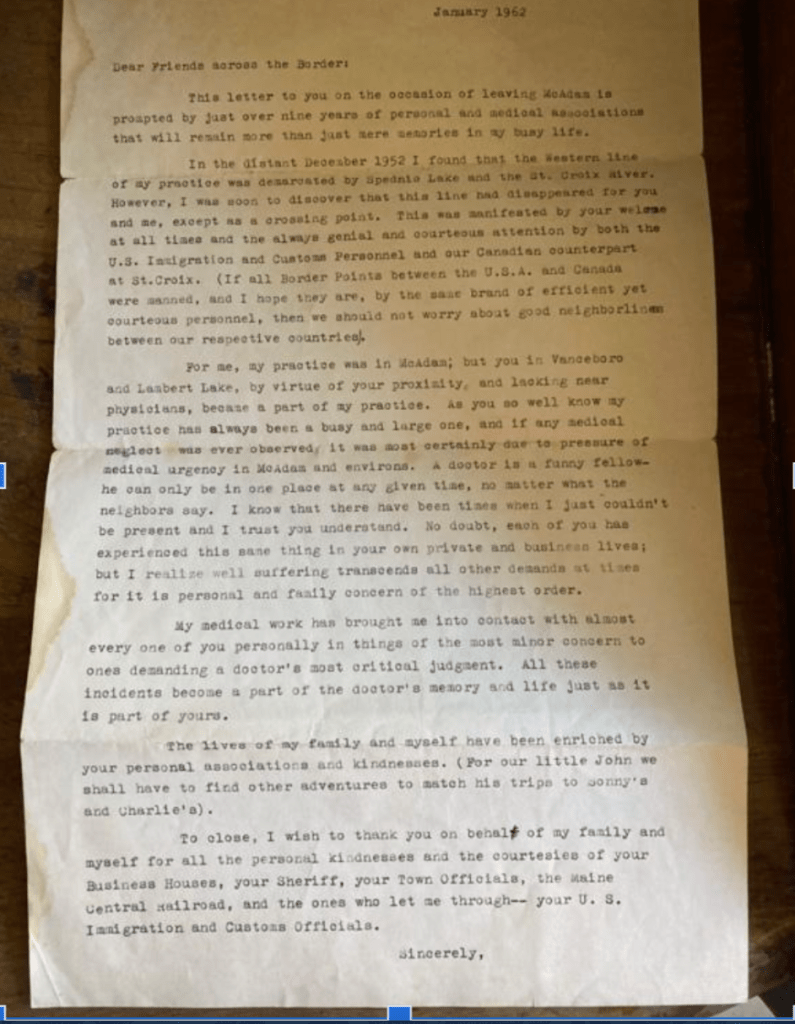

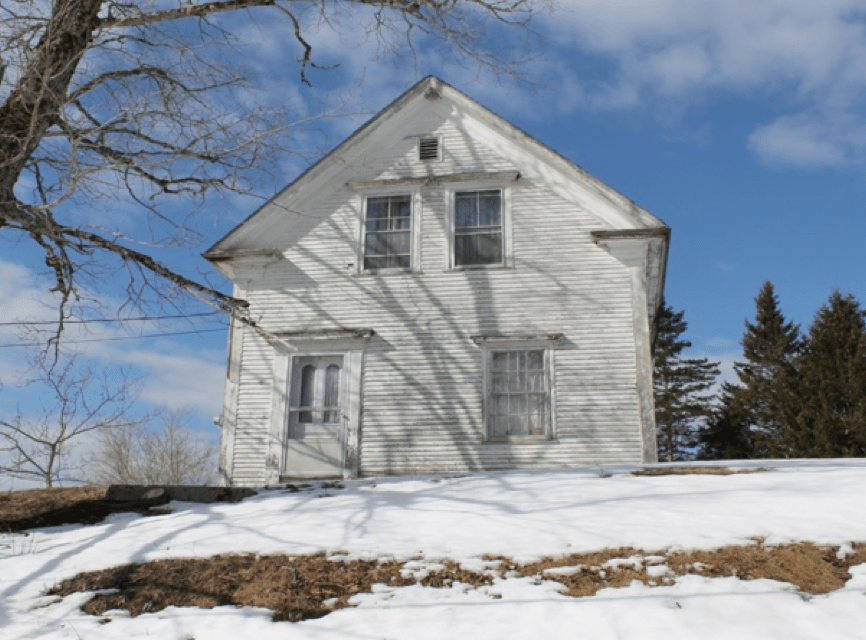
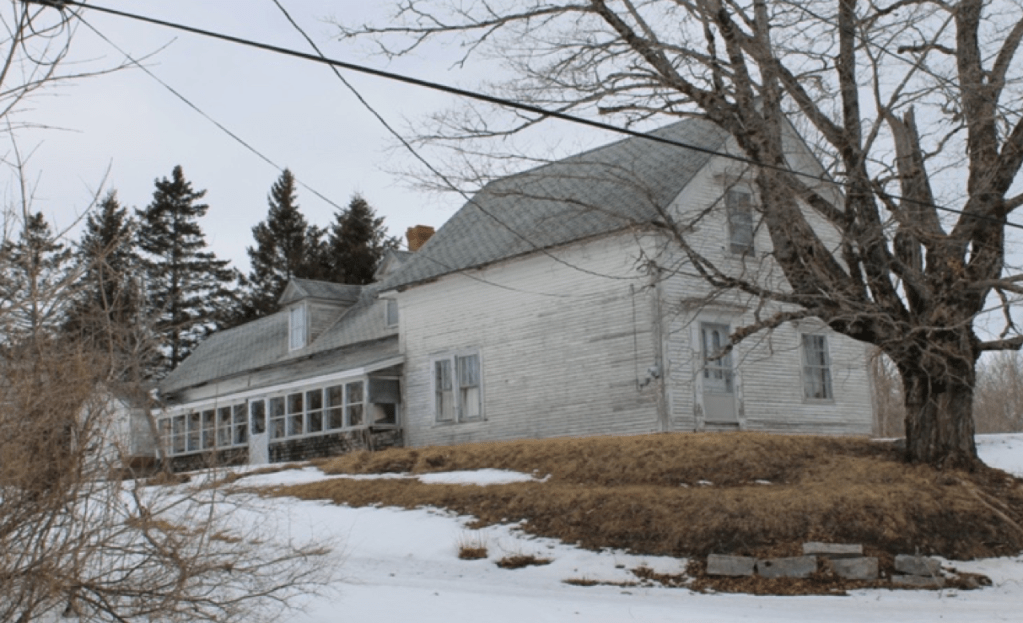


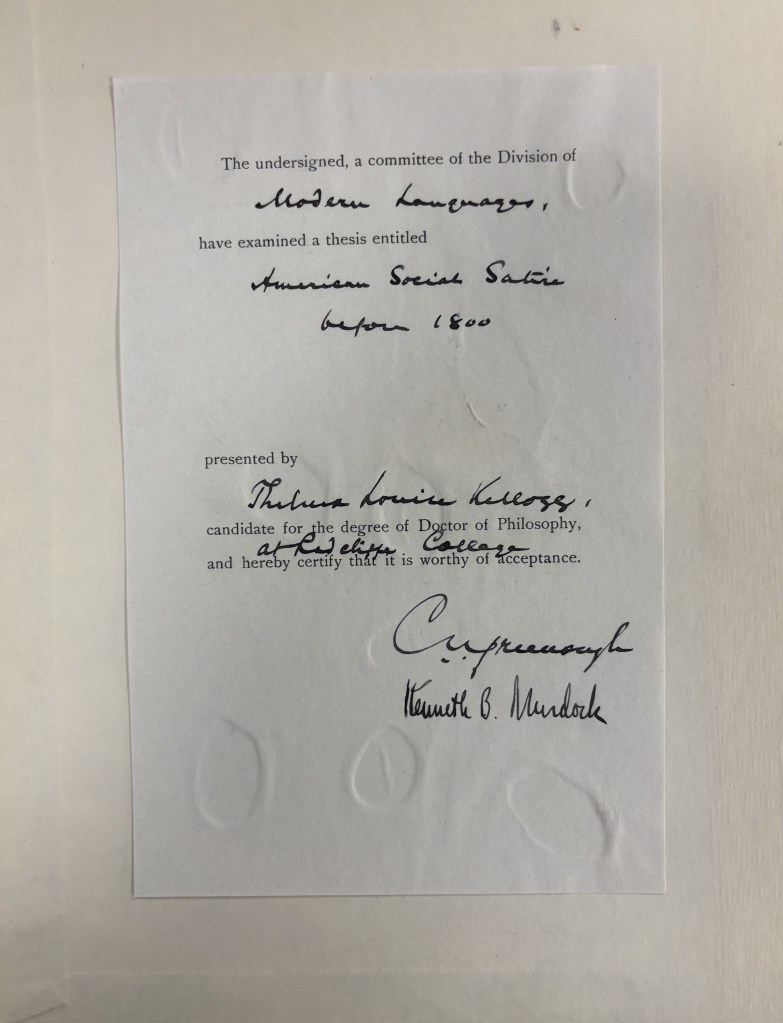
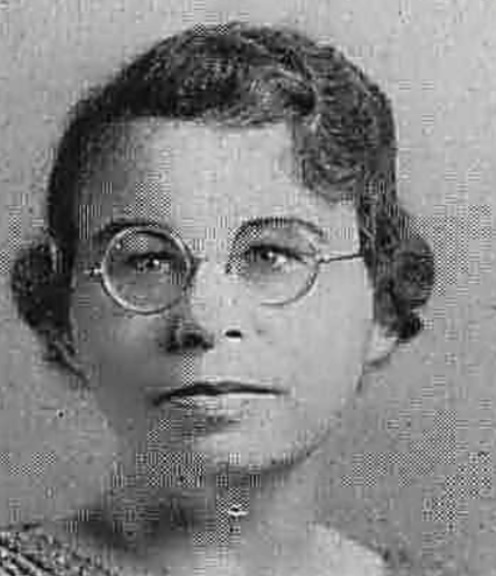
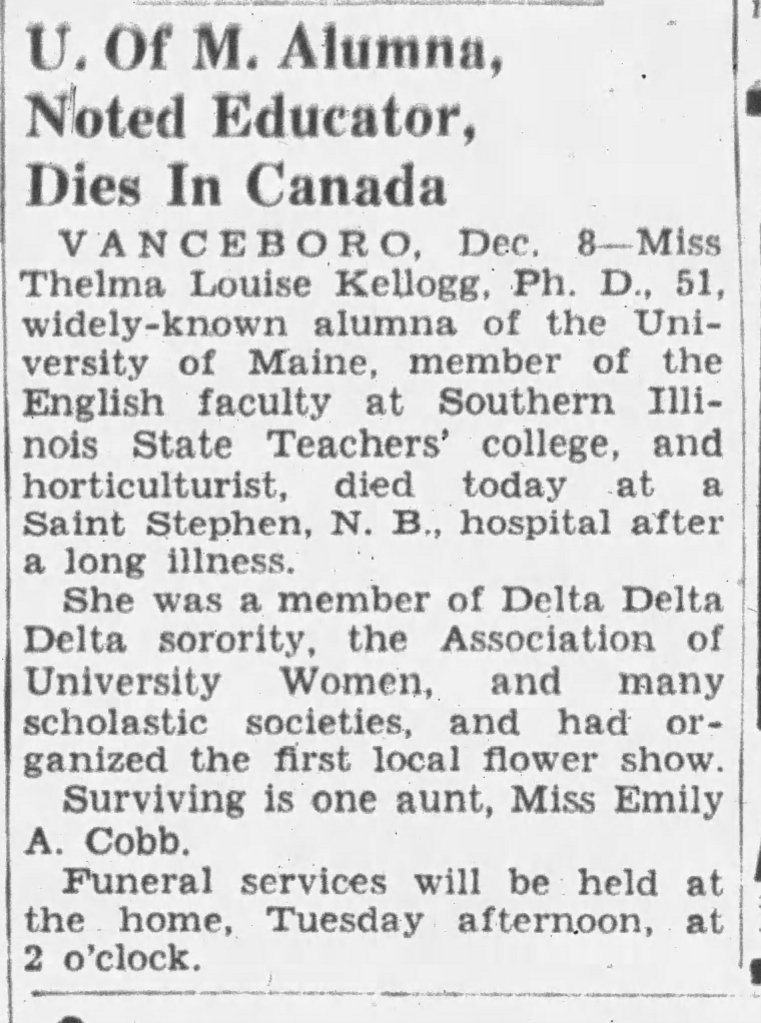
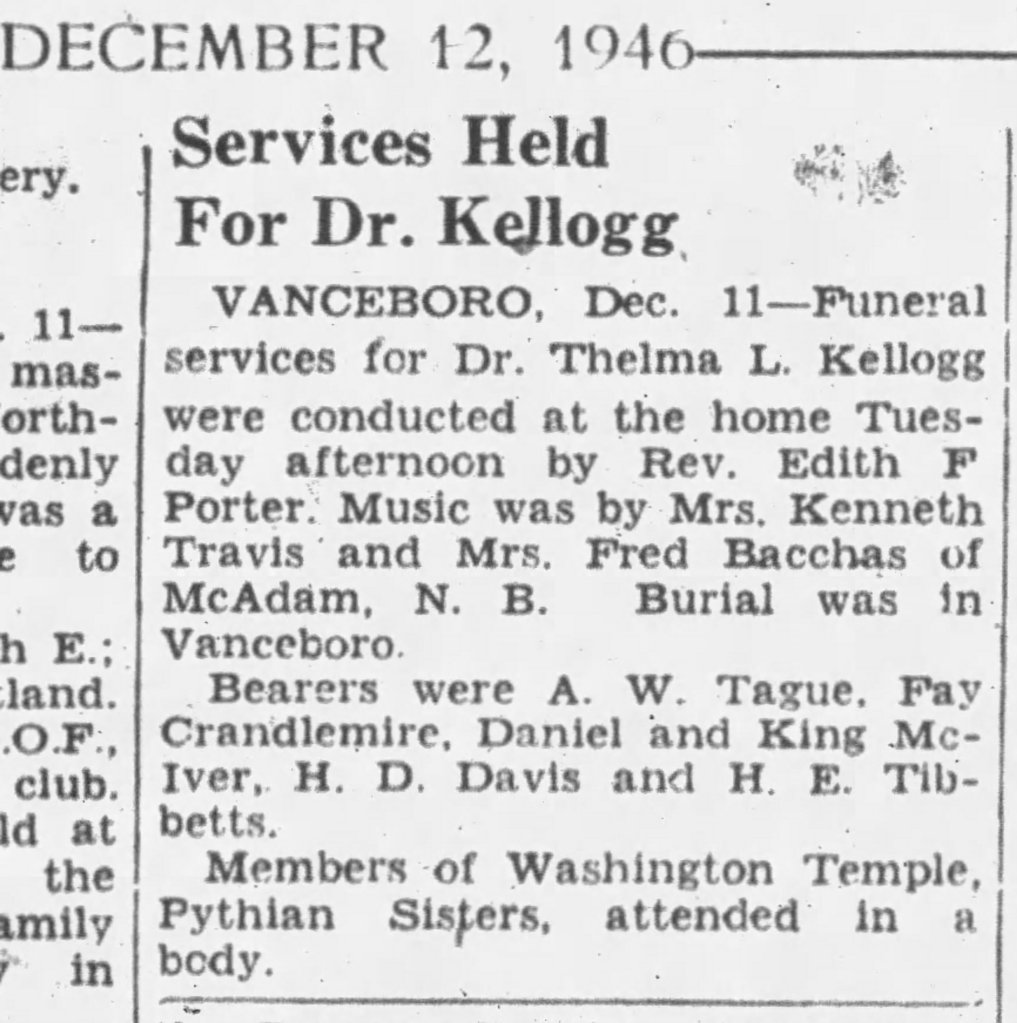
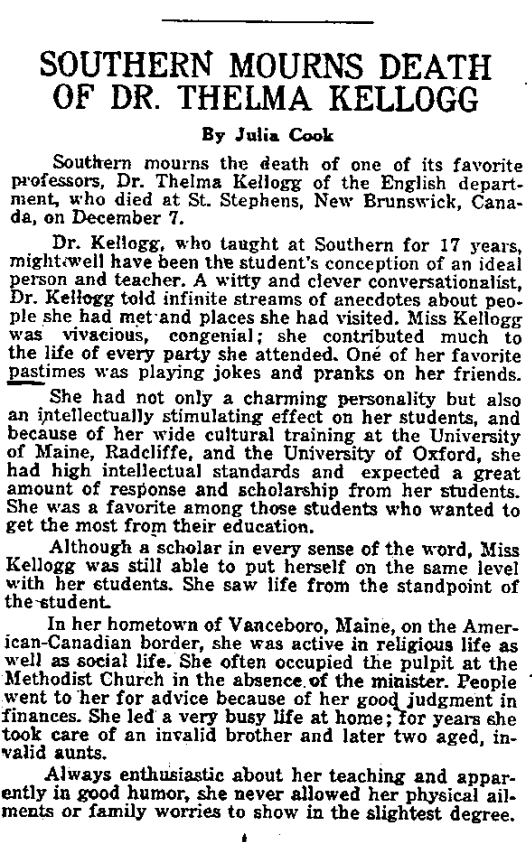
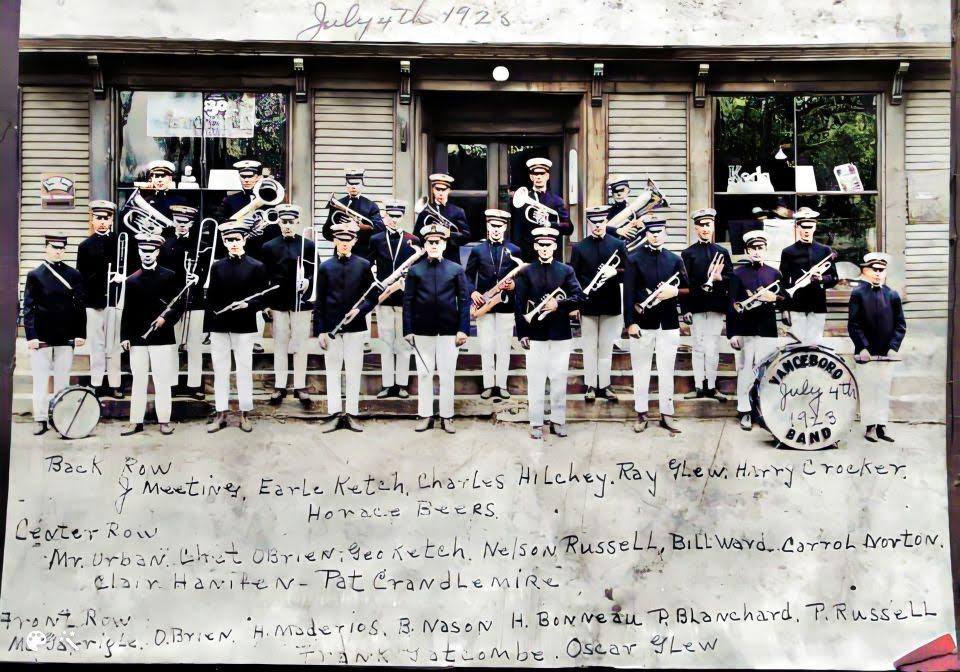
 Vanceboro Historical Society