Articles

It Takes a Village: Health Care, Past and Present

Part 1: Vanceboro Doctors by Alaine Peaslee-Hinshaw1

Vanceboro, Maine, and McAdam, New Brunswick, Canada have long been good neighbors. There was once a time when Vanceboro was the larger of the two, with village doctors who travelled to McAdam when needed. Then the tides turned. 

When McAdam was first settled between 1857 and 1869 as a collective of lumbering camps alongside the Canadian railroad line, there were no roads into the settlement, so if a doctor was needed it was necessary to take a section handcar and pump the six miles to Vanceboro, then a much larger place.2 By 1871 the village of Vanceboro had grown to include thirty-six frame houses, fifteen log dwellings, two hotels, two stores, a schoolhouse and a public hall.3 The population of Vanceboro in 1880 was 381, and 870 in 1890.4

For many years, Vanceboro had resident, medical practitioners. Several doctors’ names have surfaced although their exact dates of practice remain incomplete. An 1881 town map shows Dr. Beatty’s residence on Salmon Brook Road, where Curtis & Cindy (Crandlemire) Scott live today.5 Dr. Gregory Arvide Martin, “Doc Martin,” born 1842 in Quebec, Canada, married to Rachel A. Mitchell, was living and working in Vanceboro in 1910. He died in Massachusetts in 1915, at the age of 85.6 A Dr. Green is also mentioned as a resident doctor of Vanceboro.7

The 1907, the Maine State Legislature Board of Health Secretary’s Report indicates Dr. Melvin L. Young practiced in Vanceboro in 1905. Dr. Young was from Oak Bay, N.B., Canada, and his obituary states that he “came to Vanceboro and at Lambert Lake to practice about 56 years ago, being highly esteemed in this village and at Lambert Lake. He was also interested in public affairs, was a trustee of the Methodist Church, and served capably as superintendent of schools.”8  

Dr. Young married Mina Johnston and eventually practiced medicine with her nephew Dr. Stillwell Johnston. Lyn Mikel Brown, grandaughter of Carrie Mansfield Brown, who lived across the street from the Johnston home, has a watercolor of three roses painted by Mina Johnston Young and given to Carrie as a gift. 

After Mina’s death, Dr. Young practiced in Wisconsin during his later years. He died in Ashland, Wisconsin at age 85.9 In 1906, Dr. Young was appointed a health/medical related inspector to the inspection station during the 1907 small pox outbreaks in Maine and New Brunswick, Canada.10  

Dr. Melvin L. Young is quoted as saying that 300 people a day were crossing the border. Doctor Johnston was cited in the 1907 Maine State Legislature’s annual report as also working in Vanceboro alongside Dr. Young during the small pox epidemic. This meant he and Dr. Johnston were on duty every day. 11 

Dr. David Hunter provided medical care to the Vanceboro railroad staff in the 1940s. His office was located beside what was known as Val La Blanc’s garage, on the corner of Water and Salmonbrook Road. As part of his job, he also offered medical care to prisoners that were traveling on the train as requested by Immigration Officers. In addition, Dr. Hunter saw residents living in Vanceboro as needed (personal communication by Joy Leech as communicated by Moe Raye, father, December 2023).

Dr. Hunter is also recorded as having operated a Children’s vaccination clinic in Vanceboro in 1941. Records indicate he moved his family and practice to Mattawamkeag in 1948 but continued patient visits to Vanceboro for a time. He was married to Sarah Smith and died in 1949.12 Former Vanceboro resident, Sandra Clendenning La Brecque, recalls her mother quoting Dr. Hunter as saying, “You take this pill, you see, you see, and if it don’t do you any good it won’t hurt you.”

Dr. Francis O’Keefe began his practice in McAdam in 1952 and was the last local doctor to attend Vanceboro residents on a regular basis. Like those before him, he was respected and provided expert compassionate medical care. Removing fishhooks was a speciality, a valuable skill to both the community and visitors. During one home visit to an elderly person,  Dr. O’Keefe asked a family member for two shots of brandy – one to cure the person and one for himself.13
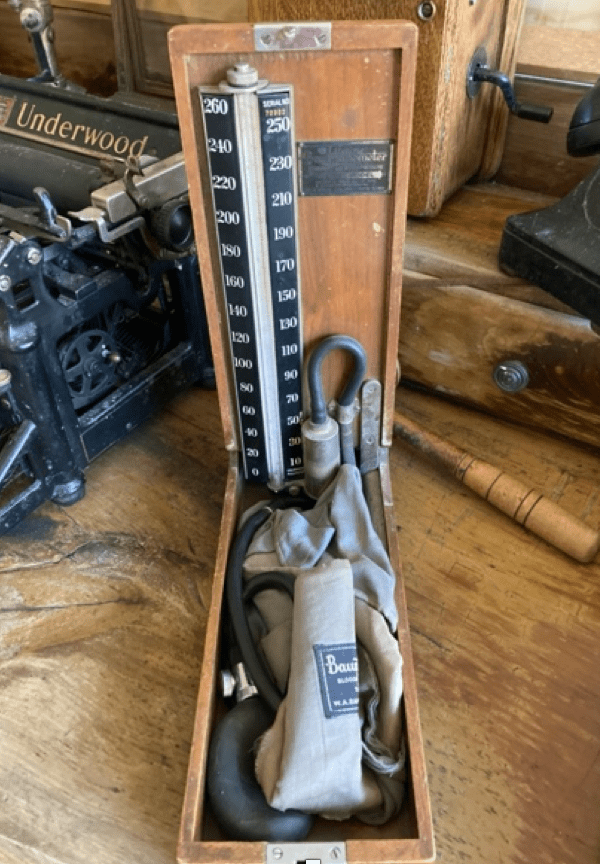
Dr. O’Keefe’s blood pressure device, on display at the Vanceboro Historical Society.

The Society also has a draft of Dr. Keefe’s January 1962 retirement letter announcing the discontinuation of his service visits to Vanceboro and Lambert Lake just after he retired from his McAdam practice and before joining the Department of Health Hospital Service. The letter, transcribed below, expresses what we imagine so many of the doctors before him felt about the good people of Vanceboro:
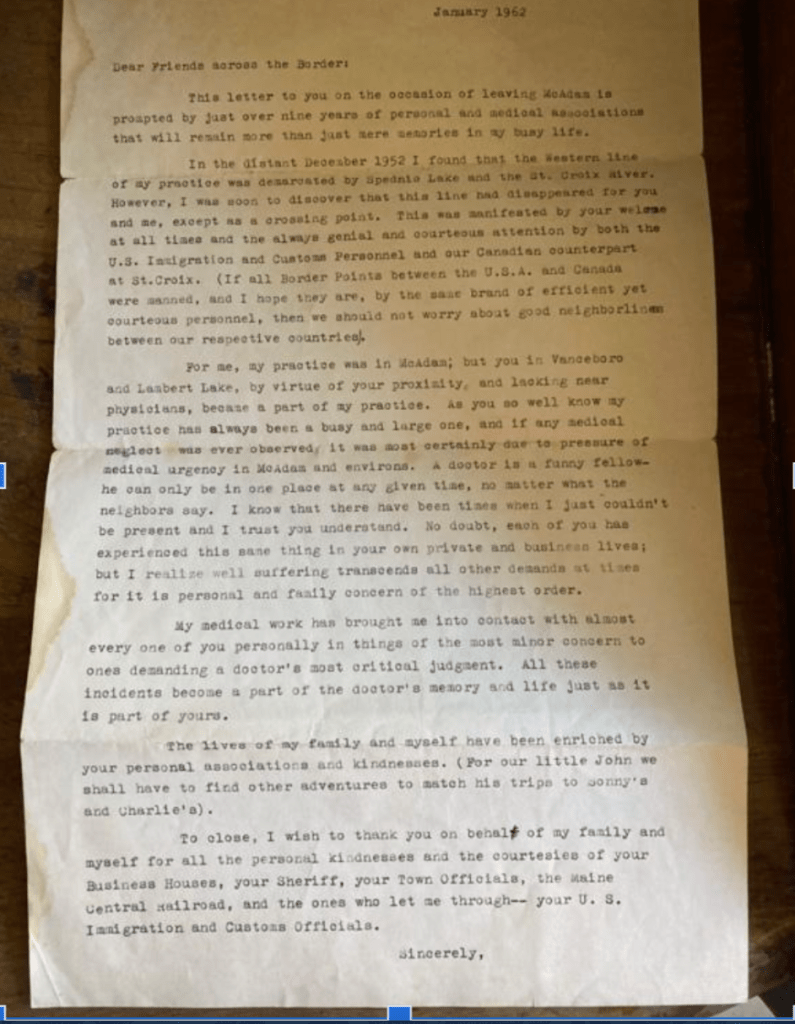
Dear friends across the border,

This letter to you on the occasion of leaving McAdam is prompted by just over nine years of personal and medical associations that will remain more that just mere memories in my busy life.

In the distant December 1952 I found that the Western line of my practice was demarcated by Spednic Lake and the St. Croix River. However, I was soon to discover that this line had disappeared for you and me, except as a crossing point. This was manifested by both your welcome at all times and the aways genial and courteous attention by both the U.S. Immigration and Customs Personnel and our Canadian counterpart at St. Croix. (If all Border Points between the U.S.A. and Canada were manned, and I hope they are, by the same brand of efficient yet courteous personnel, then we should not worry about good neighborliness between our respective countries).

For me, my practice was in McAdam; but you in Vanceboro and Lambert Lake, by virtue of your proximity and lacking near physicians, became a part of my practice. As you well know my practice has always been a busy and large one, and if any medical neglect was ever observed, it was most certainly due to pressure of medical urgency in McAdam and environs. A doctor is a funny fellow – he can only be in one place at any given time, no matter what the neighbors say.  I know that there have been times when I just couldn’t be present and I trust you understood. No doubt, each of you has experienced this same thing in your private and business lives; but I realize well suffering transcends all other demands at times for it is personal and family concern of the highest order.

My medical work has brought me into contact with almost every one of you personally in things of minor concern to ones demanding a doctor’s critical judgment. All these incidents become a part of the doctor’s memory and life as it is part of yours.

The lives of my family and myself have been enriched by your personal associations and kindnesses. (For out little John we shall have to find other adventures to match his trips to Sonny’s and Charlie’s).

To close, I wish to thank you on behalf of my family and myself for all the personal kindnesses and the courtesies of your Business Houses, your Sheriff, your Town Officials, the Maine Central Railroad, and the ones who let me through – your U.S. Immigration and Customs Officials.

Sincerely.

THE DOCTORS, MCADAM – HOME VISITS by Joy Leech

My grandfather, Aubrey T. Raye was born in Vanceboro on July 21, 1910.  He grew up on a farm on the Farm Road. His family consisted of his parents, Frank and Icy and four other siblings.  He told me stories of what living in Vanceboro was like and these two stories have always remained memorable to me.

When my grandfather was a young boy, one of his siblings became ill and was in need of a doctor. He was the one to try to get the doctor from McAdam to come to his home. He hitched up the horse and sleigh, as it was winter, and set off for McAdam, six miles away. He got the doctor who came with him to care for his sick sibling.

The other story was when he was a boy attending school in Vanceboro. In the spring and fall a doctor would come to the school and set up an operating table in a classroom by pushing desks together. The doctor would do minor procedures like tonsillectomies or any other minor surgery. Once the procedure was done, the children would be taken outside to lie on the school lawn to recover. The teachers would help in providing care. He would often say many children would not have survived without the doctors who would come to your home and treat their patients.

Dr. Stillwell Johnston & the “Lying-In” House

Stillwell Johnston was born in Sebec, Maine, December, 23, 1876. He came to Vanceboro with his parents in 1886 when he was ten years old. He died December 2, 1929 (age 52) and is buried in the Vanceboro Cemetery. Stillwell married Annie Geneva White, from Forest City, Maine, in 1901. She was born in 1881 & died in 1919 of influenza. It is not clear if their son, Llewellyn, also died of the flu in 1919. Dr. Johnston remarried Ethel Dewitt in 1920.14

At one time, Dr. Johnston owned and lived in what was, until recently, referred to as The Powell house. The house was sold recently to Bart & Jen Kasten, friends of the Stillsons & Camelis, who are Susee descendants living in the circa 1875 house across the street. The house has two distinctions. One, it has an unusual, curved wall, and two, it was once a “Lying-In” house – a maternity ward of sorts, a house for women who had just given birth to rest and recuperate.
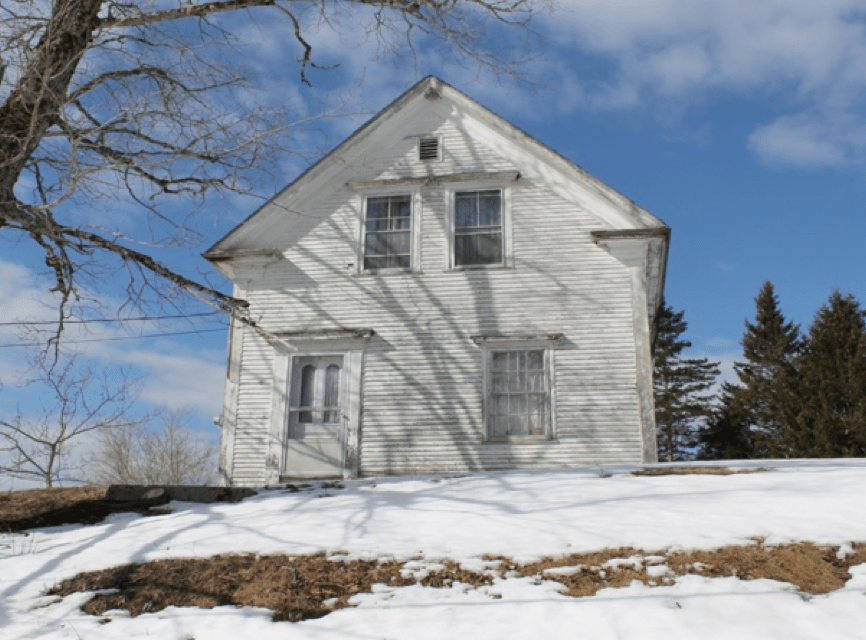
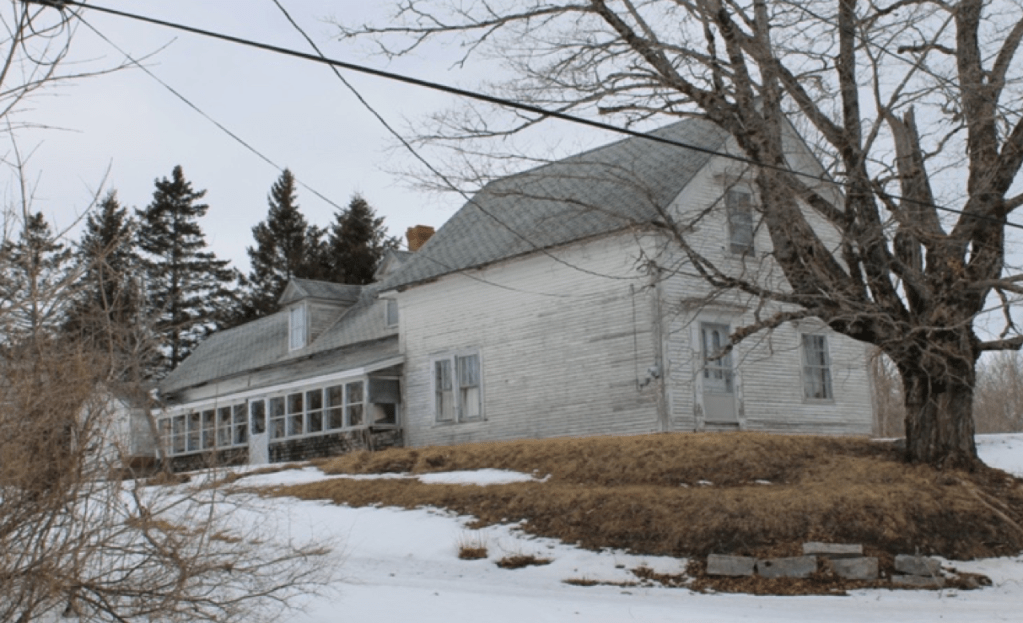
The Lying-In House. Approximate ownership: Johnston, Medeiros, Burns (c. 1928-1942), Powell (1944-2023), now Kasten House.
[Photos by Alaine Peaslee-Hinshaw] 

Lying-in

The word “midwife” originates from the old English word mid “with” & wife “woman.”15 When labor started, a call went out to summon the midwife and “gossips,” a small group of women who supported the mother and midwife through the birthing process. Nowadays “to gossip” means to make idle talk or spread rumors, but the term originates in the birthing room.

Lying-in time ranged from two weeks to two months. As a practice, a pregnant woman limited her movement before or after birth in order to reduce risk of pregnancy or postpartum complications. Lying-in, or postpartum confinement, was considered an essential component of the postpartum period. We do not know how long Dr. Johnston operated the Lying-In house. We do not know if there was a town midwife. 

Christine Sewell Stillson reports that while her mother, Frances Susee, grew up across the street in the older but almost identical “Susee house,” Frances was actually born in the lying-in house across the street. Frances Susee‘s birth certificate was signed by Dr. Stillwell Johnston who may have lived in the house at that time. Dr. Johnston is linked to another house on High Street in Vanceboro at a later date.     

Sadly, and tragically, Dr. Johnston and his daughter, Natalie Maxine, 22, both of Vanceboro, died December 2, 1929, in Chipman Hospital, Stephen, N.B. from injuries received when their car was wrecked by a northbound Canadian Pacific freight train at Valley Road crossing near St. Stephen, N.B. Maxine just recently graduated as a nurse from Chipman Hospital. Dr. Johnston was 52, Maxine 22.16 Both are buried in the Vanceboro cemetery. Dr. Johnston’s obituary, Vanceboro, December 16, 1929, reveals how beloved and esteemed he was as a hometown physician:17

The tides had turned. By 1911 McAdam, Canada, was the larger town of 1,111 people. The population peaked in 1956 at 2,803.18 By 1950, Vanceboro’s population was 497 and rapidly decreasing to 300, then 200, then 100 residents at present, 2023. Vanceboro’s nurses became the town’s only medical practitioners and childbirth took place in hospitals in McAdam or in Calais, Maine.19

Footnotes:

  1. Special thanks to Dorothy Amero Cummings & Lyn Mikel Brown of the Vanceboro Historical Society, and to Gary Beers of V’boro, Maine Community Facebook group. ↩︎
  2. Redstone, W.A., The History of McAdam (1871-1977), McAdam Senior Citizens Historical and Recreational Club, 1979., p. 85. ↩︎
  3. Faye E. Luppi, & Marcella L. Sorge. Vanceboro, Maine, 1870-1900: A Hinterland Community, p.132. Maine History 25, 2(1885):88-113. ↩︎
  4. Donham, Maine Register State Yearbook, No.36-June 1905, p.1005. ↩︎
  5. George, N. Colby & Co., Atlas of Washington County Maine, 1881, p. 39. ↩︎
  6. V’boro, ME Community Facebook page obituary section shared by Dorothy Amero Cummings. ↩︎
  7. Redstone, W.A., The History of McAdam (1871-1977), p. 85. ↩︎ ↩︎
  8. V’boro, ME Community Facebook page obituary section shared by Dorothy Amero Cummings. ↩︎
  9. Ancestory.com; an obituary posted by Michelle Johnson. ↩︎
  10. Maine State Legislature State Board of Health of Maine Office of the Secretary’s Report, 1907, p.30. Maine Legislature(.gov), http://lldc.mainelegislature.org. ↩︎
  11. V’boro, ME Community Facebook page obituary section shared by Dorothy Amero Cummings. ↩︎
  12. V’boro, ME Community Facebook page obituary section shared by Dorothy Amero Cummings. ↩︎
  13. Rootsweb.com: Croix Courier Journey Through Time, Good Times, Hard Times,1926-1945, and, Ancestory.com; an obituary posted by Michelle Johnston. ↩︎
  14. https://en.wikipedia.org/wiki/Midwife ↩︎
  15. Rootsweb.com: Croix Courier Journey Through Time, Good Times, Hard Times,1926-1945. St. Croix Courier Journey Through Time…..1926-1945 and 8V’boro, ME Community Facebook page obituary section shared by Dorothy Amero Cummings., and Ancestory.com; an obituary posted by Michelle Johnson. ↩︎
  16. Ancestory.com; an excerpt of obituary posted by Michelle Johnson. ↩︎
  17. Wikipedia McAdam, New Brunswick. https://en.m.wikipedia.org. ↩︎
  18. https://en.wikipedia.org/wiki/Vanceboro,_Maine ↩︎

The Remarkable Life of Dr. Thelma Louise Kellogg

by Lyn Mikel Brown

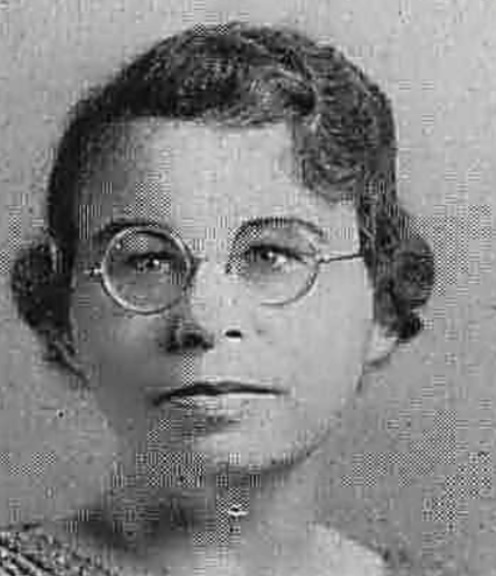
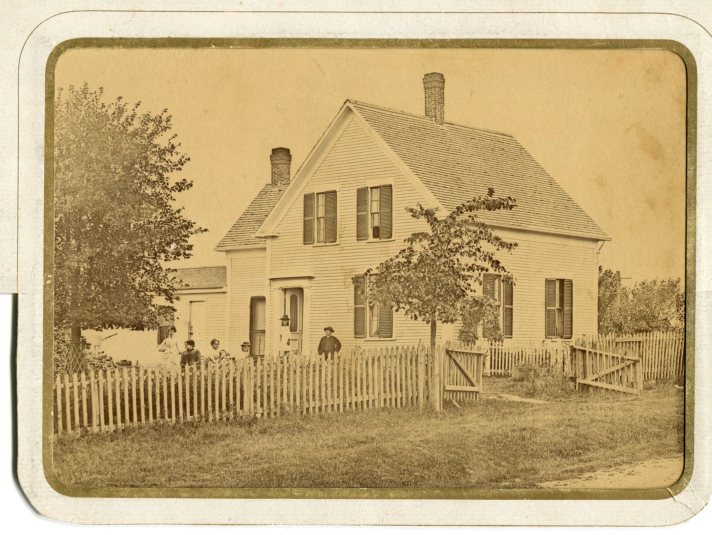
Dr. Thelma Louise Kellogg was born in Vanceboro on January 18, 1894, the youngest of Horace Kellogg’s four children. Her mother was Alice Cobb Kellogg, Horace’s second wife. Like her three siblings, she was likely born in the Kellogg family house on High Street. Her parents later bought and moved the family into what is still regarded as the Thaxter Shaw House, off First Street.

Thelma graduated from Vanceboro High School and, in what was very unusual for young women in 1914, went off to college to study English at the University of Maine at Orono.

At UMaine, Thelma compiled an impressive academic record. She was a member of the prestigious honor society, Phi Beta Kappa and, as a senior, served as an assistant instructor in English. Politically active on campus, she was Secretary of the College Equal Suffrage League, (CESL), an organization founded in 1900 as a way to attract younger Americans to the women’s rights movement. And she had fun as a member of Delta Delta Delta Sorority, Glee Club and Mandolin Club.

Her senior yearbook profile offers hints to her lively personality and political passions: “Who’s that, snickering and giggling? Can’t be any other person than “Kay” Kellogg, our movie friend and disloyal American. Kay averages six trips a week to the movies (only shortness of the week keeps her average so low). O, you may think her a very demure young miss about Campus, but there are people who could tell many a tale of “Tuggy,” “Charlie,” “Jack,” or “Dickie.”                                                 

Following her graduation in 1918, Thelma taught for the next five years while enrolled in graduate studies at UMaine–she received her Master of Arts in 1923. Her thesis, “The Life and Works of John Davis 1774-1853,” an English writer known for popularizing the story of Pocahontas, was later turned into a book, “the first to be published of a series of such studies by graduate students in the University of Maine.”1

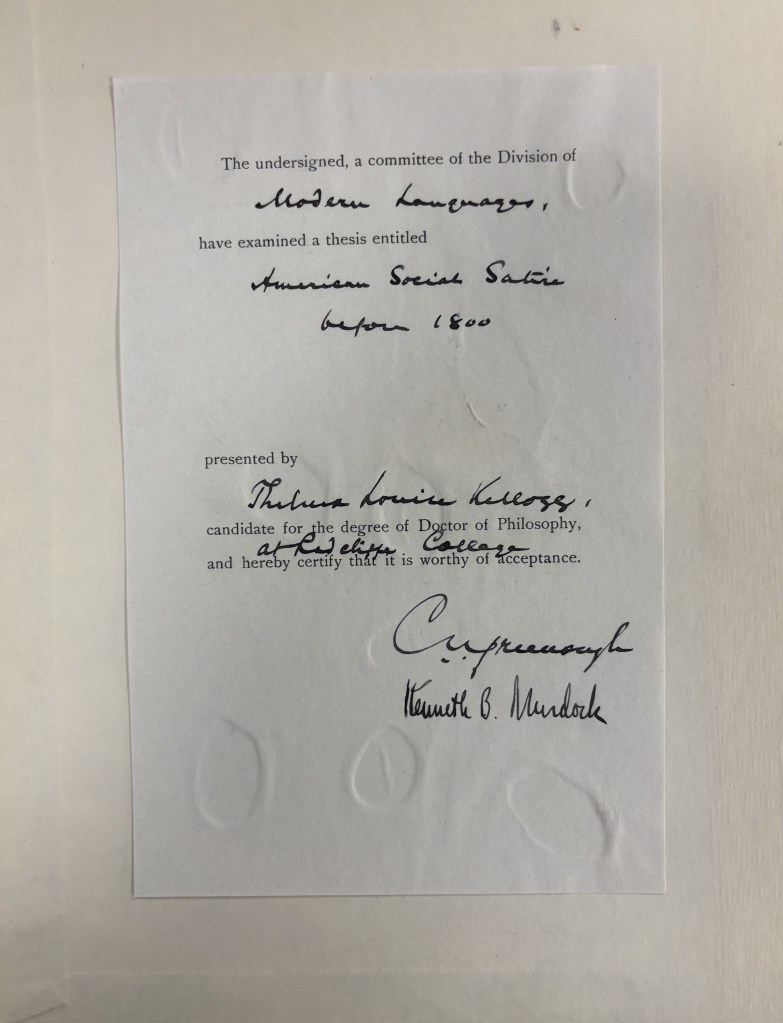
Thelma then attended Radcliffe College where she taught for six years, earned a second A.M. in Philology (the history of languages, especially through literature) and a Ph.D. in English. Her dissertation, “American Social Satire before 1800,” completed in 1929, was an ambitious study of satire in newspapers, magazines and early American almanacs. It was an exhaustive analysis: two volumes and 577 pages. Below is a photo of her dissertation housed in the Harvard archives and, next, the signature of her advisor, Harvard English Professor, Dr. Kenneth Murdock, certifying the dissertation. Both photos are courtesy of the Harvard University Archives.

The summer after graduation from Radcliffe, Dr. Kellogg studied at Oxford University in England. She then accepted an appointment, fall of 1929, teaching English at Southern Illinois Normal University (SINU) in Carbondale, Illinois.

In 1933, according to the SINU school newspaper, The Egyptian, Thelma received her retroactive invitation to Phi Beta Kappa because at the time she was a student at the University of Maine the honor society did not exist on campus. “Dr. Kellogg was elected to the national honorary scholastic fraternity when she returned to UMaine for her fifteen reunion.”

The paper continues, “Her election to membership in Phi Beta Kappa is the second distinction which has been conferred upon Dr. Kellogg…. during the several years she has spent here…as a member of the faculty of the English Department. In 1931 she was chosen to membership in the exclusive organization, All Maine Women. Each year one or two persons are elected to membership in this organization which is composed of members representative of the ideal woman student of the University of Maine….”2

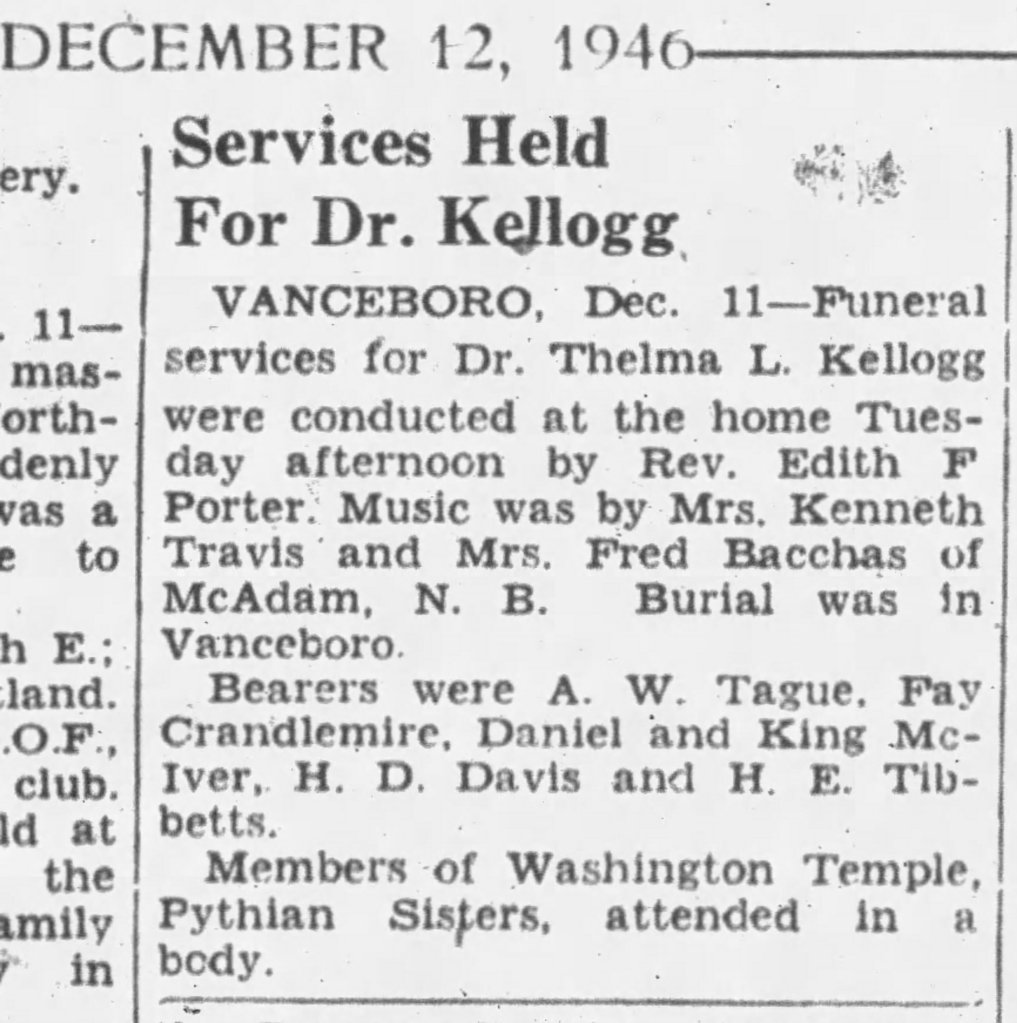
Unfortunately, poor health forced Dr. Kellogg to relinquish her duties as Professor of English in 1946, a year before SINU became Southern Illinois University. She returned home to Vanceboro, spending her final days in her beloved community, living in her family home. She died in the St. Stephen, New Brunswick hospital on December 7, 1946 at the age of 52.

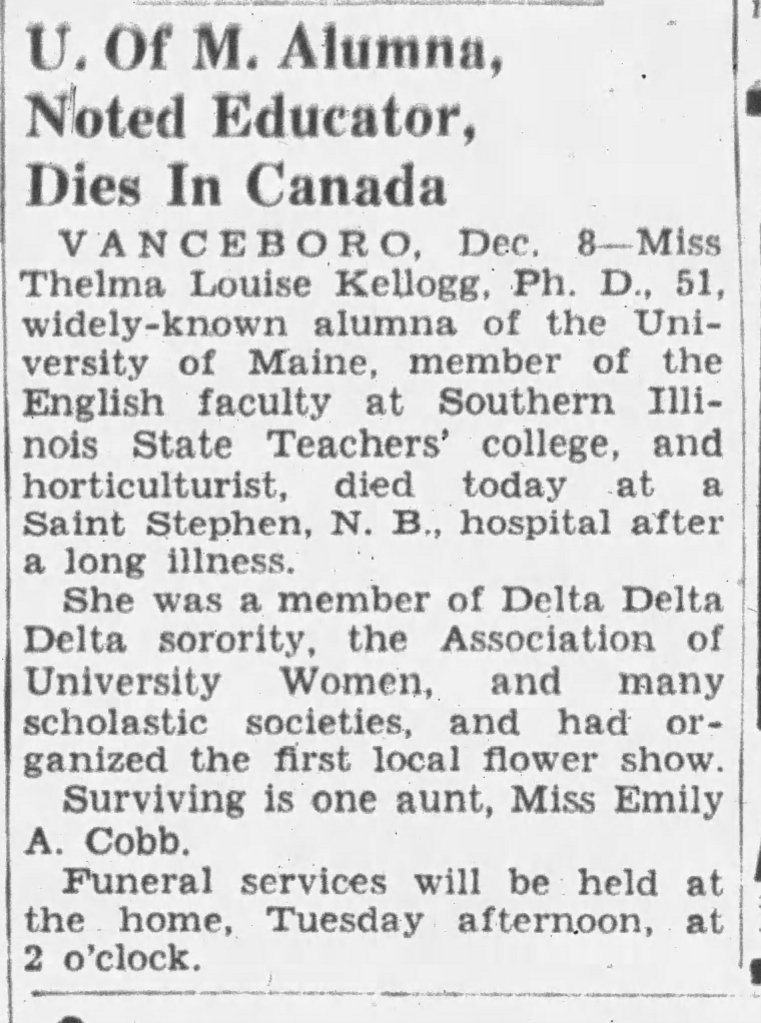
The Bangor Daily News announced Thelma Kellogg’s death, recounting her academic history and activities, including her love of horticulture.

Thelma Louise Kellogg was buried with her brother Harold in the Vanceboro Cemetery.

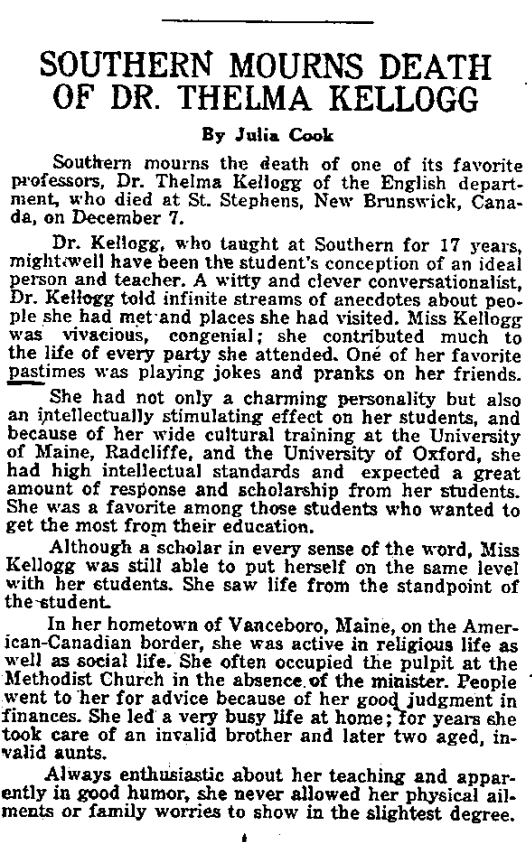
Dr. Kellogg was described by her colleagues at SINU as a “dynamic, suburb teacher,” interested not only in the welfare of the student, but also of the community.”3

“Southern mourns the death of one of its favorite, professors,” the campus newspaper reports.4 “Dr. Kellogg…might have been the student’s conception of an ideal person and teacher. A witty and cleaver conversationalist, Dr. Kellogg told infinite streams of anecdotes about people she had met and places she had visited. Miss Kellogg was vivacious, congenial; she contributed much to the life of every party she attended. One of her favorite pastimes was playing jokes and pranks on her friends.”

Dr. Kellogg was “intellectually stimulating” and “demanding” and also accessible — a teacher who “saw life from the standpoint of the student.”

Thelma Louise Kellogg was, also, deeply connected to her family and beloved hometown — caring for ill and aging family members over the years, preaching at the Methodist church, a horticulturalist and avid member of the Vanceboro Gardening Club.

After more than 25 years of devoted service as a teacher, It was natural that in disposing of her estate Thelma Kellogg should think of how to support the next generation. Her will provided that each of the three institutions with which she was affiliated would receive almost $30,000 (approximately $500,000 in today’s dollars), to establish scholarships in her name. Her largesse enabled many deserving students and scholars to pursue their educational ambitions. The Thelma Louise Kellogg scholarship to the University of Maine and Southern Illinois University, which specifically designated for “one or more deserving and needy students majoring in English,” continue to this day. Radcliffe merged with Harvard University in 1999. Thelma’s gifts enabled deserving students and scholars to pursue their educational ambitions. What better legacy for a scholar and gardener than planting seeds for the future.

  1. Kellogg, Thelma Louise. 1926. The Life and Works of John Davis 1774-1853; Forward by editor H.M.Ellis. University Press: Orono, ME. ↩︎
  2. Dr. Thelma Kellogg Recently Elected to Phi Beta Kappa, The Egyptian, Feb. 22, 1933. ↩︎
  3. Gifts Administered By SIU Foundation, The Egyptian, August 11, 1964. ↩︎
  4. Cook, Julia. Southern Mourns Death of Dr. Thelma Kellogg, The Egyptian, January 10, 1947. ↩︎

Tooting Their Own Horns: Vanceboro’s Town Band

by Lyn Mikel Brown

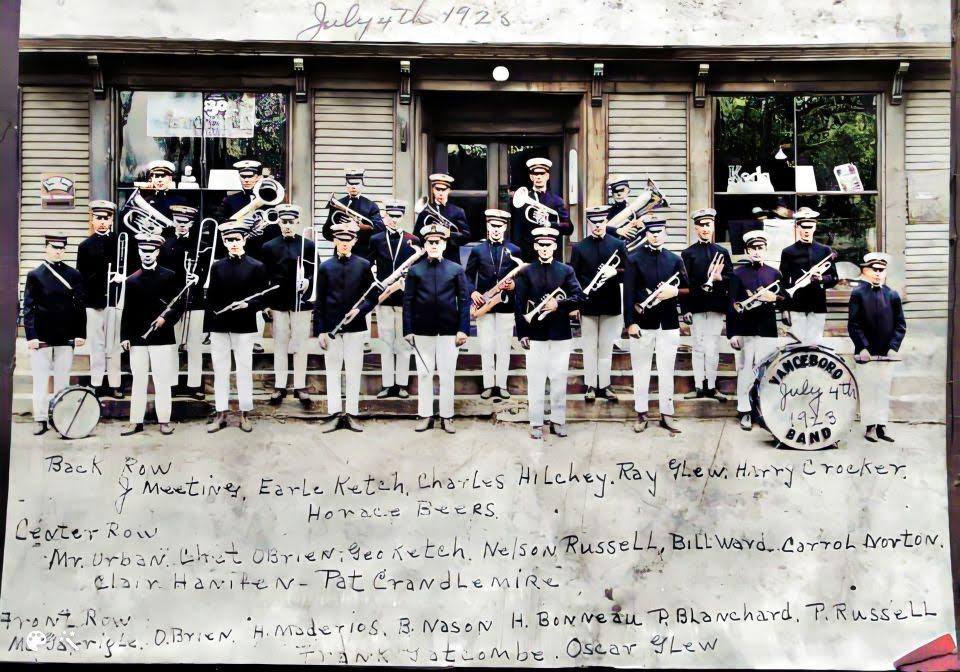
When Teresa and Richard Monk moved into their house in 1970, they discovered two big brass horns in the cellar. They’d bought the house from Lloyd Day, a customs inspector, but the instruments, they soon discovered, came from another house Mr. Day owned, once Perley Blanchard’s, a member of the Vanceboro town band. The Monks donated both horns to the Vanceboro Historial Society, where they now sit under a photo that includes Blanchard and the rest of the twenty-two uniformed band members.

The Vanceboro Brass Band was organized and directed in 1922 by Harold Bonneau, a U.S. Customs officer who played and taught violin and clarinet. By 1925, the group was in high demand, playing for parades, at home and away ball games, offering concerts on Memorial Day and the joint celebration of Canada’s Dominion Day, July 1st, in McAdam and U.S. Independence Day, July 4th, in Vanceboro.

Vanceboro’s marching band, 1923.

Every September the band traveled to the St. Stephen Exhibition, a popular county fair, complete with harness racing, stage shows, agricultural displays, and carnival rides. Bands from the surrounding area were invited, a different one on display each day of the week. The band of the day would parade from the international boundary halfway across the Ferry Point Bridge and proceed to St. Stephen, down Water Street, left onto King Street and on to the exhibition grounds.

Herb Gallison, in his memoir, The Life and Pretty Good Times of Herb Gallison writes about Vanceboro’s turn to parade on September 1925. To appreciate the story one needs to know that, prior to their departure for St. Stephen, a number of the band members had a taste of the good stuff.

On the Vanceboro Band’s day, the members assembled at the Knights of Pythias Hall, mostly bright and generally early. Uniforms pressed, white caps gleaming, duck trousers chalk white, black shoes shined, and instruments mirror-bright, except for the clarinets and drums, which were naturally dull. The members boarded various privately owned automobiles and went bumping down the old Woodstock Road with chins held high by the choker collars….Squeezing the tuba into the trunk didn’t appear to be easy. Someone was heard to remark, “That car is loaded to the gills.” It was never determined whether the remark was actually directed at the occupants.

Somewhere along the route the five-passenger sedan containing seven uniformed musicians got separated from the caravan. They finally showed up on the bridge just before the band was due to step out. Most of the musicians were not immediately aware that they had detoured through Milltown, where a certain apothecary was reputed to be dispensing the much-sought-after elixir.

The band assumed parade formation in the middle of the bridge. The command was issued and it moved out toward Canada. As it made the right-angle turn down Water Street the band was playing “The Gladiator” by Himself, John Philip Sousa. It is a difficult enough number to play while seated in a concert hall. Near the Canadian Pacific Depot the band made the sharp left turn up King Street.

In front of Burns’ Restaurant, with the thoughts of delicious boiled lobster dripping melted butter causing general salivation, the band struck up “Invercargill,” an old favorite it could play by memory in the dark. Suddenly a trolley car on the rails in the middle of the street came rattling from the direction of the band’s destination.

Something had to give, and the car coming downgrade wasn’t fixing to stop. With the old familiar march tune blaring forth, the band took a starboard tack toward Cliff Hanley’s meat market—all but the tuba player. From the front row on the extreme port quarter he swerved left and marched along the gutter in front of Johnson’s drug store, never missing a note, while the streetcar passed between him and the rest of the band. As the car creaked on by, the marchers swung back to the middle of the street and the tuba left the ditch to join formation, still Oompa-oomping those resonant bass notes.

Thanks to the Monks, the Vanceboro Historical Society has that rogue tuba. We don’t know if the tuba player had a bit to drink or if he simply made the safest maneuver. Either way, if you think it’s easy playing the Invercargill March side-stepping a trolley, give a listen.

Civil War Veterans and Neighbors

When the European & North American Railway Line connecting Maine to New Brunswick was completed in 1871 and the Shaw Brothers Tannery began operations, Vanceboro’s population grew quickly. Scores of enterprising young men and women migrated east to establish new lives and livelihoods on the banks of the St. Croix. This is the story of two of these newcomers who shared a common and arduous history: both were members of the famed 16th Maine Volunteer Infantry Regiment that served in the Union Army during the Civil War.

Henry Mansfield was a Private in Company B. He joined the 16h Maine on September 8, 1863, at age 29. He was a farmer in Greenbush when he enlisted as a “volunteer substitute” for Melvin Grant, Esq. of Eddington. During the spring and summer of 1864, the 16th Maine fought with Grant’s Army of the Potomac in the bloody and brutal “Overland Campaign” in Virginia. Henry was captured in the battle of Weldon Railroad on August 19, 1864, and sent to three of the most infamous Confederate prisons: Libby, Belle Isle, and, finally, Salsbury. He was released in a prisoner exchange on June 21 and honorably discharged on July 21, 1865.

Horace Kellog was a Private in Company C. He joined the 16th Maine on September 3, 1864, at age 18. He was working on his father’s farm in Patten when he enlisted as a volunteer, having finally received his parents’ permission to do so (his older brother, Marcellus, a Private in the 1st Maine Calvary, had died earlier that summer).  During the fall of 1864 and spring of 1865, the 16th Maine fought in the final battles of the war in southern Virginia; the regiment (including Horace) was present at Lee’s surrender at Appomattox on April 9, 1865. He was honorably discharged on June 5, 1865.

In spite of the regimental affiliation they shared, Henry and Horace never served in the 16th Maine at the same time. Henry was taken prisoner before Horace joined the regiment, and Horace was discharged before Henry was released. Yet just nine years later they would be neighbors on the west side of High Street in Vanceboro.

After the war, Henry returned to Greenbush, where he discovered that his first wife, assuming he had died in the war, had remarried. They were divorced in 1871. Because of injuries and illness during his imprisonment, he was unable to do manual labor. He became a night watchman for the Eastern & North American Railroad, perhaps first in Mattawamkeag, where he met Julia Kimball. 

Henry bought their house on High Street in Vanceboro in December 1872 from George Sprague (opposite Second Street); he married Julia in May 1873. They moved to Vanceboro, and their four children, Harry, Carrie, Edith, and George were all born in the house. Henry worked for the railroad until his death on May 19, 1905, at the age of 72; he is buried in the Vanceboro cemetery.

After the war, Horace returned to Patten. He lost interest in farming, and, instead, decided to go into business with his cousin, Ezra Jameson, of Lincoln. They moved to Vanceboro, purchased land, and opened a store in 1872. 

Horace married his first wife, Addie Tupper from Topsfield, in 1872. Addie bought their house on High Street in October 1874 from Wallis Works. Addie died in 1882; in 1884 Horace married Alice Cobb (the daughter of his neighbors, Charles and Sarah Cobb). Horace’s four children, Carl, Horace Jr., Harold, and Thelma, were all born in the house. Horace bought out his cousin, his store thrived, and he became one of Vanceboro’s most prominent citizens. He died on March 8, 1917, at the age of 72; he is buried in the Vanceboro cemetery.

We know very little about Henry and Horace’s relationship during the 31 years they were neighbors in Vanceboro. Were they friends? Did they talk about their experiences in the war? We know that Henry attended at least one regimental reunion (in Augusta in 1883); perhaps Horace joined him? Perhaps they attended GAR Post meetings in Calais or Eastport together? Or, perhaps they weren’t interested in reliving the horrors of the war, or their social circles were different enough that their paths rarely crossed, even in a small town. No matter what, they both served the union with distinction and valor and Vanceboro is proud to call them her own.   

The Exchange Hotel

The Exchange Hotel is well-known in Vanceboro history because of its association with Werner Horn’s failed attempt to blow up the railroad bridge spanning the St. Croix in February 1915.

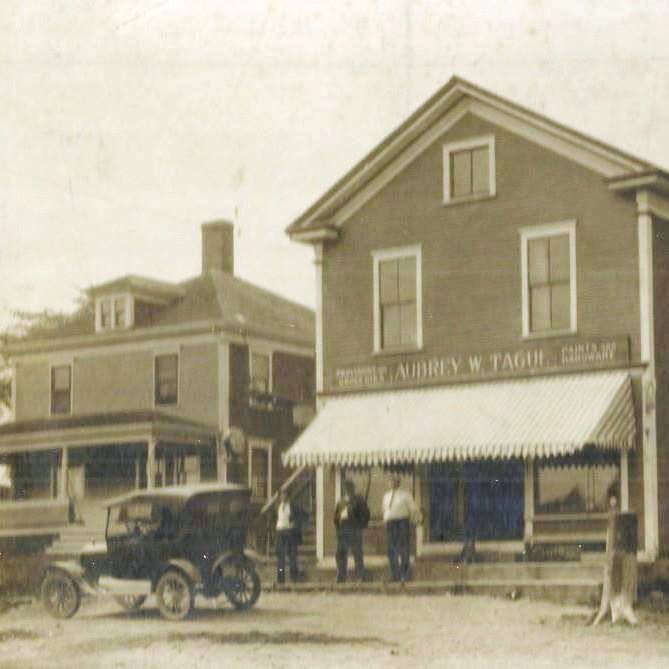
What is less well-known, however, is that the hotel, operated by James Tague’s son Aubrey, and neighboring buildings, owned by prominent businessman Horace Kellogg, tragically burned just a year later, on April 22, 1916.

According to the Bangor Daily News, “On Wednesday morning about 2 am a fire broke out at the rear of the Exchange Hotel. Before it was discovered the hotel was on fire, from there the fire spread to the store of and barn owned by Horace Kellogg. Many other houses were threatened, especially Mr. Kellogg’s storehouse and the residence of L. Field. These buildings were saved only by the heroic work of the soldiers of the 62nd Contingent from St. Croix, and much praise and thanks are due to them.”

There was only one immediate casualty of the fire. Henry Lowe of Danforth was staying overnight in the hotel with his cousin James McTague, intending to travel to Bangor in the morning.

But the fire and subsequent losses took its toll on Horace Kellogg, too. He died in March 1917, and his obituary includes the following: “a little over a year ago the store in which he started business in Vanceboro was burned at the time of the burning of the Exchange Hotel. The old building held associations for Mr. Kellogg which inevitably came of long associations with such things and his friends had noticed a great change in him since that time.”

After the fire the hotel was never rebuilt. In the fall of 1916 the hotel lot was divided between James Tague’s heirs: Bertha Tague Keef and her husband Ralph built a house on the west side of the hotel lot that was purchased by Faye and Georgia Crandelmire in 1934 and still stands today. Aubrey Tague’s store occupied the east side of the hotel lot for many years.

The Road Less Traveled: Ruth Holbrook (1896-1993)

by Mark Tappan and Lyn Mikel Brown

We’ve taken a deeper dive into the life of one of Vanceboro’s most adventurous and accomplished “daughters”– Ruth Carolyn Holbrook (1896-1993).

Ruth’s remarkable story is linked, of course, to that of her mother, Louisa Catherine Sprague Holbrook (1863-1937), and Louisa’s father (Ruth’s grandfather), George MB Sprague (1828-1913), one of Vanceboro’s “founding fathers.” Sprague was a farmer living in Princeton, Maine, married to Rhoda Colwell Sprague (1834-1870) when Louisa—their first child–was born. A year after Rhoda’s death in 1870, followed shortly by two of Louisa’s younger siblings, George married Margaret Bishop and accepted a position as Deputy Collector of Customs in Vanceboro. The family relocated to Vanceboro when Louisa was eight. The family lived in a big house on the corner of Second and Shaw Streets, where they raised five children.

In 1887, when Louisa was 24, she married local businessman E. A. Holbrook (1863-1934). They immediately moved into the large Holbrook house on Salmon Brook Road, where E.A. and his brother Harry had been raised by E.T. and Mary Holbrook. E.A. and Louisa raised three daughters in that house: Mary (1888-1941), Margaret (1891-1973), and Ruth. The doting parents had three small white stones, one for each daughter, embedded in the living room stone fireplace. 

Louisa’s adult life was comfortable, and she enjoyed the benefits and privileges afforded to her as the spouse of a successful businessman and landowner in Vanceboro during the first decades of the 20th century. For example, on the 1900 census, E.A., Louisa, and their three daughters, along with the widowed E.T., are listed as living in the house along with an 18-year-old servant, Essa Stythan. Louisa’s obituary says that she was “long prominent in fraternal and social life in Vanceboro….[s]he was a charter member of Washington Temple Pythian Sisters…a member of the nonpareil chapter, Order of the Eastern Star…and chairman of the Vanceboro branch of the Calais chapter of the Red Cross.” In addition, “of a social disposition, Mrs. Holbrook was known and esteemed by the entire community personally and in social gatherings.”

We don’t know much about Ruth’s early life. She went to Vanceboro schools, and she likely travelled with her family during holidays. She graduated from Vanceboro High School and entered Colby College in the fall of 1915, at the age of 19 (following in the footsteps of her sister, Margaret, who graduated from Colby in 1912). While there, she was a member of the Delta Delta Delta sorority, the Chi Gamma Theta sophomore society for women, the Ladies Glee Club, and the Guitar Club.

Ruth is third from left in the top row

We can only guess why Ruth decided to leave Colby after only two years. She was certainly a gifted artist, and perhaps Colby did not provide her with enough training or academic support in that realm. Maybe Colby’s small campus in Waterville did not feel like a good fit. Perhaps she had bigger dreams. In any case, she spent the 1917-1918 academic year “attending an art school” in Boston, according to the Bangor Daily News; in January 1920, she was reportedly “attending school” in New York City.

We do know that in May 1922, at the age of 25, Ruth applied for a US passport to travel to Belgium, France, and Switzerland, sailing on the Melita out of Montreal. Her passport application lists her address as 266 West 94th St. in Manhattan and her occupation as a “costume designer.” She continued to live and work in New York through the 1920s and 1930s. She is listed on the 1930 Federal Census as living on West 92nd St. in Manhattan as a “roomer.” Her occupation is listed as “buyer for specialty shop.” We don’t know more about her professional life during this period—possibly she was employed in the arts, design, and fashion industry during the difficult years of the Depression.

Ruth’s 1922 Passport Picture

Ruth was certainly a talented artist. By the mid 1930s she turned her attention to illustrating children’s books, and subsequently, wrote and illustrated her own. Her first illustrated book was Blanche Elliott’s Timothy Titus (Doubleday, Doran, & Co., 1937), followed by a “junior” book she wrote and illustrated herself. Cap’n Benny’s Birdhouses (Doubleday, Doran, & Co.,1938), follows an unlikely friendship between a boy and a lonely retired Northeast Harbor sea captain. She then illustrated Hildreth Tyler Wriston’s Camping Down at Highgate (Doubleday, Doran, & Co., 1939). In 1940, she published her most well-known book, Katy’s Quilt (Doubleday, Doran, & Co., 1940).

Katy’s Quilt tells the story of a young girl and her family living in Washington County, Maine, just after the Civil War. The book is fascinating because, while Ruth clearly took some literary license in telling Katy’s story, it reflects quite accurately real events in Ruth’s family and in the growing towns of Calais, Princeton, and Vanceboro in the 1860s and 1870s.

Katy (clearly modeled after Ruth’s mother Louisa Catherine) is excited when her father (modeled after Ruth’s grandfather, GMB Sprague) takes a new job in Vanceboro. The family packs up their belongings, takes a horse and wagon to Calais, then a train up the Canadian side of the St. Croix River, and walks across the unfinished bridge to Vanceboro and their newly built home “on the top of the hill.”  Once the bridge is completed, the whole town celebrates President Ulysses S. Grant’s visit to Vanceboro to commemorate the completion of the European & North American Railway. And Katy even gets to meet the President, who compliments her on her shiny new tassled shoes.

Katy’s Quilt was the Literary Guild’s selection for August 1940. It also received a glowing review from Oscar Shephard in the Bangor Daily News. While this “delightful” book about a family of “Maine pioneers of an earlier and more rugged day” is “intended primarily for little ones,” writes Shephard, “it will appeal also to those adults fortunate enough to have retained a touch of childhood’s idealism in their hearts.” The book is “simply and honestly told,” and “Miss Holbrook has a deft literary touch. Her style is smooth as velvet—or, if you prefer another simile, a flowing crystal stream that carries the reader along with it. She writes with effortless art.”

In spite of the success of Katy’s Quilt and Ruth’s obvious talent as an artist and writer, she published nothing after 1940, either as author or illustrator. Instead, she continued to work in the New York City retail industry. She is listed in the 1940 census as living in Scarsdale, NY with her sister Margaret Titcomb and Margaret’s son Lee Raymond Titcomb (age 11). Margaret is registered as the “owner” of “ladies retail apparel” and Ruth is listed as “saleswoman” of “ladies retail apparel” (it would seem they worked together in the store Margaret owned). Ruth does not appear in the 1950 census; Margaret and Lee, do, however, living together (without Ruth) in Eastchester, NY (a 10-minute drive from their 1940 Scarsdale address).

In 1952, at the age of 56, Ruth upended her life and changed her professional direction completely. She and her nephew, Lee (then age 23) founded Woodbury Pewter in Woodbury CT. According to Lee’s son, Brooks Whitcomb, current CEO of the company (now in its 73rd year of operation), Lee was an electrical inventor and engineer and Ruth was working for major department stores designing window displays. With Ruth’s marketing and design background and Lee’s mechanical skills, they decided to go into business together. What distinguished Woodbury Pewter was craftsmanship — each piece was made by hand, using the tools and methods utilized by pewter smiths in the 1700s and 1800s. When they started the business, according to Brooks, “Dad would make the pewter and my great aunt Ruth would load up her Studebaker station wagon; and like the old-fashioned Yankee peddlers, would zoom around to little stores all over New England, selling the wares they were making.”

Ruth and her nephew Lee Titcomb, Jr.

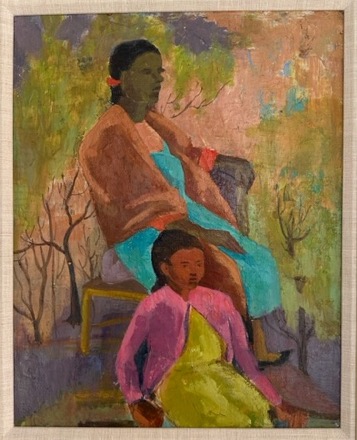
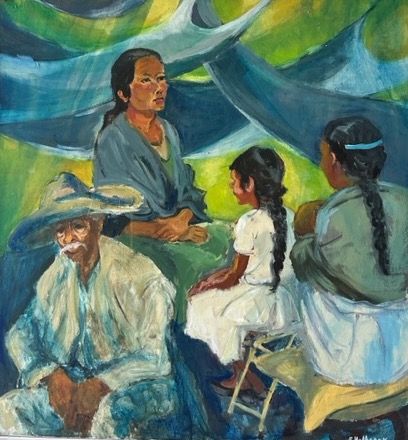
Later in life, Ruth moved to Mexico to live, once again, with her sister Margaret. There she studied art, shifting from watercolor to acrylic, and producing colorful portraits of local people and sweeping landscapes in Mexico. In 1973, at the age of 82, Margaret died and was buried in San Miguel de Allende, Guanajuato, Mexico.

The final chapter in Ruth’s remarkable life was spent in Florida, living with family and continuing to paint. Ruth died in Palm Beach on February 20, 1993 at the age of 97.

Memorial Day

For a town its size, a great many young men and women from Vanceboro served their country. All but a few returned to build and support a community where people looked out for one another. Those who experienced loss were shored up by friends and neighbors who mourned with them, brought food, attended services and funerals. Dorothy Cummings Amero describes Memorial Day as “a big deal in Vanceboro” with “a parade that went from the Legion Hall to the cemetery” and included most of the town: “Legion members, Boy Scouts, Knights of Pythias, and the school kids, grade by grade.” Officiants and veterans stood on the hill of a cemetery decorated with flowers and flags. There were speeches, bowed heads, a lone bugler playing Taps, a twenty-one gun salute. “Even as kids we knew why we were there,” Dorothy remembers, “to express our gratitude to those who fought and died so that we can live the way we do.”

Please take a moment to reflect on those community members, both men and women, who served and send love into the world for those who made the ultimate sacrifice.

Telephones Come to Vanceboro

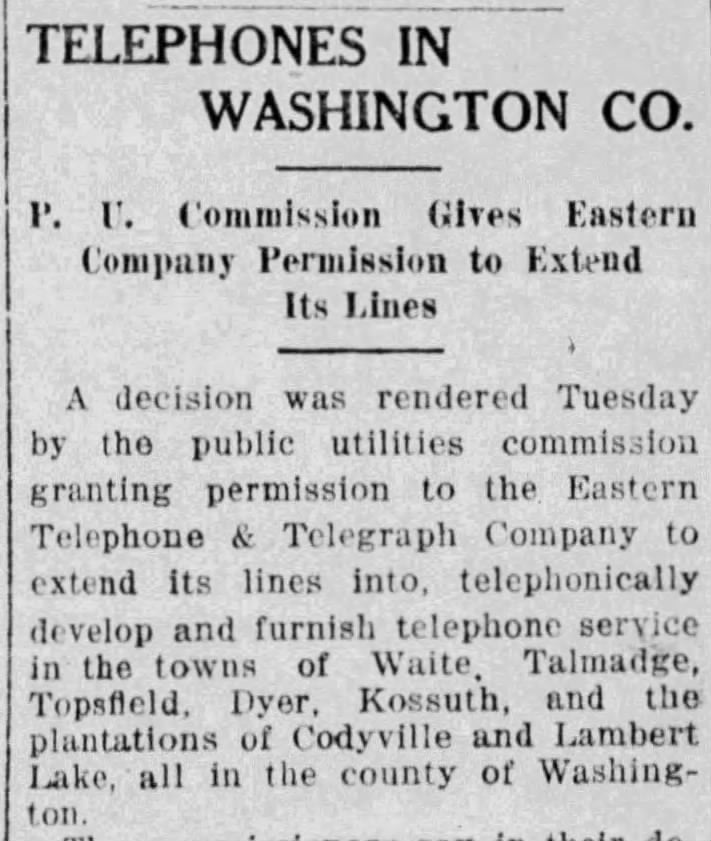
While the railroad station was connected through telegraph pretty much from the town’s beginnings, telephones came to Vanceboro and surrounds in 1919.

Folks remember the old crank telephones and party lines well into the 1950s. As is so often the case in border towns, things, well, operated a bit differently. Calls were directed through Canada and then back to the states.

Philip Palmer, stationed in Quantico, VA in WWII remembers that calling home went something like this:

Me to Virginia operator: “Vanceboro 545 ring 5.”

Operator to DC: “Vanceboro 545 ring 5.”

Repeat to New York, Boston, Bangor, Calais, St. Stephen.

“Sometimes there would be a long delay before the St. Stephen operator would answer and the Virginia operator would get frustrated and wonder out loud what was taking so long,” Mr. Palmer explained. “I told her that we were going from the U.S. to Canada so it had to be inspected, which was causing the delay. She said, ‘Oh.’”

Mary McAleney, then living on Salmon Brook Road with her family, also recalls how the connection downstate went through Canada. Her family didn’t have a phone until 1960, so she walked into town to make a call.

“To call my Grandfather in Brooks we would go to Tid Sears’ store to use the phone. I remember when I was entrusted with this task. After clearing things with Tid, I called the McAdam operator who connected to St. Stephen to Calais, then to an operator in Bangor then Belfast then Brooks, where I would ask for my Grandpa.”

Bill Brown remembers the sense of awe he felt with their first family phone.

“Definitely an ‘…everything’s up to date in Kansas City…’ moment for me when it was installed. It was a two piece crank phone, with a wooden box that had the ringer, attached to the living room wall. You “dialed” the phone by picking up the black receiver/mouthpiece and then turning the crank on the side of the box. One long crank to get an operator and an out of town line. People were given a two or three ring “number.” Ours was two longs and a short. There were two and four party lines. If someone was talking on your line, you had to wait your turn. And you could hear a click from someone else’s phone or hear them breathing when they would pick up to listen in on your conversation.”

Operators, of course, and sometimes a nosy neighbor or two on the party line had the full scoop on town gossip. Some folks remember grouchy operators, no doubt annoyed at those who didn’t follow protocol. Harold Little from McAdam, whose mother Dorothy (Brown) Little grew up on High Street, recalls his Uncle Lindy visiting from Vanceboro. 

“He’d call Kenny Essensa to see if he was home. He would grab that handle and give it about two complete turns. He knew he would get hell and the supervisor would come on the line to give it to him. But he knew that supervisor all his life and he would say, “Is that pretty little Annie Egan?” Annie would say, “Oh my God, Lindy Brown!” and they would have a great chat.”

Party lines remained through the 1970s and early 80’s and many can recite their numbers to this day. Among the artifacts at the Vanceboro Historical Society is an original crank phone as well as its successor, itself a relic of the past, the rotary phone.