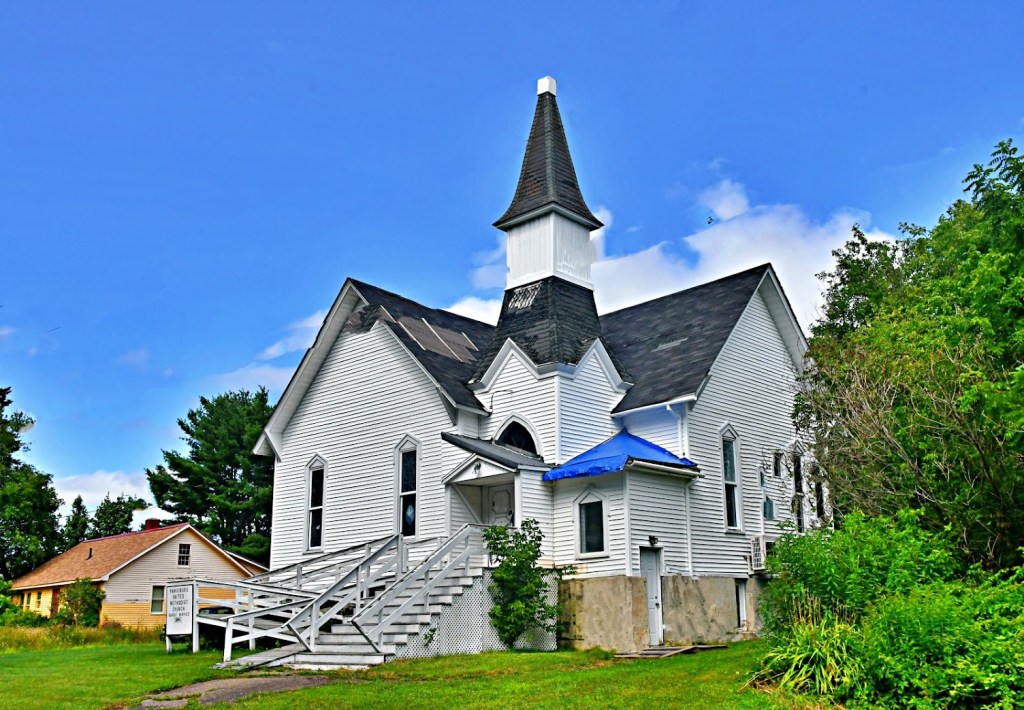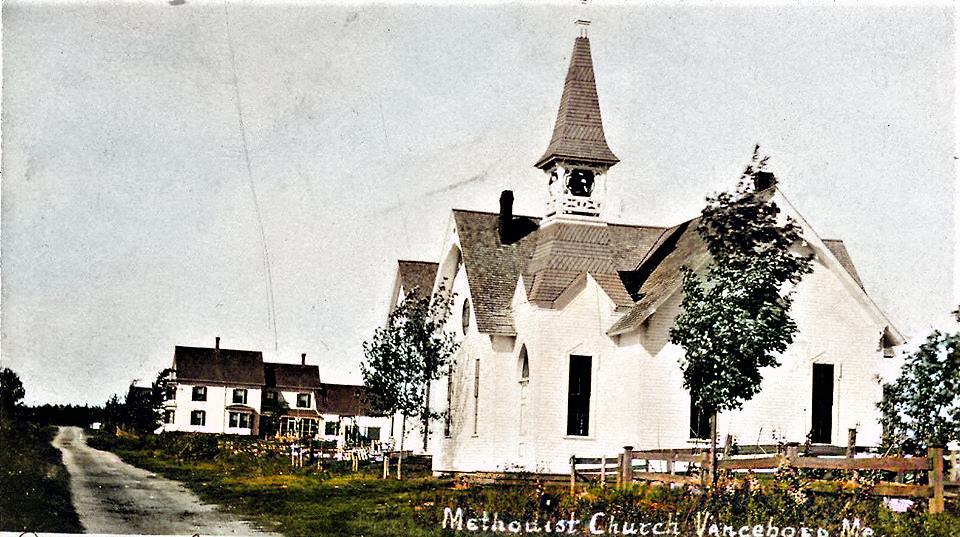
The story of the Vanceboro Methodist Church is, in many ways, the story of Vanceboro itself. Though the earliest church documents were lost in a 1989 fire that destroyed the home and took the life of records keeper, Ethel Mason, historical records and memories of the church were collected on the occasion of the 1990 centennial anniversary of the church’s present sanctuary. What remains tells us a great deal about a village church shaped by the railroad, cross-border cooperation, and continuity across generations.
Methodism first arrived in Vanceboro in 1873, carried not by wealth or formal institutions, but by itinerant preaching and the determination of a handful of believers. Rev. G. Edwin Williams, an English Wesleyan minister traveling from St. John and later McAdam, New Brunswick, preached in Shaw Hall and in the home of George and Mrs. Eales at the corner of High and Second Streets. The congregation was small and fragile in those early years, and not always welcomed. According to church recollections, Methodists were eventually locked out of Shaw Hall by a disciple of another denomination because “Methodist” did not appear in the Bible. Forced from their meeting space, the congregation worshiped quietly in private homes for nearly three years. John Swaney, Sr., a Civil War veteran, was active in the early society and, in absence of a pastor, often conducted services and officiated funerals, also acting as the undertaker.
And so the church endured. Through the late nineteenth century, a succession of ministers served the growing mission circuit that included Forest City and Lambert Lake. By 1888, under Rev. Eli S. Walker, the congregation formally organized and constructed a vestry or parsonage on the corner of High and Second Streets, with rooms below for the minister’s family. Two years later, in 1890, the congregation purchased a new lot from Ann M. Drake and erected the present sanctuary on High Street. Constructed in Carpenter Gothic style, the builder is unknown; perhaps a local millwright, guided by trustees and the congregation.
Even in its earliest years, the church reflected the cooperative spirit of a remote border town where denominations and neighbors depended on one another. When the first vestry and parsonage were completed, the Methodist congregation invited the local Roman Catholic priest to hold Mass there until the Catholic church was ready. Over the decades, the two congregations continued to support one another’s events and celebrations. When the Methodist church later upgraded from its original pump organ to an electric one, the older instrument was donated to the Catholic chapel.
As Vanceboro grew during the height of the railroad era, the church grew alongside it. In 1905, Vanceboro became a “single-point charge,” meaning its minister served only the local congregation rather than traveling between several communities. Five years later, the church purchased a parsonage from Alice Conrad for $1,100, aided in part by the tireless fundraising of the Ladies’ Aid Society. In 1916 and 1917, the sanctuary itself was physically moved back twenty feet so a new basement and furnace could be installed, reflecting both the congregation’s ambition and the practical realities of maintaining a church in northeastern Maine.
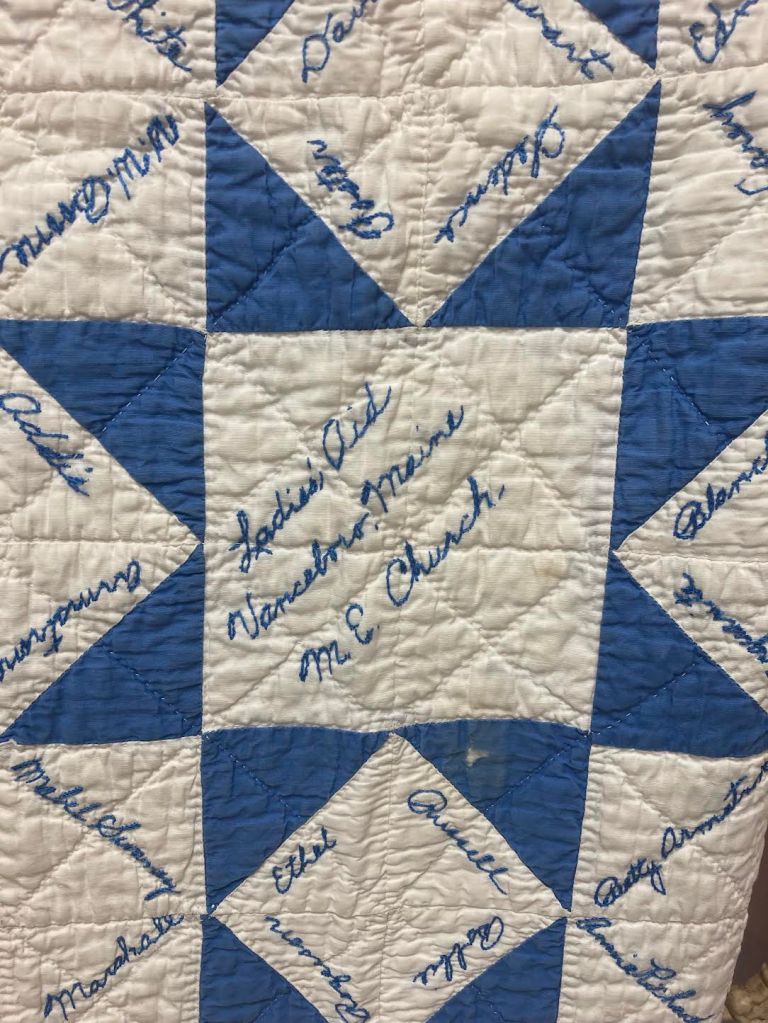
Carol Buchanan donated this 1920’s quilt to the museum on the day of the town’s 150th celebration. Her mother-in-law, Georgia Gallison Buchanan, won the quilt in a raffle. Made by the Ladies Aid Society, each handcrafted square represents a member. A beautiful example of the fundraising efforts of the Society over the lifetime of the church.
The church weathered hardship as well as growth. In 1942, disaster nearly struck when fire swept through the sanctuary. Townspeople—young and old alike—joined together to battle the blaze and save the building. For a short time, services were held in the local high school while repairs were completed. Insurance funds helped restore the church and install new windows, but the deeper story was one of collective effort: a community determined not to lose one of its central gathering places.
The decades that followed brought continual renewal. The old parsonage was sold in 1952 and replaced with a new one beside the church, its mortgage finally paid off in 1961. The vestry was paneled in 1967, and new communion pieces and a pulpit Bible were dedicated. In 1971, the church received a new oil furnace and foundation. During the 1970s, the congregation shared pastoral leadership with St. Paul’s United Church in McAdam, New Brunswick, continuing the cross-border relationships that had shaped the church from the beginning.
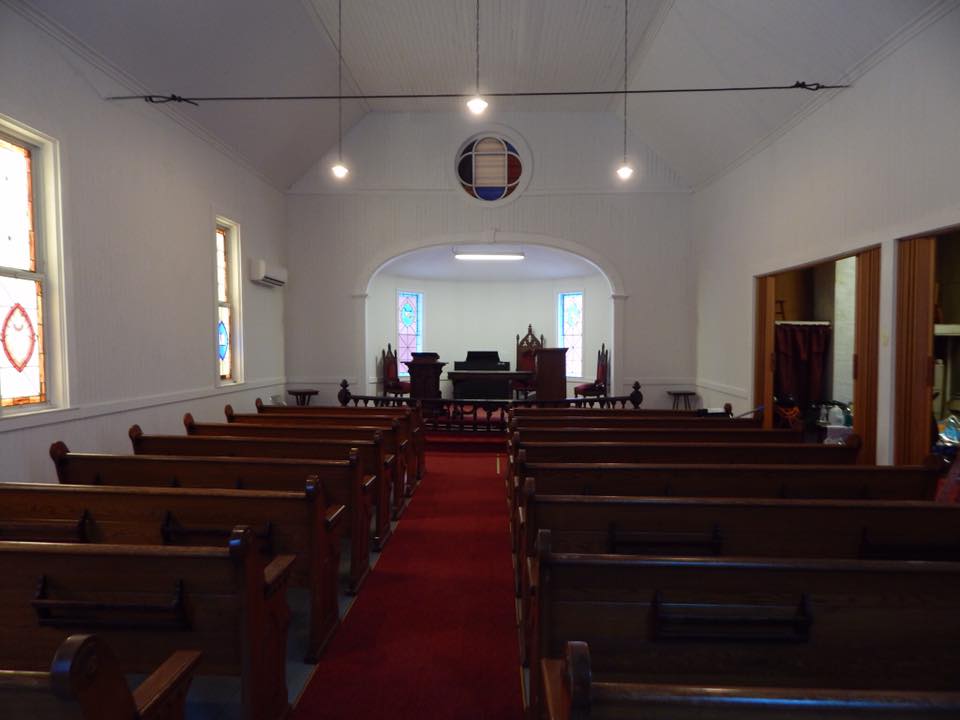
Modern conveniences arrived gradually. In 1976, the kitchen was remodeled and indoor plumbing and a restroom were finally installed. During the early 1980s, the furnace was replaced again, storm windows added, and memorial stained-glass windows installed through community fundraising efforts. Their dedication in 1982 became a major gathering for the town.
By 1990, the church had become more than a place of worship. It stood as a witness to the persistence of a small rural community that had survived fires, economic change, denominational differences, and the rise and decline of the railroad. The history of the Vanceboro Methodist Church is ultimately not only about religion, but about neighborliness, adaptation, and the enduring importance of shared places in small-town life.
Today, the church bears witness to generations of people who refused to let it disappear. When fire nearly destroyed it in 1942, townspeople formed bucket lines and saved it. When repairs were needed, the Ladies Aid Society and local families raised money through suppers, sales, memorial gifts, and volunteer labor. When modernization came slowly, the congregation adapted — adding a basement, furnace, kitchen, stained glass windows, running water, and accessibility improvements over time.
But preservation is never finished. Deferred maintenance, rising costs, and a shrinking congregation threaten a beautiful church building that cannot easily be replaced once gone. The Vanceboro Methodist Church is more than a religious structure. It is a living witnesses to local history and the people who built this once vibrant border community.