Lyn Mikel Brown

The Henry (1832-1905) and Julia Mansfield (1850-1896) home, located on High Street across from the intersection of Second Street, remained in the family for ninety years and four generations. The house, bought in 1872 by Henry, was passed down to second child Carrie Mansfield (1877-1959). It was then inherited by her son, Linwood Brown (1922-2006). Lindy, a railroad engineer, his wife, Diane, a school and volunteer town nurse, and their four children lived in the home until 1962.

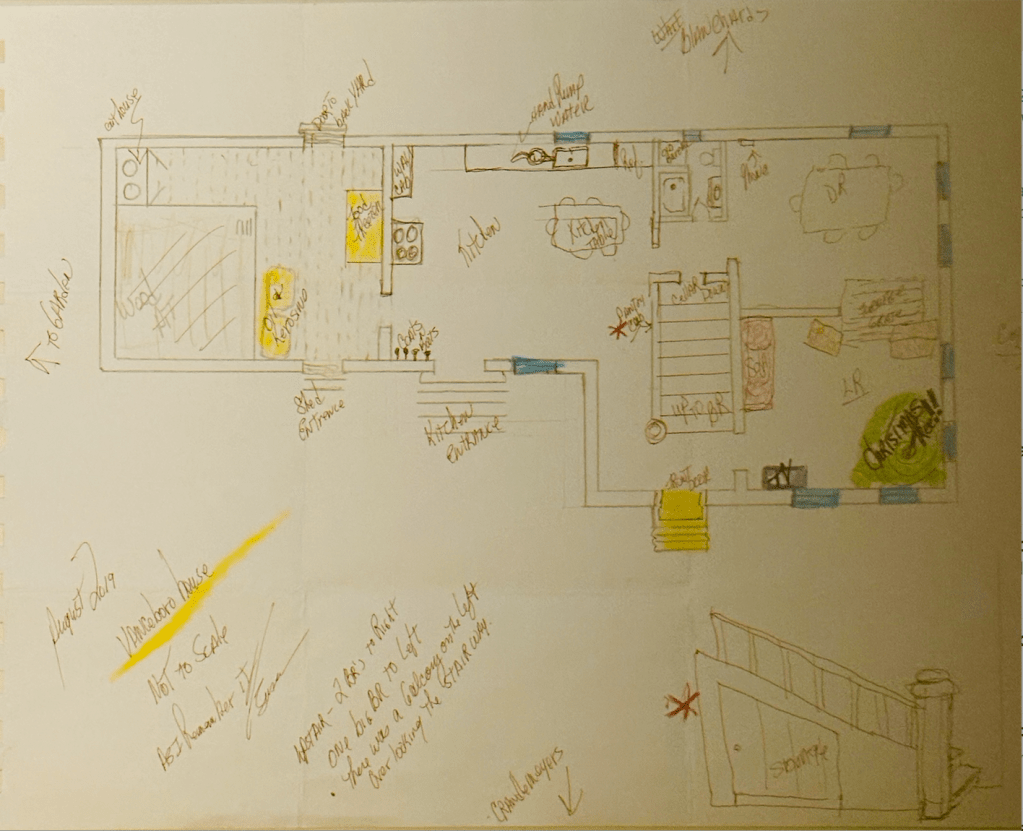
Built as a connected farmhouse, the Mansfield house consisted of three attached buildings: the main house with living room and dining room downstairs and two bedrooms upstairs, a connected kitchen with a bedroom above, and an attached woodshed and outhouse. Each structure had it’s own porch and entrance on the south side facing a line of elm trees, and beyond, the neighboring house. A back door from the woodshed led to a backyard with apple trees and the family tended large vegetable gardens on the west side of the house. The family bought and sold attached parcels of land over the years.
On the back of the above photo, taken around 1886, Linwood Brown — born in the house, as was his mother, Carrie — offers historical detail:
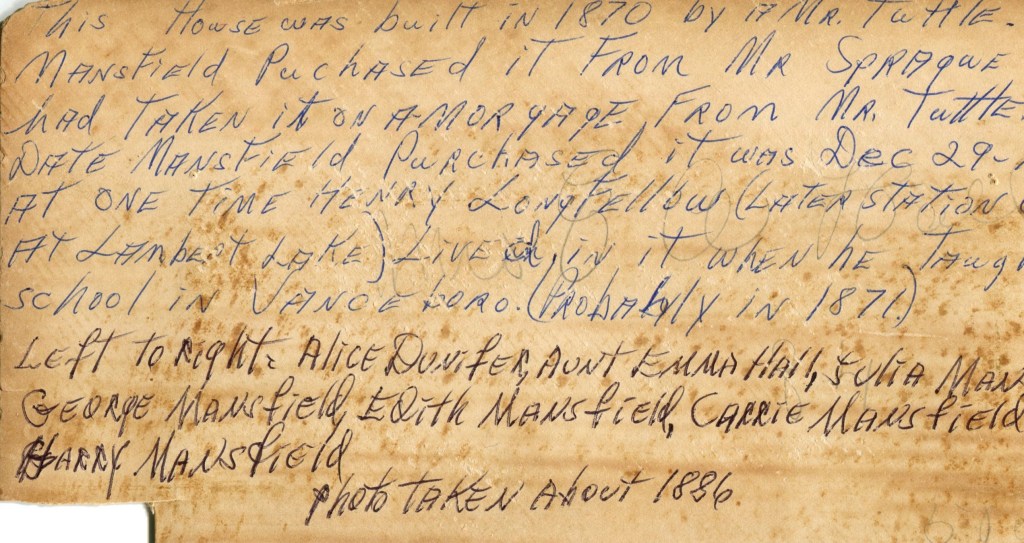
Interested in this chain of purchases and sales, we did a little digging. Deeds tell us the house was originally built — perhaps by Mr. Tuttle, though there is no record — for the Shaw family, who built a number of houses as they settled in Vanceboro at the opening of the Shaw Bros. Tannery. It’s not clear who was to occupy the home, but the July 18, 1872 deed of sale to customs officer, George Sprague, is presented by brothers Fayette, Brackley, William and Thaxter Shaw on behalf of “the firm of F. Shaw and Brothers” and signed by the four brothers and their wives.
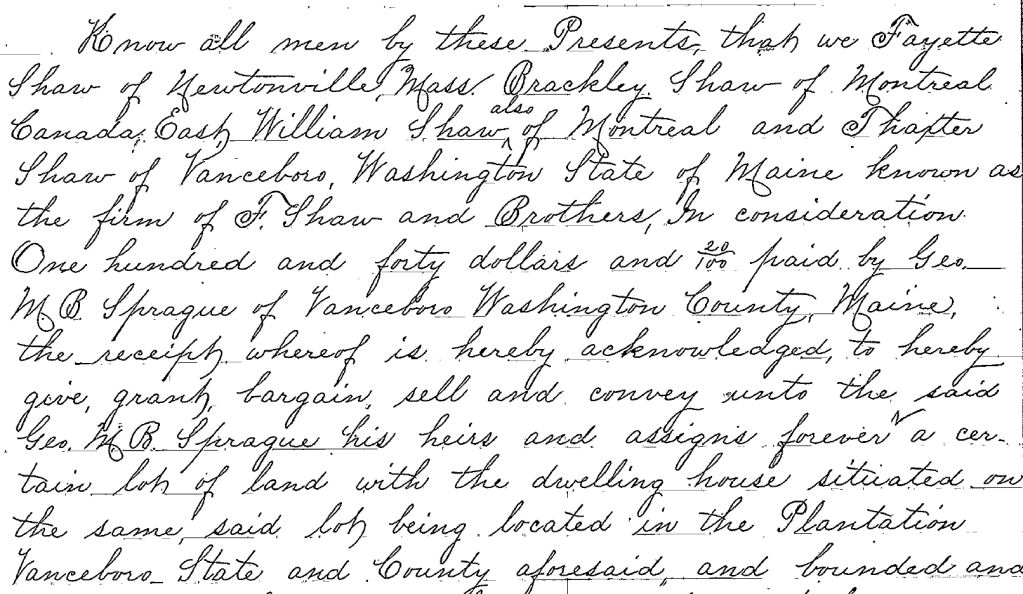
The deed continues with descriptions of the various property stakes and a set of unusual notable conditions for the sale, which suggests both the Shaw’s moral code and the power they wielded in the community at this time:

Because of injuries and illness during a lengthy Civil War imprisonment, Henry Mansfield was unable to do manual labor. He became a night watchman for the European & North American Railroad. Julia died young and after Henry’s death in 1905, Carrie married Ora Brown from Milford, who worked in Vanceboro as a custom’s agent. After Ora’s death in 1924, Carrie remained in the house with her children, Katherine, Martha, Dorothy and Linwood. The Depression arrived soon after and with little income and three children still at home, Carrie could afford no structural adjustments to the house — no electricity or indoor plumbing. The house, largely uninsulated, was heated by a wood stove in the kitchen and a Franklin stove in the living room. It wasn’t until 1955, after Linwood married and he and Diane and her two young children moved in to live with Carrie that the house was wired for electricity, insulated and plumbing installed. The kitchen sink included a new hand pump. As Lindy and Diane’s family grew, the pantry on the north side of the house was replaced with a bathroom and a kerosine heater in the basement added. A large floor grate between the dining and living rooms heated the home.

After Carrie’s death in 1958, Linwood, Diane, and their children, Bill, Susan, Lyn and David lived on in the house until they moved to Calais in 1962. Years later, Susan drew this floor plan of the house as she remembered it.
Lindy and Diane sold the house on October 24, 1963 to Roger and Dorothy (Dot ) Fisher, who moved in with their two children. Roger worked as a customs agent and Dot, like Diane, was a school and town nurse. Now unoccupied, the house remains standing, though time has taken its toll.


 Vanceboro Historical Society