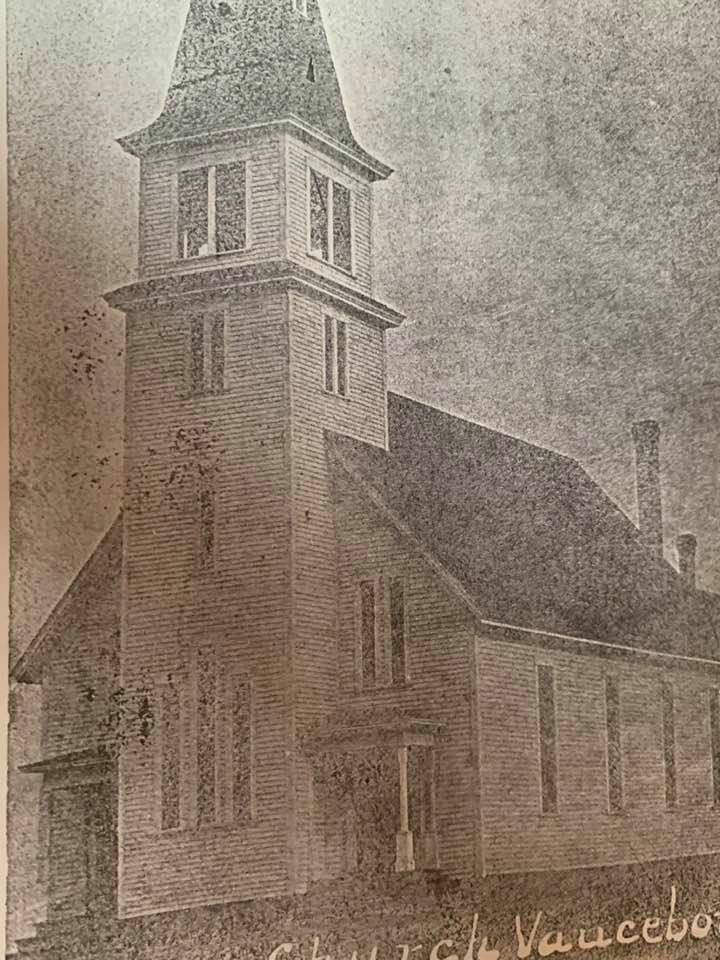
It’s been a mystery, these two photographs shared of an unknown church in Vanceboro. Enough time has lapsed that memory doesn’t serve — not even parents or grandparents remember a Church on Church Street.
The first photo is a grainy scan from a member’s family album. It’s a stately building. Research tells us the church was most likely constructed by a local master carpenter, built in Carpenter Gothic style with a wood-frame meeting house, corner tower and tall spire.
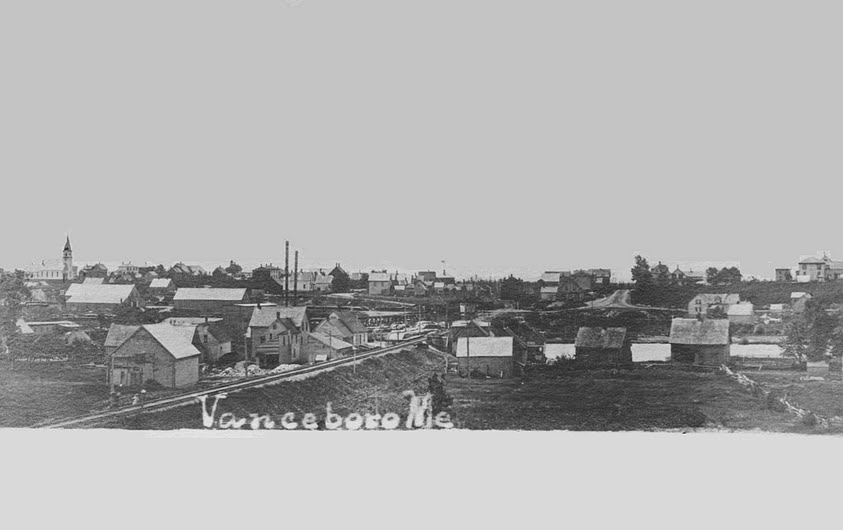
The second photograph, much clearer, is a long distance view taken from the St. Croix side of the river. Here we see F. Shaw and Bros. tannery buildings along and above the river and a growing Vanceboro depot and village. The building is to the far left on a slight rise, supporting the theory that it was situated on what is now Church Street. Since no other church has existed there, it makes sense that the street was named after the building.
A November 15, 1884 mention in the Washington County section of The Bangor Daily Whig and Courier sheds light:
“The Union Church, at Vanceboro, is about finished on the outside, and the vestry ready to be occupied. The spire of the building adds very much to the appearance of the village. The society having exhausted their funds, have concluded to defer operations for the winter or until they can raise sufficient [funds] to complete the building next year.”
In rural areas, Union Churches were built as nondenominational meeting houses, a shared arrangement used by multiple Protestant denominations, especially in small towns like Vanceboro where there were not enough people or resources to sustain separate congregations. Such meeting houses were usually constructed by using a regional pattern book rather than an architect. Rail access in Vanceboro (by 1871) meant pattern-book designs could travel in, even if materials and labor were local. By 1886, the Vanceboro Methodist Church and the Catholic Church of the Guardian Angel had also been built, so it’s likely the Union meeting house was used by an amalgam of other denominations, perhaps Congregationalists, Baptists, and Presbyterians.
Searching Maine Historical Society records, we discover the Vanceboro Union Church officially organized itself as a Congregational Church on August 23, 1891, recording 16 members. It was received into the Washington [County] Conference of the Maine Congregational Church at the Annual Meeting of the Conference in Milltown, New Brunswick, on June 8, 1892, E.T Holbrook was the representative of the Vanceboro congregation at that meeting; he was also elected as a delegate to the state conference.
Holbrook was a bookkeeper in the Shaw Brothers Tannery store. In 1882, he opened his own general store in town and acquired two farms south of town, where he grew crops and raised livestock. He was a notary public and served as a selectman. He represented Vanceboro and surrounds in the Maine House of Representatives from 1883 to 1884, and in the Maine Senate from 1889 to 1890.
That additional well-to-do early town business leaders are listed as church members and officers — J.M.B. Sprague, the deputy collector of customs, served as Sunday School Superintendent; Emily Cobb, a local milliner, served as clerk — suggests that the Vanceboro Congregational Church was a religious home to the Vanceboro middle class.
This was typical of other Congregational churches in small Maine towns at the turn of the century. Congregational churches were primarily associated with the long-established, socially respectable middle and upper-middle classes, and the community’s elite. Given the attraction of workers to the tannery, it’s possible there was a class distinction in local worship. Workers choosing the Methodist and Catholic Churches; businesspeople choosing the Congregational.
Between 1892 and 1905 the church was quite active, although total membership does not appear to have ever exceeded more than 31. A June 17, 1896 column in the Bangor Daily Whig and Courier reports, “The Reverend Mr. Morrison Marian of the Congregational Church in Vanceboro preached a very interesting sermon last Sunday evening to a large congregation.” An August 17, 1897 column reports a Rev. W.T. Sparhawk preached the summer in Vanceboro and was to return in the fall to the Bangor Theological Seminary. The change in pastors and the return to seminary in the latter case might suggest a sequence of part-time ministers, not uncommon in rural parishes.
As a meeting house, the church also played a central role in the village. There are mentions of picnics, concerts, talks, gatherings of local groups such as the Order of the Pythian Sisters, and various evening socials held in the vestry, at least one by the graduating class of 1898.
The Fire of August 31, 1905
Vanceboro was a town of wooden structures and fires were a constant threat. The summer of 1905 was especially dry. Indeed, there had been a five year stretch of dry weather. An article on the front page of the Bangor Daily Whig and Courier, and picked up by newspapers across the state, reports a nightmarish sequence of events. A fire broke out in the ruins of the old tannery, the town was threatened, volunteer firemen and citizens worked heroically to limit the damage, but the Congregational Church, uninsured, was lost. As was, we presume, the church history.
“The Congregational Church, a Large Stable, Two Dwelling Houses Burned.
VANCEBORO, Aug. 31 — The Congregational church, a large stable owned by C. F. Keefe, and two unoccupied dwellings were burned tonight by fire which originated from the ruins of an old tannery. Several buildings caught four or five times and for a while the town was threatened, but further damage was prevented by heroic work.
The dry weather handicapped the volunteer firemen in their efforts. The fire was still burning at noon, but under control. The loss is estimated at $10,000. All the insurance carried upon the church was permitted to lapse a short time ago.”
The reported lapse in insurance coverage offers a reason no Congregational Church stands on Church Street today. A tragedy for those who worshipped there, and for the entire town. The spire did, indeed, add very much to the appearance of the village.


 Vanceboro Historical Society