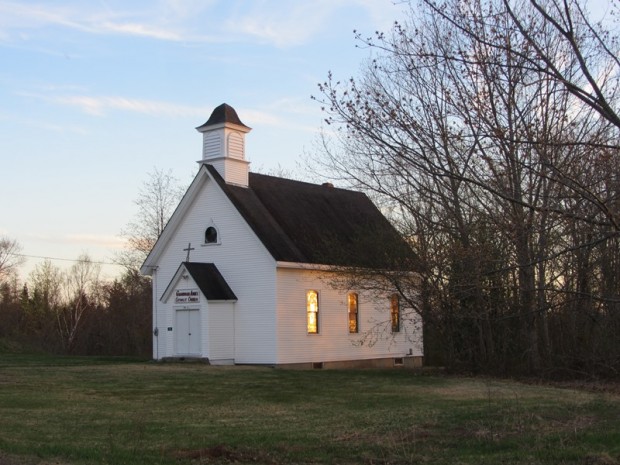
Church of the Guardian Angel, 2013, stained glass windows still in place. The chapel was, soon after, deconsecrated and sold.
Catholicism came early to Vanceboro by way of Ireland and the diocese of Portland. F. Shaw Bros arrived in Vanceboro in 1869 and, with their tannery constructed, so did a good many immigrant workers, many of Irish Catholic descent. The Shaw brothers donated land for a Catholic Church southerly of the European & North American railroad on a lot that abuts what is now route 6.
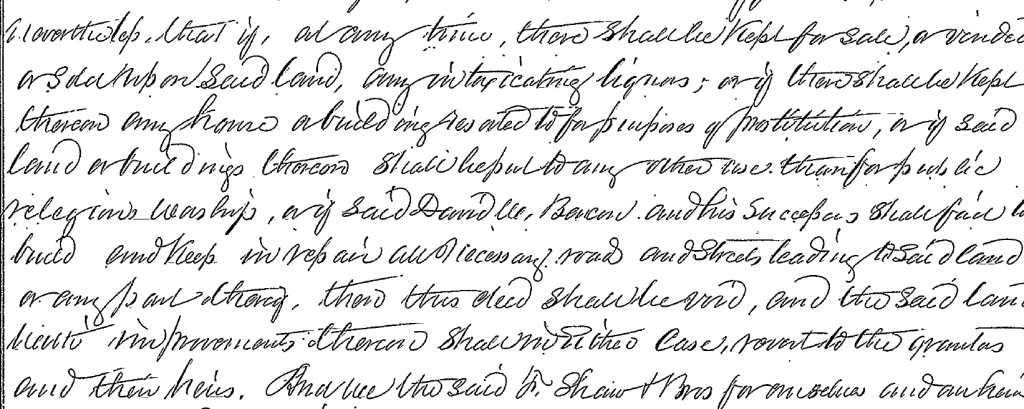
Deeded to Right Rev. David W. Bacon and dated July 9, 1874, the Shaw sale was subject to clear stipulations, perhaps reflecting stereotypes of the Irish at the time:
“…if, at any time there shall be kept for sale or vended on said land any intoxicating liquors; or if there shall be kept thereon any house or building used for the purposes of prostitution, or if any said land or building is used for any other purpose than religious worship” the land will be returned to the Shaw brothers and their heirs. Rev. Bacon was then the Roman Catholic Bishop of Portland.
Portland’s Bishop Healy made a summer visit to Vanceboro in 1886. Rev. T. G. Plant, residing in Winn, began the construction of the modest mission chapel, which was dedicated by Bishop Healy under the patronage of the Guardian Angel.
As congregants waited for the church to be completed, they held meetings in the Methodist vestry on the corner of High and Second Streets. This was the beginning of a long, close relationship between Vanceboro’s Methodist and Catholic parishioners. Over the years they supported and attended one another’s church suppers, fairs and annual picnics and, for a time, Catholic youth participated in Methodist Youth Fellowship (MYF).
In addition to generations of local parishioners, the Church of the Guardian Angel was attended by Customs and Immigration families over the years. Here young Virginia Cleary and Mary McAleney, daughter of customs worker, Bill McAleney, pose for their Confirmation photo.
Virginia Cleary and Mary McAleney, 1952, posing on the front lawn of Donald Wescott’s house, which used to sit beside the Catholic Chapel. The two chimneys in the background to the left of the barn are most likely those of the old Customs House.
At this time, the priest traveled by train from Danforth for Sunday Mass. Later, in the 1960s a priest traveled from Lincoln. In the 1980s, a reciprocal arrangement existed where a Maine priest would serve on Campobello Island, New Brunswick and a McAdam, New Brunswick priest would cross the border to minister in Vanceboro.
In 2013 the Church of the Guardian Angel was deconsecrated, the stained glass, alter and pews removed. The original organ and bell that still remain in the building were gifts from the Methodist Church, offered when the Methodists replaced their original pump organ with an electric version and closed their belfy.
The organ, original to the Methodist Church, gifted to the Church of the Guardian Angel
The building sold in 2014 to Darin McGaw, who has his own deep ties to Vanceboro. His mother, Cathy Prescott, attended the church and from the lawn he can see across the road to the house his grandfather, Carlton Prescott, built. Carlton grew up in Codyville. He married Ruby Tracy of Vanceboro and worked for 40 years as a clerk for Maine Central and Canadian Pacific Railroads.
Being the same premises described in the 1874 deed from the Shaws to Right Rev. David W. Bacon, the sale of the building and property from the Diocese of Portland to Mr. McGaw included restrictions, in this case addressing acts deemed offensive to Catholic teachings.
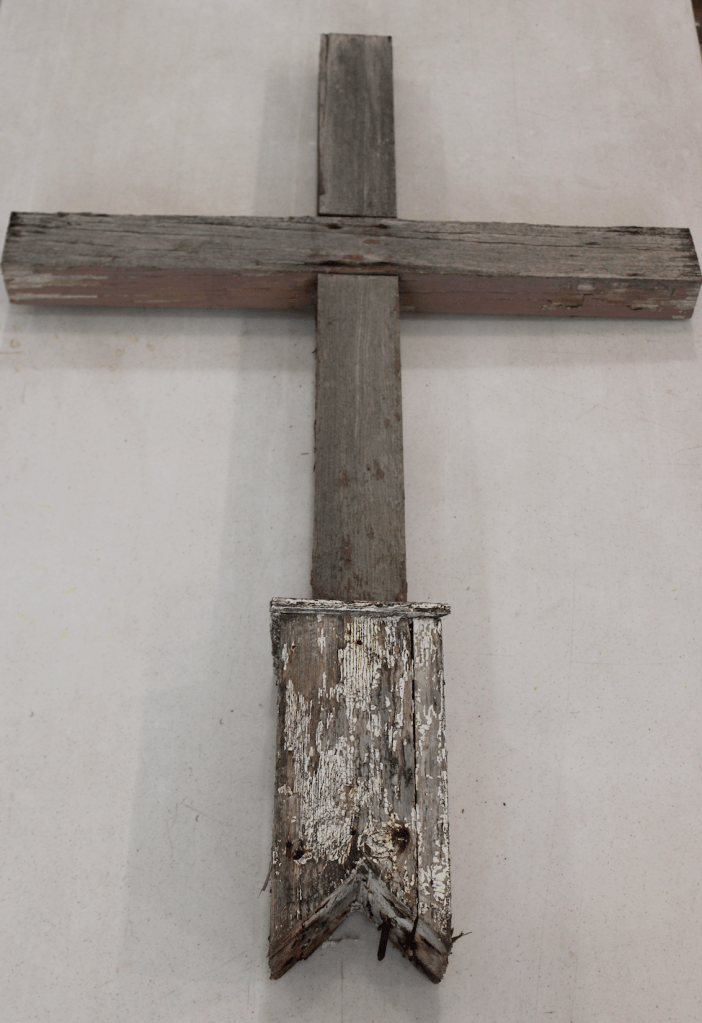
Mr. McGaw simply uses the building for storage. He has a love for the place and has worked to ensure the building remains in good condition, repairing and painting the exterior and shoring up the stone basement foundation. This summer, he donated to the museum the wooden cross that once graced the entrance of the chapel, vestments found in the priest quarters to the back of the sanctuary, and the sign announcing the time of services.
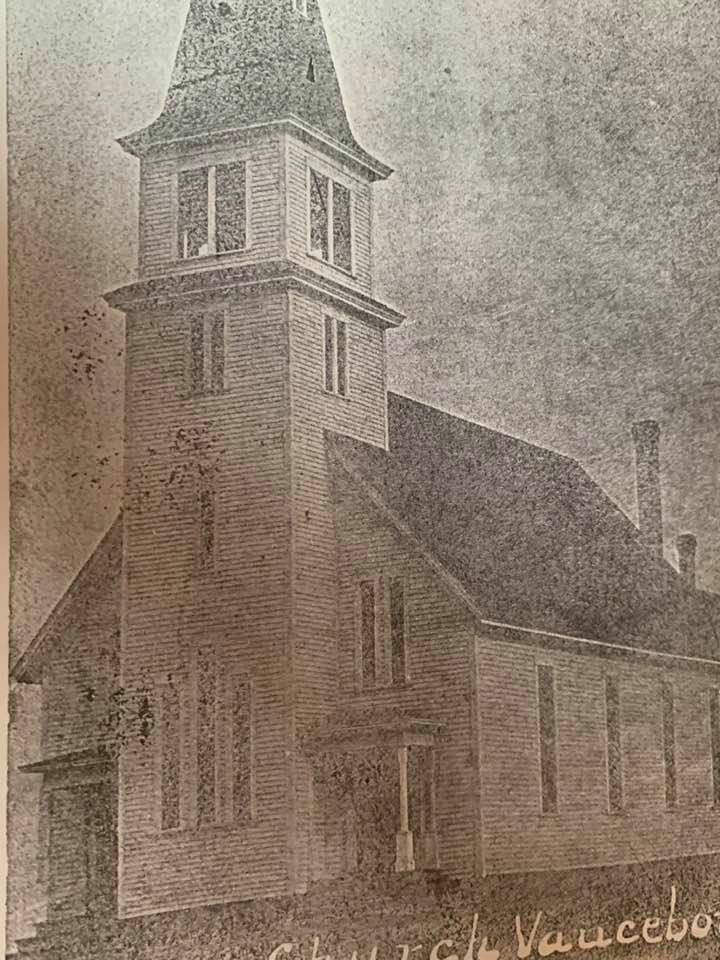
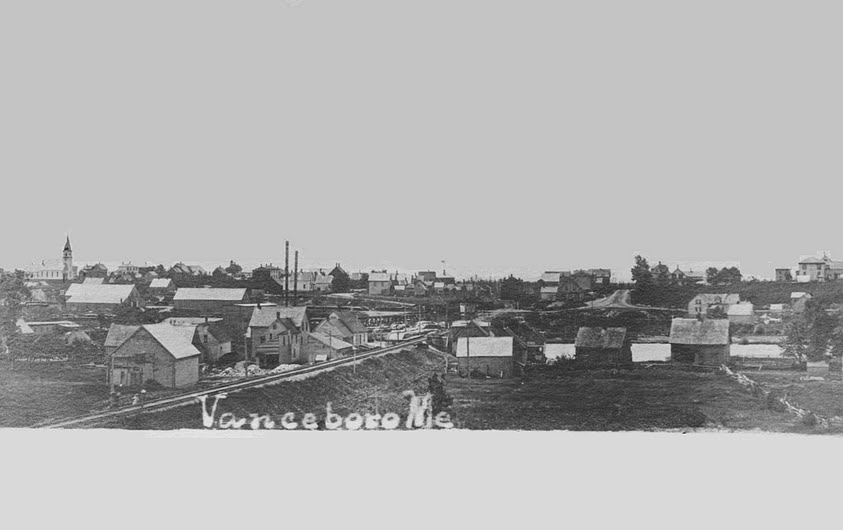
It’s been a mystery, these two photographs shared of an unknown church in Vanceboro. Enough time has lapsed that memory doesn’t serve — not even parents or grandparents remember a Church on Church Street.
The first photo is a grainy scan from a member’s family album. It’s a stately building. Research tells us the church was most likely constructed by a local master carpenter, built in Carpenter Gothic style with a wood-frame meeting house, corner tower and tall spire.
The second photograph, much clearer, is a long distance view taken from the St. Croix side of the river. Here we see F. Shaw and Bros. tannery buildings along and above the river and a growing Vanceboro depot and village. The building is to the far left on a slight rise, supporting the theory that it was situated on what is now Church Street. Since no other church has existed there, it makes sense that the street was named after the building.
A November 15, 1884 mention in the Washington County section of The Bangor Daily Whig and Courier sheds light:
“The Union Church, at Vanceboro, is about finished on the outside, and the vestry ready to be occupied. The spire of the building adds very much to the appearance of the village. The society having exhausted their funds, have concluded to defer operations for the winter or until they can raise sufficient [funds] to complete the building next year.”
In rural areas, Union Churches were built as nondenominational meeting houses, a shared arrangement used by multiple Protestant denominations, especially in small towns like Vanceboro where there were not enough people or resources to sustain separate congregations. Such meeting houses were usually constructed by using a regional pattern book rather than an architect. Rail access in Vanceboro (by 1871) meant pattern-book designs could travel in, even if materials and labor were local. By 1886, the Vanceboro Methodist Church and the Catholic Church of the Guardian Angel had also been built, so it’s likely the Union meeting house was used by an amalgam of other denominations, perhaps Congregationalists, Baptists, and Presbyterians.
Searching Maine Historical Society records, we discover the Vanceboro Union Church officially organized itself as a Congregational Church on August 23, 1891, recording 16 members. It was received into the Washington [County] Conference of the Maine Congregational Church at the Annual Meeting of the Conference in Milltown, New Brunswick, on June 8, 1892, E.T Holbrook was the representative of the Vanceboro congregation at that meeting; he was also elected as a delegate to the state conference.
Holbrook was a bookkeeper in the Shaw Brothers Tannery store. In 1882, he opened his own general store in town and acquired two farms south of town, where he grew crops and raised livestock. He was a notary public and served as a selectman. He represented Vanceboro and surrounds in the Maine House of Representatives from 1883 to 1884, and in the Maine Senate from 1889 to 1890.
That additional well-to-do early town business leaders are listed as church members and officers — J.M.B. Sprague, the deputy collector of customs, served as Sunday School Superintendent; Emily Cobb, a local milliner, served as clerk — suggests that the Vanceboro Congregational Church was a religious home to the Vanceboro middle class.
This was typical of other Congregational churches in small Maine towns at the turn of the century. Congregational churches were primarily associated with the long-established, socially respectable middle and upper-middle classes, and the community’s elite. Given the attraction of workers to the tannery, it’s possible there was a class distinction in local worship. Workers choosing the Methodist and Catholic Churches; businesspeople choosing the Congregational.
Between 1892 and 1905 the church was quite active, although total membership does not appear to have ever exceeded more than 31. A June 17, 1896 column in the Bangor Daily Whig and Courier reports, “The Reverend Mr. Morrison Marian of the Congregational Church in Vanceboro preached a very interesting sermon last Sunday evening to a large congregation.” An August 17, 1897 column reports a Rev. W.T. Sparhawk preached the summer in Vanceboro and was to return in the fall to the Bangor Theological Seminary. The change in pastors and the return to seminary in the latter case might suggest a sequence of part-time ministers, not uncommon in rural parishes.
As a meeting house, the church also played a central role in the village. There are mentions of picnics, concerts, talks, gatherings of local groups such as the Order of the Pythian Sisters, and various evening socials held in the vestry, at least one by the graduating class of 1898.
The Fire of August 31, 1905
Vanceboro was a town of wooden structures and fires were a constant threat. The summer of 1905 was especially dry. Indeed, there had been a five year stretch of dry weather. An article on the front page of the Bangor Daily Whig and Courier, and picked up by newspapers across the state, reports a nightmarish sequence of events. A fire broke out in the ruins of the old tannery, the town was threatened, volunteer firemen and citizens worked heroically to limit the damage, but the Congregational Church, uninsured, was lost. As was, we presume, the church history.
“The Congregational Church, a Large Stable, Two Dwelling Houses Burned.
VANCEBORO, Aug. 31 — The Congregational church, a large stable owned by C. F. Keefe, and two unoccupied dwellings were burned tonight by fire which originated from the ruins of an old tannery. Several buildings caught four or five times and for a while the town was threatened, but further damage was prevented by heroic work.
The dry weather handicapped the volunteer firemen in their efforts. The fire was still burning at noon, but under control. The loss is estimated at $10,000. All the insurance carried upon the church was permitted to lapse a short time ago.”
The reported lapse in insurance coverage offers a reason no Congregational Church stands on Church Street today. A tragedy for those who worshipped there, and for the entire town. The spire did, indeed, add very much to the appearance of the village.
International rail has been central to Vanceboro since its founding, shaping both local life and the broader national economy. During World War I, the St. Croix River trestle bridge was a portal to Canadian harbors and Europe so vital it was bombed by a German spy. The Vanceboro station and its once 10-track-wide yard were among the busiest in the country, with more than two dozen trains a day from both the U.S. and Canada. This busy rail activity continued here long after automobiles and trucks had begun to diminish rail travel elsewhere.
Yet Vanceboro’s key role in the transcontinental railroad remains largely unknown.
At the Vanceboro Historical Society, one of our goals is to bring that hidden history to light through engaging displays and educational programming. So, we were thrilled when board member Gene MacDonald generously donated his 12’x20’ unfinished railroad museum building—complete with artifacts, historic photos, railway records, display cabinets, a motorized “putt putt” railcar, and an original railroad signal. Located along the tracks in downtown Vanceboro, the building had been unused for years.
Billy Grass prepares the MacDonald museum for the move
With Canadian Pacific now owning the land and freight traffic on the rise again, we made the decision to relocate the building to ensure its long-term preservation and public accessibility. After successfully applying for support from the Morton-Kelly Charitable Fund, we began preparations to transform the structure into a permanent, three-season interactive railroad exhibit.
Curator Alaine Peaslee-Hinshaw organized a team of local volunteers to move the building and putt putt to the lawn beside the VHS museum. She documented the effort and worked with the crew as they prepared and placed the building on skids and pulled it up the steep rise of Cobb Hill to its new home at the end of High Street.
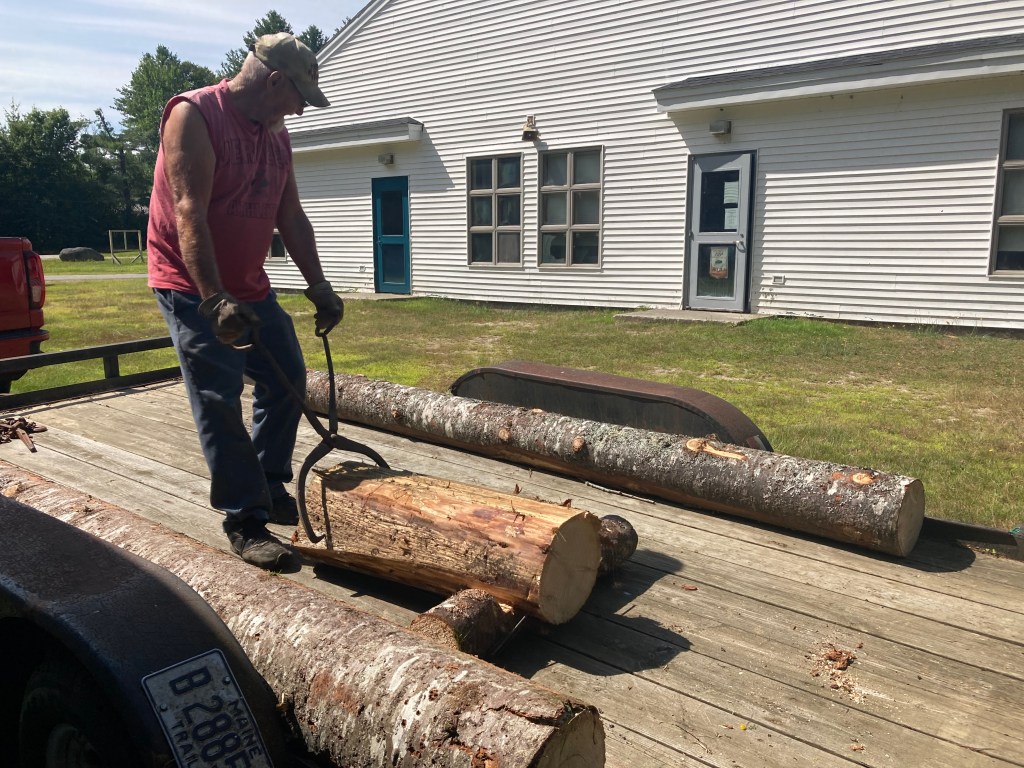
Using traditional logging tools and techniques passed down through generations—peaveys, line-in bars, railroad spikes, tie tongs, and a deep understanding of balance points and fulcrum—the team safely positioned and leveled the building. Along with Alaine, thank you to Curty Scott, Billy Grass, David Scott, Harvey Day and Larry Sam Day for their collective effort.
Curty Scott and Billy Grass use traditional tools to secure log skidsOnce on site, after using fulcrum and pivot points to remove and load skids, Billy uses tie tongs to position logs
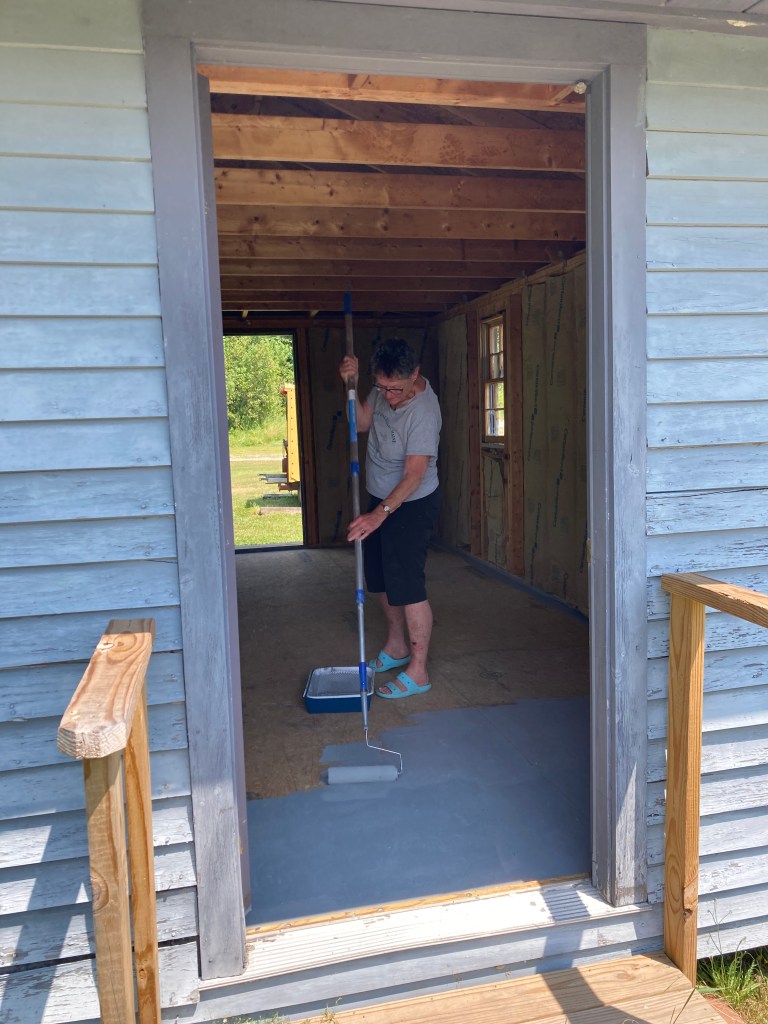
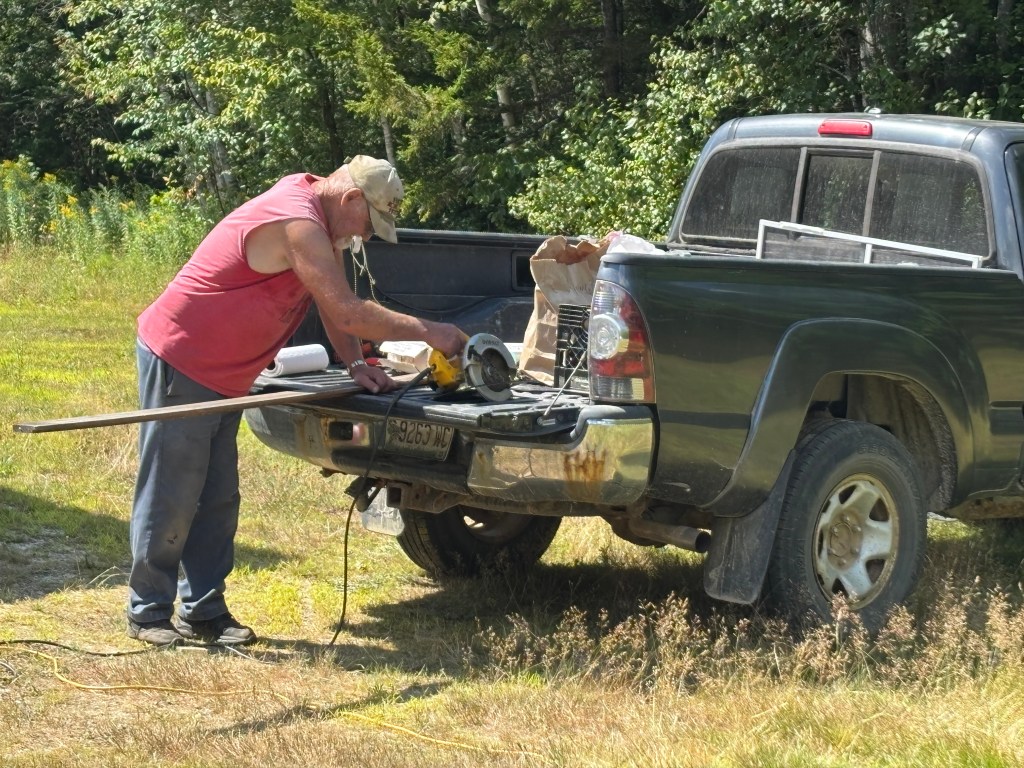
Days later, a collection of board members, family and friends, many with deep ties to customs and a station and rail yard that once employed over 100 local men, gathered to renovate the building. Fueled by hot coffee and Donna’s homemade apple buckle, sandwiches and shared stories, the crew scraped and painted the building exterior, replaced rotting trim boards and broken windows, and wired the interior.
Mary McAlaney paints museum floor Alaine Peaslee-Hinshaw replaces windows while David Brown, Donna Beach Wright and Lyn Mikel Brown paint museum exteriorMark Hyland and Faye Luppi wire the interiorEnzo Cameli scrapes the exteriorBilly Grass cuts replacement trim boardsThe end of the day and a fresh coat of paint!
Alaine, ever the organizer, is already making a to-do list for our next work day: moving the signal, repairing drywall, repainting original railway station benches, painting and moving display cabinets, researching and building exhibits. There’s still much to be done, but with the support of Morton-Kelly Charitable Trust and the passion and work ethic of so many, our goal of preserving Vanceboro’s rich railroad history is within reach.
Deepest appreciation to all the board members and volunteers who helped move the building and putt putt and who offered services and gathered, not only to revitalize and wire the MacDonald building, but to work on other museum projects:
Alaine Peaslee-Hinshaw for organizing the move and work day day, painting the building floor, and for supply, tool and task organization.
Christopher Hinshaw for repairing the museum metal door and installing new storage closet shelves
Mark Hyland for a donation request and S.W. Collins Lumber in Lincoln for the donation of exterior stain and painting supplies.
Billy Grass for leveling the building, his speedy roof trim repair and, with Cory Beach, for providing the RR track rails for the putt putt car
Faye Luppi, Mark and Matt Hyland for wiring the building.
Enzo, Sara, and Lilly Cameli for long hours scraping, painting and to Enzo for photography transfer work
Donna Beach Wright for showing up with homemade rolls and apple buckle!
David Brown, Donna Beach Wright, Lyn Brown and Mark Tappan for painting the building exterior; also Lyn and Mark for lunch item purchases and Mark for the lunch roll out.
Danny Beers and Holly’s General Store for broom set donation
George and Susan (Crandlemire) Howard for storage unit space
Elaine and Gene MacDonald for paint and use of their garage
The term “custom house” is now considered a historical anachronism, but at one time such houses were a key source of funding for the early federal government. They played an important roll collecting taxes and regulating commerce. They housed offices for the government officials and inspectors who processed paperwork for the import and export of goods and fought smuggling and revenue fraud. They were located in key seaports like San Francisco, New York and, in Maine, Portland and Bath. Vanceboro’s Custom House was a sign of the importance of the town as an international port of entry.
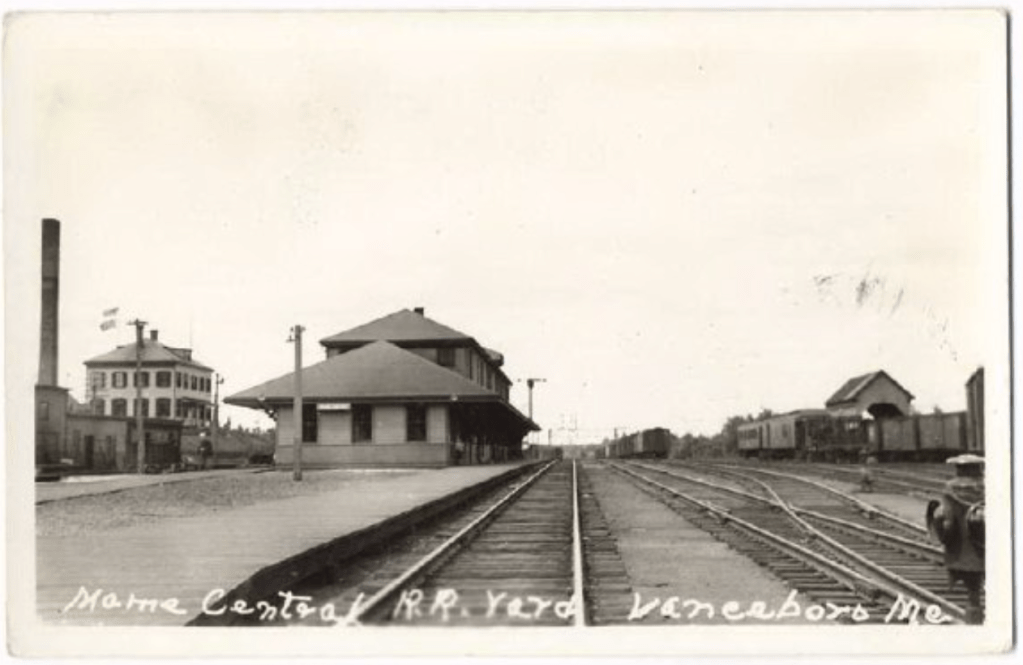
In nearly every historic photo of the railroad station and yard, the Vanceboro Custom House looms large. The impressive two story clapboard building housed offices and the second floor residence of the Port Director. The front entrance to the building was on Railroad Street. Large doors and a set of stairs at the back of the building connected the custom house to the railroad station.
This early, undated photo of the custom house from the side, shows both the front entrance on Railroad Street and the back, where stairs connect to the railroad station below. There appears to be someone climbing the outside of the building or washing windows, but scale of the image suggests more likely a flag unfurling in the foreground.
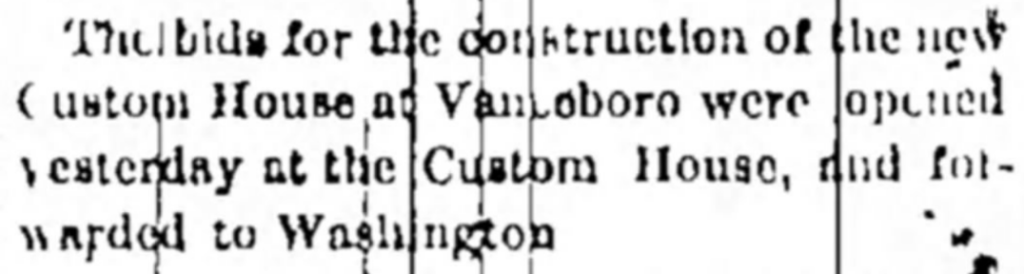
The May 29, 1884 issue of the Bangor Daily Whig and Courier reported opening bids for the Custom House had been received and forwarded on to Washington D.C.
The impressive building went up soon after, seen clearly in this 1890 photo of the first Vanceboro railway station.
After the first station burned in 1905, a second was built in the same location below the custom house.
Mary McAleney's father worked customs in the 1940s and 50's and she recalls the significance and impressive nature of the building:

"The grand building told the prominence of the port and the prominence of the Treasury Department electors. Customs was under the Treasury Department then. Immigration was Judiciary. Even I remember when they got their revenue by collecting duties and imports, before income and business taxes.

So the custom house was usually the grandest place in a town. And you look at the Portland Custom House, where it is, right there on Commercial Street. And so in Vanceboro, that was that big house up on the hill.

I remember going up to the custom house and thinking I was probably in the Capital or something. It had wide stairs, oak bannisters all polished. I remember thinking, my God, it’s just like going to see the queen. It was a beautiful building and it kind of hung on the hill and looked down on the station. Once or twice I met my dad up there and we went down the stairs to the station platform. I remember just being fascinated by those stairs because there were several stories.

Gary Beers, who lived in a duplex across the street from the custom house as a child, recalls playing in and around the building in the early 1950s.

“The lower floor of the Customs House was an office, with a hallway-lobby sort of space with huge doors front & rear. We liked to go in & creepy-mouse through, so we could go down the outside stairs to the railyard level."
Now, with air travel, the increase and complex nature of international trade and technological advances, custom houses are a thing of the past, simply beautiful historical buildings. Those in Portland and Bath have been converted for other uses. Vanceboro’s Custom House was put up for sale in 1965.
Here we lose the trail. Maybe with no takers, the building was razed. We can only imagine what might have been had the building remained its stately self. Perhaps a home for city offices, post office, a hotel, the Vanceboro Historical Society.
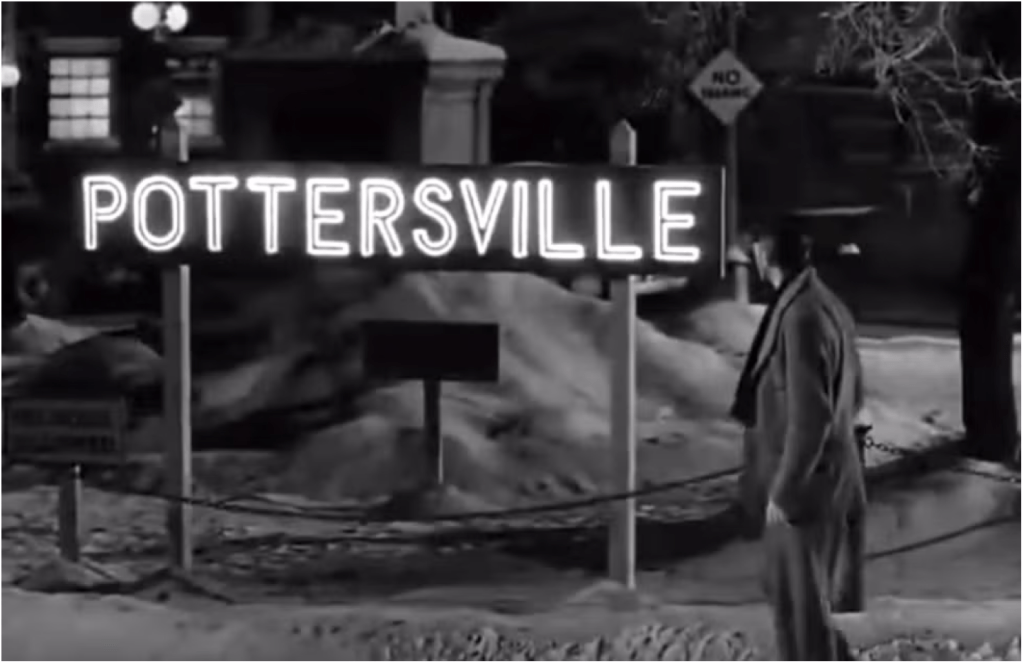
In the 1946 Christmas classic, It’s a Wonderful Life, George Bailey postpones his plans to see the world when his father dies suddenly and he is pressed to take over the family business. Bailey Brothers Building and Loan is committed to shoring up the community by lending money to families who couldn’t qualify for loans from banks to build homes and George finds himself battling the “richest and meanest man in town,” banker and slum lord, Henry Potter. After a series of unfortunate events, facing the loss of the Building and Loan, George nearly jumps from a bridge into the river. He’s rescued by an angel, Clarence, who shows George what his family and his town of Bedford Falls would be without his generosity and decency: the dark, soulless town of Pottersville.
This holiday season, we give thanks to the early citizens of Vanceboro, who withstood the efforts of the Shaw brothers, owners of the tannery, to rename the town “Shawville.”
F. Shaw & Bros
F. Shaw & Bros was a Boston firm that dominated the Maine tannery business in the late 1800’s. There were Shaw tanneries in Kingman, Jackson Brook (now Brookton), Forest City and Grand Lake Stream (formerly Hinckleytown Plantation). Vanceboro was an especially attractive location because of the railroad and the promised completion of the transcontinental European & North American Railway.
The tannery arrived in 1869 to a small collection of logging camps. By 1870 Vanceboro and Lambert Lake combined had a population of 573. In 1873, the tannery consisted of 12 machines worked by 40-60 employees and produced more than 60 tons of shoe-sole leather. Each worker was paid $8 per week. The town grew to over a thousand.
Early Vanceboro was, in essence, a Shaw Bros company town: a saw mill, a stable and blacksmith shop, a public hall, a company store. In time, there was a school, a church, a hotel and rail station. The Shaws built a number of large family homes and establishments in town. Some, like Thaxter Shaw’s off First Street, had wrap around porches and grand views of the river.
Workers, though, lived in tenement houses down on the flats, closer to the tannery. The work was difficult and dirty, the chemicals toxic. The operation dumped waste directly into the water: salt liquor from soaking skins, lime liquor used to swell skins and loosen hair, waste tan liquor, tan-bark refuse after leaching. As the business boomed, waste polluted the St. Croix and damaged the spawning beds of landlocked salmon and brook trout.
On a sunny October 19th, 1871, President Ulysses S. Grant arrived in Vanceboro to great fanfare. According to the Bangor Daily Whig and Courier, thousands arrived to watch the President drive a golden spike to dedicate the transcontinental rail line that would send goods across the border to ports in St. John, New Brunswick and on to Europe.
Depiction of Grant’s Vanceboro visit, from Ruth Holbook’s 1941 children’s book, Katy’s Quilt
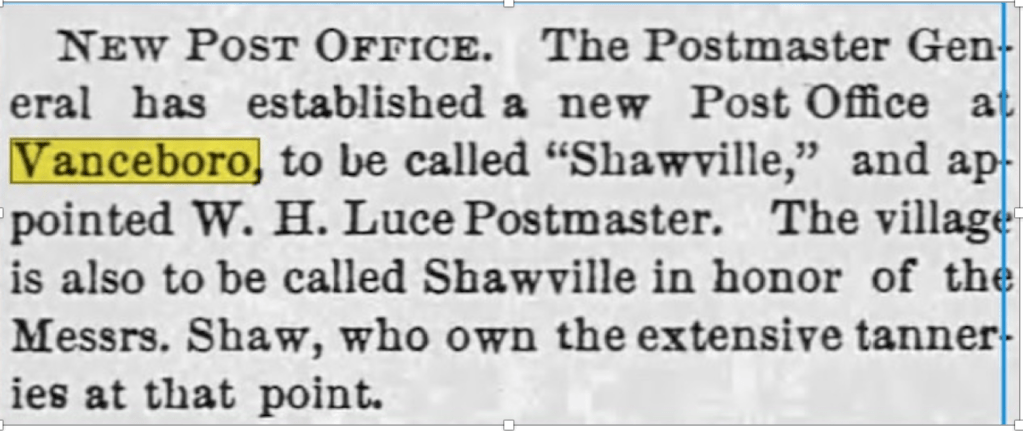
The Shaws wasted no time. Less than two weeks after the celebration, on October 31, 1871, the Bangor Daily Whig and Courier, reported the town was “to be called Shawville in honor of the Messrs. Shaw, who own the extensive tanneries at that point.”
It wasn’t to be for long. On Nov 23, 1871, the Bangor Daily Whig and Courier reports a reversal of the decision. Shawville will be Vanceboro once again.
We don’t know what happened. Maybe the change to Shawville was made illegally, a kind of entitled name grab that caught the attention of authorities? Maybe local townspeople, like those in the fictional Bedford Falls, gathered together in support of the greater good, refusing to be used as a company town by a wealthy landowner? We like to think it was the latter.
In 1874, the town was officially incorporated as Vanceboro. In 1883, the immense Shaw operations failed. Unlike other tannery towns, Vanceboro weathered the loss, in large part because of the railroad and the opportunities it offered. People bought back Shaw properties, elected town leaders, and reimagined their future.
Merry Christmas and Happy New Year to all from the Vanceboro Historical Society and the little town that could.
Among the many endeavors undertaken by the Holbrook family during their long years in Vanceboro were two large farms south of town, where they raised crops and a large herd of pure-bred cattle. The “Holbrook Farms” were purchased first by E.T Holbrook, and then turned over to his son, E.A Holbrook in the early 1900s.
G.T. Holbrook, E.T.’s grandson (his father was Harry Holbrook, his mother was Georgia Peva Holbrook) also lived on the south side of town with his wife Agnes (Therriault) on a lot just past the cemetery. He purchased an Aladdin Kit Home, the “Newport,” which was shipped in parts on the railroad from the Aladdin Company in Bay City Michigan. G.T. Holbrook assembled the house in 1931. Alaine Peaslee-Hinshaw and Christopher Hinshaw bought the home they now call Wild Field Farm and several acres of land in 2018.
The Holbrook family loved spending time on their land—their “homestead”–which stretched from what is now Holly’s store (originally E.A. Holbrook Dry Goods) all the way down Farm Road to the river at Wingdam Island.1 When creating a Holbrook family display for the Historical Society museum, Alaine discovered an album with photos of the family’s favorite picnic spot, “Holbrook Grove,” on the river bank across from Wingdam Island.
Printed on the photo: Holbrook Grove, Vanceboro. The caption along the bottom reads: “Old Picnic Ground on St. Croix River. Foot of Wingdam Island”
“The old road through the woods to Wingdam is our favorite walk,” Alaine said. “Their favorite picnic spot on the river bank across from Wingdam is our favorite spot!”
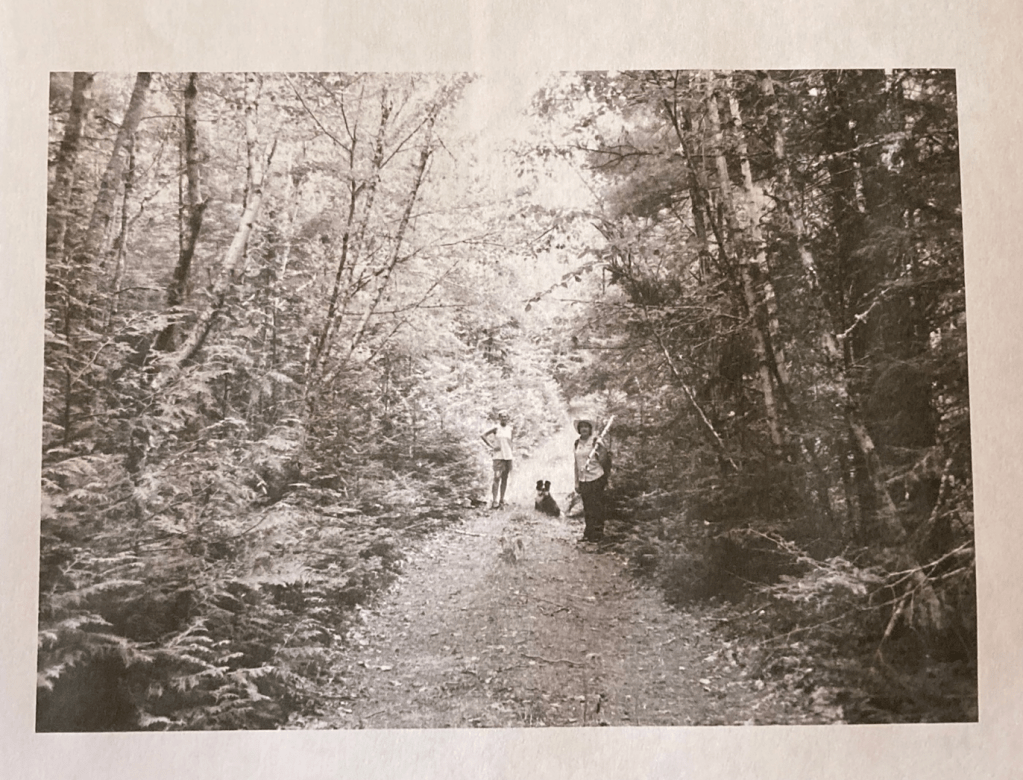
Alaine was inspired to recreate one of the Holbrook photos. She posed her friend, Sara Cameli (a Susee descendant) with herself and her dog Inka in the exact spot Agnes and G.T. stood along the pathway to the picnic area. Sara’s daughter, Lilly, took the picture. “We love the way the past and the present blur in these photos,” Alaine says. “It feels like a ghost story to me. Holbrooks, Hinshaws…the Holbrooks referred to their land as “the homestead,” which is what we call it!”
Agnes and G.T. Holbrook on the path to their favorite picnic spot, early 1900sAlaine Peaslee-Hinshaw, Inka, and Sara Cameli in the same spot, 2024.
__________________________________________
The island’s name invokes a “wing dam,” a river-driving term referring to a barrier that, unlike a conventional dam, extends partway into a river, forcing water into a fast-moving center channel while slowing water flow near the bank. ↩︎
The currently best-remembered Vanceboro School was built in 1925 at a then cost of $30,000 ($543,724.86 in today’s currency). The town population at that time was about 600, with more than 180 students in attendance.
It was a two-story Greek-revival style building that included all, then-modern, improvements such as steam heat, electric lights, running water, and electric ventilating system. The rooms were large, well-lit, finished in varnished dark wood with walls of light and dark green.
The first story was one large room separated by folding doors separating 1st & 2nd grade at the front from 3rd-6th to the rear. The doors, when opened, became a large auditorium for school entertainments. Grades 7-8 occupied the 2nd story front, with one large and one smaller room to the rear for the High School. The sidewalls in each room were configured as a cloakroom for winter coats and boots.
The toilets, lavatory, boiler room, and chemistry lab were in the basement. Entry/exit was restricted to boys on the left and girls on the right. The playground at the rear, not shown, contained a merry-go-round, slide, swings, and gym rings. Basketball was played in the Knights of Pythias Hall across the street.
The back of the Vanceboro school. The Knights of Pythias Hall is to the left, across Third Street. The hall was used for community events as well as school dances and basketball games.
The daily schedule in later years had classes starting at 8:30 a.m.; two 15-minute recesses (upper & lower schools) between 10:00-10:30; a 30-minute lunch period whereupon students walked home (uphill in the snow both ways); ending at 3:00 p.m. From 2:30 p.m., high school students were expected to study and prepare for the next day’s classes.
Of note is the seven on five high school class schedule used, at least the last many years. In order to offer enough credits so students could earn sufficient for graduation, seven class period subjects (times two for the two teachers) were planned. However, there were only five actual periods in the school day, so the schedule looked like this:
1st Day: 1,2,3,4,5
2nd Day: 6,7,1,2,3
3rd Day: 4,5,6,7,1
4th Day: 2,3,4,5,6
5th Day: 7,1,2,3,4
6th Day: 5,6,7,1,2
7th Day: 3,4,5,6,7
REPEAT
The last graduating high school class was 1967 with, thereafter, grade 9-12 students attending Lee Academy or East Grand High School. The elementary school was moved to an all-new facility on High Street in 1993 (closed permanently in 2016 and is now a town facility and home to the Vanceboro Historical Museum). The hall and school were subsequently demolished, and the town fire station occupies the school grounds.
A VENERATED, ICONIC EDUCATOR
It should be no surprise that one truly special teacher taught there for its entire existence. Madeline Hazel Field.
Born in Vanceboro on August 11, 1901, to Lewis A. & Mary C. (Sullivan) Field, she attended the local schools, graduating in 1919. She then passed two years at the University of Maine and began a teaching career at high schools in Columbia Falls, Jonesport, Harrington, and Caribou.
Continuing her education with summer classes, she began what became a life’s work as a high school assistant in the new Vanceboro High School when it opened in 1925, ending when it closed in 1967. She was awarded her bachelor’s degree from the University of Maine in 1933. She also became a full member of the American Association of French Teachers.
Teaching English, Latin, and French, her faithful and efficient work earned her the esteem of parents and students during her entire tenure. Her no-nonsense demeanor and instructional delivery gave her students a solid linguistic foundation. She passed away May 3rd, 1973, an exemplary personification of “Teacher.”
On Oct. 1, 1886 George W. Ross of Vanceboro Maine received a five year lease on the Junction House in McAdam, New Brunswick.1
The two story building to the far left, in the distance, is the Junction House hotel. The large building in the center is the New Brunswick Railway Station. In 1885, the Junction House was located between the north and east railroad tracks, close to the current tunnel.2
Mr. Ross was well known in Vanceboro and had many business interests. In January 1887 he became the proprietor of the Vanceboro Dining Hall (the railroad station restaurant and hotel) by purchasing all of the furniture and furnishings from his uncle, Michael Ross.3 He appointed Mr. Frank L. Thurber of Bangor to manage the Hotel in McAdam. Dan Bishop also managed the Hotel in McAdam for a time after Thurber.
The St. Croix Courier of August 1886 states that Ross planned to connect the two hotels with a telephone line.4 The Courier of May 30, 1889 confirms the telephone line was in use at this date.5 This may have been the first telephone connection out of McAdam. The Courier of Nov. 4, 1886 tells of a grand re-opening party at the Junction House.6 A special train with a large party from Vanceboro arrived in McAdam at 5:30 p.m. The evening began with a large meal followed by speeches given by Mr. Johnson and Mr. Sprague of Vanceboro, and Mr. Steves of Bangor. Mr. Watts of McAdam delivered a talk on the History of McAdam from 1871. There was singing by the railroad manager, Mr. Cram, and Mrs. Conley, with music provided by the Vanceboro Brass Band. Mr. Moreau of Vanceboro was the master of ceremonies.
Mr. Ross owned an 18 acre vegetable farm in Vanceboro. The produce was used to supply his hotels. George Ross was also a pig farmer and is mentioned in American Berkshire Record‘s ”Index to Owners”:7
Ross, George W., Vanceboro Me.
Boars:
* Cato of Riverside, Registry #: 25655
Sows:
* Juno of Riverside, Registry #: 25656
* Minnie of Riverside, Registry #: 25657
A Guest Book from the Junction House, the only known artifact of this hotel, is currently on display at the McAdam Train Station. Dated April 28, 1887, it reads “Geo. W. Ross Proprietor,” in the upper right corner. The Guest Book date for April 27, 1887 has an entry for Sir Leonard and Lady Tilley of Fredericton. Tilley was one of the Fathers of Confederation and at that date held the position of Lieutenant Governor of N.B. George W. Ross retired from operating the Junction House on Oct, 1, 1891.8
– Proprietor of a confectioner shop and filling station
– Postmaster General, Vanceboro
George Ross’s business life is one example of how the communities of Vanceboro and McAdam have been linked in many ways over the past 150 years. Ross ran the Junction House in the heyday of the small New Brunswick and Canadian Railway, just before it was bought out and transformed by the Canadian Pacific Railway.
Ross’s most famous arrest was the a German Spy, Werner Horn, who tried to blow up the Railway bridge connecting Vanceboro and St. Croix New Brunswick. This arrest received international attention on both sides of the Atlantic. ↩︎
Additional references:
Maine Register Or State Yearbook and Legislative Manual 1891 (free google book ), page 743
Court Directory and Court Officers , Washington Co. Maine , 1925
Vanceboro shared a serious piece of world history when it hosted, at the railroad station, the British Balfour Mission delegation.
The Mission, also referred to as the Balfour Visit, was a formal diplomatic visit to the United States by the British Government during World War I, shortly after the United States’ declaration of war on Germany (1917).
The mission’s purpose was to promote wartime cooperation, and to assess the war-readiness of Britain’s new partner. British Foreign Secretary Arthur Balfour, President Woodrow Wilson and chief advisor, Colonel Edward House, had a meeting that discussed the secret treaties which bound Britain and France to Italy and the proposed Balfour Declaration.
The Declaration was a public statement issued by the British Government announcing its support for the establishment of a “national home for the Jewish people” in Palestine, then an Ottoman region with a small minority Jewish population. The declaration was made in a letter dated 2 November 1917 from the Foreign Secretary Arthur Balfour to Lord Rothschild, a leader of the British Jewish community, for transmission to the Zionist Federation of Great Britain and Ireland.
The declaration had many long-lasting consequences. It greatly increased popular support for Zionism within Jewish communities worldwide and became a core component of the British Mandate for Palestine, the founding document of Mandatory Palestine. It indirectly led to the emergence of the State of Israel and is considered a principal cause of the ongoing Israeli–Palestinian conflict, often described as the world’s most intractable conflict.
Foreign Minister Arthur Balfour’s Issued Declaration
The American Commission at the Vanceboro Station, April 21, 1917
Generals George Leonard Wood, Robert Edward Lee Michie, Robbins, Admiral Frank F. Fletcher, and others2
Assistant Secretary of State Breckinridge Long greeting Foreign Minister, the Earl, Arthur James BalfourThe combined parties start for Washington
Footnotes
Balfour, Arthur James, and Oliver Wendell Holmes Collection. The Balfour visit: how America received her distinguished guest. Edited by Towne, Charles Hanson New York: George H. Doran Co, 1917. Pdf. https://www.loc.gov/item/17030750/. ↩︎
George Warren Ross was, at various times in his life, a proprietor, postmaster, game warden, a state detective and the town’s deputy sheriff. He ran the railroad hotel and restaurant, owned a confectionery and ice cream shop, had an interest in the roller skating rink, co-owned the Armstrong Picture House, and ran a filling station. George, one might say, was a big bass in a small pond.1
Ross moved to Vanceboro before the town incorporated in 1884, even before President Grant himself opened the European & North American Railway in 1871. Born on July 11, 1858, the oldest of five, the son of a latch mill worker in Winn, Ross was fifteen when he was sent to apprentice as a clerk at his uncle, Michael L. Ross’s railroad hotel and restaurant. In 1882, twenty-four years old, he married Mary Bishop from Prince Edward Island and two years later welcomed his first child, a son named Warren.
Warren died in infancy and it appears Ross threw himself into work and community. In 1887 he bought out his uncle’s interest in the hotel and restaurant and then ran the whole affair for another nine years. He nurtured his various dealings and properties, accepted the role of postmaster general, then deputy sheriff and took to the rails as a state detective, ferreting out petty thieves traveling the dinky from Vanceboro to Bangor. During the summers he travelled with different circuses as a legal adjuster. By the time Mary delivered a daughter, Marion, twelve years later, in 1896, George had built them all quite a successful life.
At forty, George W. Ross joined the Maine Warden Service. It was 1898, and a slew of new game laws had just come into effect. As deputy sheriff, he already had the power to arrest poachers, but the additional warden pay plus half the fines and all the carcasses for each conviction would have made the job especially appealing. Within a year he was in an all-out battle of wits with notorious poacher George Magoon.
In some obvious ways, the two Georges were a lot alike. They married the same year. Both jumped into family and community life. Both were short and stout with clear moral principles and endless energy for the things that mattered to them. Persistent, determined, and enterprising, each in their own fashion, it seems, was larger than life.
They were also different. George Magoon was nineteen when he bought a hardscrabble farm near Love’s corner in Crawford, a full fifty miles south of Vanceboro. He didn’t have much as a kid, but he was no stranger to hard work. At twenty, he married Etta Love and together they had seven children. They raised cattle and pigs, tended a big garden and a large apple orchard. Magoon worked the lumber camps in the winter, the river drives in the spring, and he hunted year round for food and profit as was his right, or so he felt.
Ross and Magoon met on the Crawford battlefield for the next seventeen years. Ross shot Magoon’s best deer dog, arrested him for hunting, issued search warrants for his property, and resorted to clever entrapment schemes. Magoon thwarted Ross at every turn, escaping from the Machias jail, enlisting lawyers to fight Ross’s harassment and entrapments, and with the help of his many loyal friends, evaded Ross more often than not.
Nonetheless, George W. Ross’s dogged determination landed him the chief game warden job and newspaper headlines. The winter of 1915, when he announced his upcoming retirement he was the darling of the warden service and the press. The local edition of The Maine Woods sent him home strutting like a rooster. “Famous as a Game Warden” the title of the article announced.3
“Chief among his assets is his versatility. He can give a horse thief a good start and then catch him, trim out the cleverest scheme which the poachers of his county have invented; drive one horse or a dozen, run a circus, hunt and fish, tell stories of the woods galore, and take a hand in politics when necessary.”
The article continues. “When he went into the warden service, Washington County was regarded as a hotbed of poaching. The game laws were regarded as of little consequence. Scarcely a train or boat left the county which did not contain game or fish which was being cut contrary to law. Warden Ross, largely through his vigilance, put an end to the practice.
Warden Ross has ferreted out, in the course of his official career, a number of the daring poachers and has been over long and circuitous trails to their hiding places. Though the mission has been fraught with some danger, he has invariably landed his man.”
Given the chance, George Magoon, who was still poaching deer and moose after Ross’s retirement might have told a different story.
On January 30, 1915, German reservist Werner Horn, dressed in a rough coat and cap, stepped off the train from Boston. The Great War was on. Canada was engaged, but the United States had not yet entered. Horn immediately drew attention in Vanceboro. Two young people, Mr. Hunter and Miss Armstrong, reported seeing him place a large brown suitcase behind a woodpile before walking toward the railroad bridge. Questioned by an American immigration inspector, Horn identified himself as Olaf Hoorn and explained that he was Dutch businessman looking to buy property.
Horn stayed a few days at the Exchange Hotel, run by a twenty-six year old Aubrey Tague and his sister Bertha. The German checked out on a frigid cold evening of Feb 1 and instead of catching the train to Boston made his way to the bridge. At 1:10am that next morning, a loud blast woke the community. Windows broke in a number of homes and businesses, including the hotel. People thought it must be a steam engine accident or an explosion in the heating plant. Deputy Sheriff Ross, it seems, did not get up to investigate.
When, soon after the explosion, a near frozen Horn returned to the Exchange Hotel, a suspicious Aub Tague put on his coat and followed the man’s footprints across First Street and down the hill to the railroad tracks. At the pump house he met Fred Mills and a few other station workers. The stink of burnt sulphur still in the air, he relayed his suspicions. Someone called the superintendent of the Maine Central railroad in Mattawamkeag who called the border patrol who called the Canadian authorities who called the county sheriff. After sorting through the international bureaucracy, deputy sheriff George W. Ross, it seemed, was the local man in charge.
Ross and two Canadian constables marched up the hill to the hotel, where Tague directed them to Horn’s room. Ross arrested Horn and led him to the station’s immigration holding cell. There he learned further details of how Werner Horn, first lieutenant of the German army, sent from Central America to Vanceboro to prevent war supplies from traveling through the United States to St. John and overseas, had attempted to sabotage the bridge with eighty pounds of dynamite. Because the bomb exploded on the Canadian end of the bridge, however, Ross’s only choice was to charge Horn with illegal transfer of explosives and mischief for breaking windows in Vanceboro.
Werner Horn (left) and deputy sheriff George W. Ross, February 4, 1915.
Word spread fast and by that afternoon crowds from both sides of the border were gathered outside the building, clamoring for information and justice. A World Wide News crew arrived by train the next morning. There to greet them in his best suit and tie was George, mustache and hair neatly combed, badge shining bright on his lapel, a silk handkerchief in his breast pocket. He alone posed for pictures alongside a stunned Horn. Asked to re-enact the arrest, George complied. Captured on film by a young newsreel cameraman from Boston, Louis de Rochemont, the incident made national news.5
After a time, George received a personal copy of the World Wide Web news reel in the mail. When friends visited, he directed Frank Gatcomb, the projectionist at the Armstrong Picture House, to play the film as a short before the feature. His deputy sheriff star gleaming, his shoulders back, a determined look on his face, the audience cheered George as he rushed the hotel room, threw open the door, drew his big horse pistol and arrested the German saboteur. When the newsreel ended, Frank, on cue, turned up the house lights and George stood and took his bow. It must have been everything a millworker’s son could dream of.
George and the Big Shows
Mary Ross, George’s wife, died in 1920. George continued to travel the United States and Canada by rail as an advance man and legal adjuster for circuses like Hagenbach & Wallace and Howe’s Great London. When a show came to town, people said, he walked around with fifteen or twenty passes, handing them out to all his friends.
“George W. Ross of Vanceboro, the well known detective and deputy sheriff, arrived in Bangor Tuesday after leaving Howe’s Great London Circus in Alabama….Mr. Ross is looking younger and more cheerful than ever, even after his little jaunt over the face of the earth of 25,000 miles, visiting 25 states and five different provinces of Canada since joining the circus as detective last March….”
Vanceboro’s Deputy Sheriff to the End
Throughout his life and into old age, George W. Ross immersed himself in Vanceboro. He was a member of the Knights of Pythias and a Free Mason, attending the Baskahegan Lodge in Danforth, and was a contemporary of early town business leaders such as Stillman Armstrong, E.A. Holbrook, and Horace Kellogg.
A Knights of Pythias gathering. George Ross, 2nd from left.
No one knows when or where George W. Ross became known as Pooch. But one can well imagine why. Ross plied his skills sniffing out poachers at home and Vanceboro was a dry town in Ross’s time. Plenty of local characters tried his patience, shooting deer out of season, making home brew to get through the long winters, smuggling spirits across the border, fighting or generally causing a ruckus. The dogged little man with the bushy white hair and side burns, wide girth and sharp bark, had been hot on their trails for years.
Ross’s Good Gulf Gasoline Filling Station
Travel and adventure behind him, George settled into his life in Vanceboro. He ran Ross’s Good Gulf Gasoline filling station on the convergence of Railroad, Water Street and Salmon Brook Road and lived with his daughter, Marion. In early 1933 he was reappointed, at 74, the oldest deputy sheriff in the state.
“Mr. Ross has completed 40 years of continuous service in the office and has the distinction of being the oldest deputy sheriff in the state, his first appointment having been in 1893….His greatest achievement in criminal arrests was the capture of Werner Horn, the German reservist who blew up the C.P. Ry. bridge over the St. Croix River between Vanceboro and McAdam, N.B. on the morning of Candlemas Day, 1915. This episode was the subject of nation-wide newspaper comment at the time and a movie reel was produced showing Werner Horn and his captor…. Mr. Ross has also traveled widely with several different circuses as a legal adjustor until his health required him to lead a quiet life at his hometown. He is now conducting a filling station in plain view of the railroad bridge where Horn made the town famous to all readers of war news.”
George Warren Ross died on September 13, 1933. The funeral service was, his obituary says, “largely attended and the floral offerings were profuse and beautiful.” He is buried beside his wife Mary in the Vanceboro Cemetery.
Footnotes:
Local observations of Ross are attributed to Lindy Brown (1922-2006), who shared memories of the deputy sheriff with his family. ↩︎
Much of the information in this section has been gleaned from the Sandy Ives book, George Magoon and the Downeast Game War. University of Illinois Press, 1993. ↩︎
Maine Woods, Vol. 37 Issue 46 – June 10 1915 (Local Edition) ↩︎


















 Vanceboro Historical Society