
Basketball Scoreboard
c. 1930–1940
Locally constructed of plywood for Vanceboro school basketball games, this hand-crafted scoreboard uses hinged tin plates to display changing scores. Its repurposed materials and block-letter signage reflect the resourcefulness of small-town athletics in mid-20th-century Maine.
Hung on the first floor of the Knights of Pythias Hall, locals remember a wood fired stove in the corner, surrounded by a wood and chicken wire cage to protect players. Time out was called when the ball landed on top of the cage. There was a clear home court advantage–visitors struggled to make a basket while avoiding the low ceilings.

Anchor from the Alice May
St. Croix Log Driving Co.
c. early 1900s
This anchor belonged to the Alice May, a 38-foot sternwheeler used on Spednic and Palfrey Lakes to tow log booms to the St. Croix River for the spring drives to Milltown and St. Stephen. Powered by twin 55-horsepower engines and carrying five cords of hardwood fuel, the Alice May served Vanceboro’s lumber economy until towing ended in 1912. Parts of the boat were later reused to power a sawmill in Cottrell.
Reference: History of McAdam, 1871–1977, p. 141; W. A. Redstone.

Bat and Glove
c. 1900
Glove and trademarked “Stillman Armstrong Vanceboro Maine Three Bagger Model No.74” baseball bat crafted by Stillman Armstrong’s Wooden Ware Company, located on the Vanceboro shore of Spednic Lake.
Donated by Harold Scribner

Train Order Hoop
c. 1885–1900
Before radio communication, Vanceboro station agents used tools like this to pass written train orders to moving locomotives on the St. Croix line. The engineer reached out and caught the wooden loop as the train passed, pulling off the attached order without stopping.
This early bent-wood style was common on rural Maine and Canadian border lines in the late 19th century.
Gene Macdonald collection

Handmade Wooden Toy Locomotive
c. 1920–1935
A hand-carved toy engine modeled on the steam locomotives that ran through Vanceboro in the early 20th century. Crafted from scrap lumber and fitted with metal rods and straps recycled from household materials, it reflects the homemade toys common in rural Maine between the First World War and the Great Depression.
Gene Macdonald collection
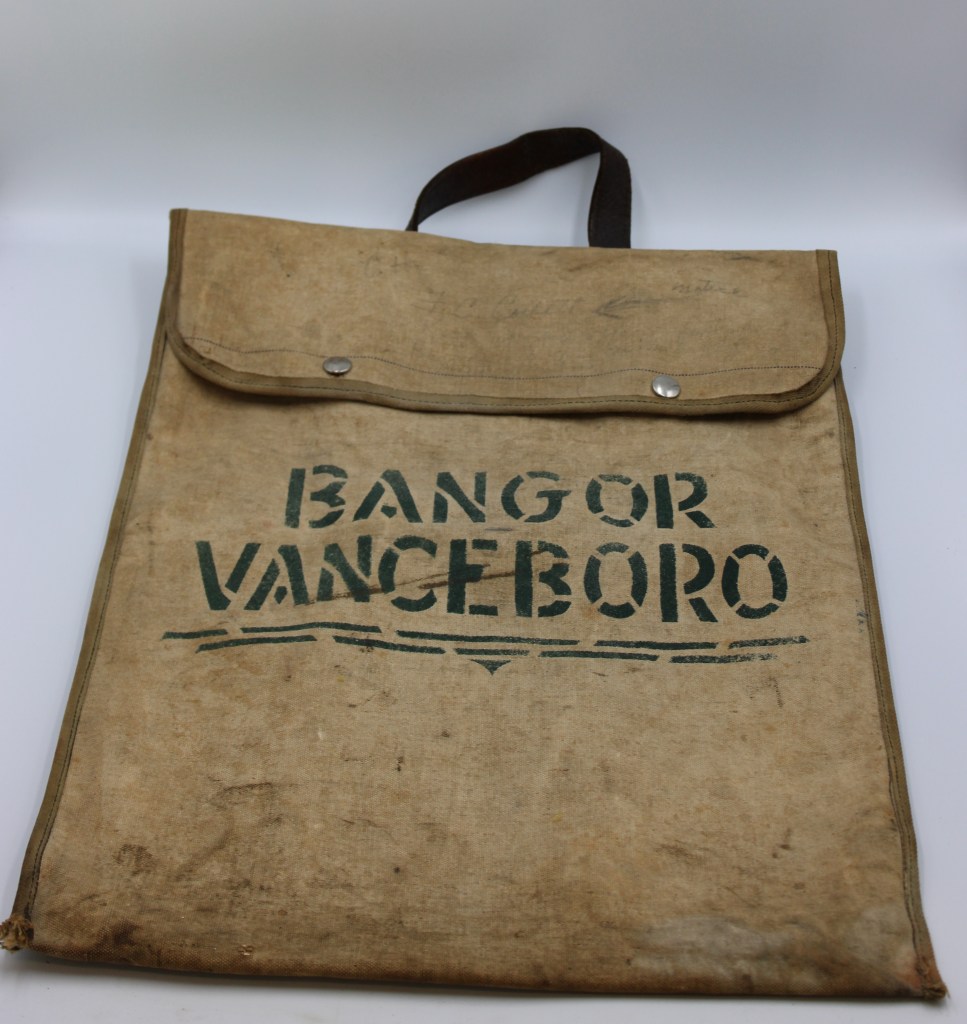
Railway Mail Pouch
c. 1930–1960
A mid-20th-century mail pouch used on the Bangor–Vanceboro rail line for transferring letters and postal bundles between stations and Railway Post Office cars. Its heavy canvas construction, snap closure, and route stencil reflect the practical equipment used in daily mail exchange on Maine Central and Canadian Pacific trains serving Vanceboro.
Gene Macdonald collection

Railroad Kerosene Lantern
c. 1920–1940
This kerosene lantern is typical of the lighting used by railroad workers for signaling, switching, and night operations during the early 20th century. Its wire-guarded globe protected the flame in harsh weather, while the wide base held enough fuel for long shifts along the rail lines. Lanterns like this were standard equipment for train crews and station agents on the Maine Central and Canadian Pacific lines serving Vanceboro.
Gene Macdonald collection
 Vanceboro Historical Society