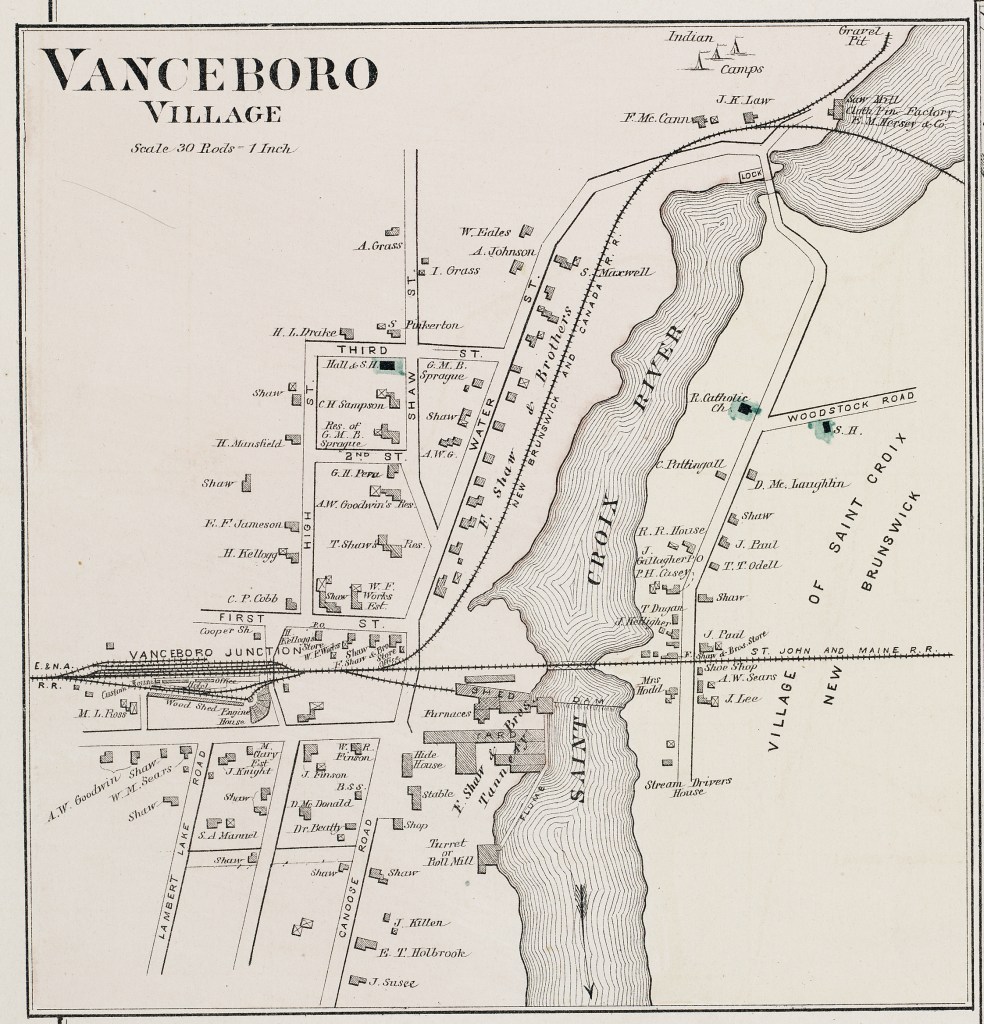
Vanceboro is located at the outlet of Spednic Lake, what the Passamaquoddy call Espotonek or the “high mountain lake,” and the headwaters of the west branch of the Skutic, or the St. Croix River. In the 1820s, Squire William Vance staked claim to Passamaquoddy homeland. A group of log cabins, in the nature of a combination logging camp and trading post, was named after Vance, himself. In 1836, he constructed a dam designed to sluice logs into the river, flooding Passamaquoddy summer gathering grounds and ancient canoe routes.
Some forty years later, the promise of transcontinental rail passage across the St. Croix enticed F. Shaw Brothers to build a tannery. A saw mill, stable and blacksmith shop, public hall, and a company store gave birth to a mill town and soon after, more houses, a school, a church, a hotel, a rail station. All anticipating that sunny day in October 1871 when President Grant stood beneath an emblazoned arch – “The West Salutes the East” – and dedicated the European & North American rail line. Trains began lumbering through Vanceboro, then the hub of the “Great International Railroad,” connecting the deep harbor of St. John west through Vanceboro to Montreal and south to Boston and New York.
The tannery did not survive the panic and recession of 1873, but the railroad ensured the growth of a prosperous little village. Vanceboro incorporated as a town on March 4, 1874, anchored by an impressive railroad station nestled along the tracks. After the first station burned in 1905, a new one took its place, complete with a hotel and restaurant, a telegraph office, business offices, custom house, a wide station platform. Trains traveled east and west along track co-owned by Maine Central and Canadian Pacific. Passengers and freight traveled through the railroad station every twenty-five minutes. The mile long yard, ten tracks deep, boasted a six-engine roundhouse, carknocker shop, water tower and pump house, icehouse, and livestock pens.
Over the next fifty years, hotels, restaurants and stores sprang up; a shoe factory, taxidermy shops, a blueberry processing plant, lumber mills, a roller rink, silent movie theater, schools, churches, civic societies and an impressive baseball field that hosted town and semi-pro teams from both sides of the border.
Vanceboro flourished through the Great War and remained strong through the Depression and World War II. When automobiles replaced passenger trains and trucks replaced freight trains elsewhere, Vanceboro depot continued to thrive. Only when Maine Central discontinued passenger trains in 1960 and Canadian Pacific discontinued passenger train stops in Vanceboro did the town struggle. The train station was largely dismantled. Though much smaller today, Vanceboro holds a rich history and deep pride of place.
 Vanceboro Historical Society