Among the many endeavors undertaken by the Holbrook family during their long years in Vanceboro were two large farms south of town, where they raised crops and a large herd of pure-bred cattle. The “Holbrook Farms” were purchased first by E.T Holbrook, and then turned over to his son, E.A Holbrook in the early 1900s.
G.T. Holbrook, E.T.’s grandson (his father was Harry Holbrook, his mother was Georgia Peva Holbrook) also lived on the south side of town with his wife Agnes (Therriault) on a lot just past the cemetery. He purchased an Aladdin Kit Home, the “Newport,” which was shipped in parts on the railroad from the Aladdin Company in Bay City Michigan. G.T. Holbrook assembled the house in 1931. Alaine Peaslee-Hinshaw and Christopher Hinshaw bought the home they now call Wild Field Farm and several acres of land in 2018.
The Holbrook family loved spending time on their land—their “homestead”–which stretched from what is now Holly’s store (originally E.A. Holbrook Dry Goods) all the way down Farm Road to the river at Wingdam Island.1 When creating a Holbrook family display for the Historical Society museum, Alaine discovered an album with photos of the family’s favorite picnic spot, “Holbrook Grove,” on the river bank across from Wingdam Island.

“Old Picnic Ground on St. Croix River. Foot of Wingdam Island”
“The old road through the woods to Wingdam is our favorite walk,” Alaine said. “Their favorite picnic spot on the river bank across from Wingdam is our favorite spot!”
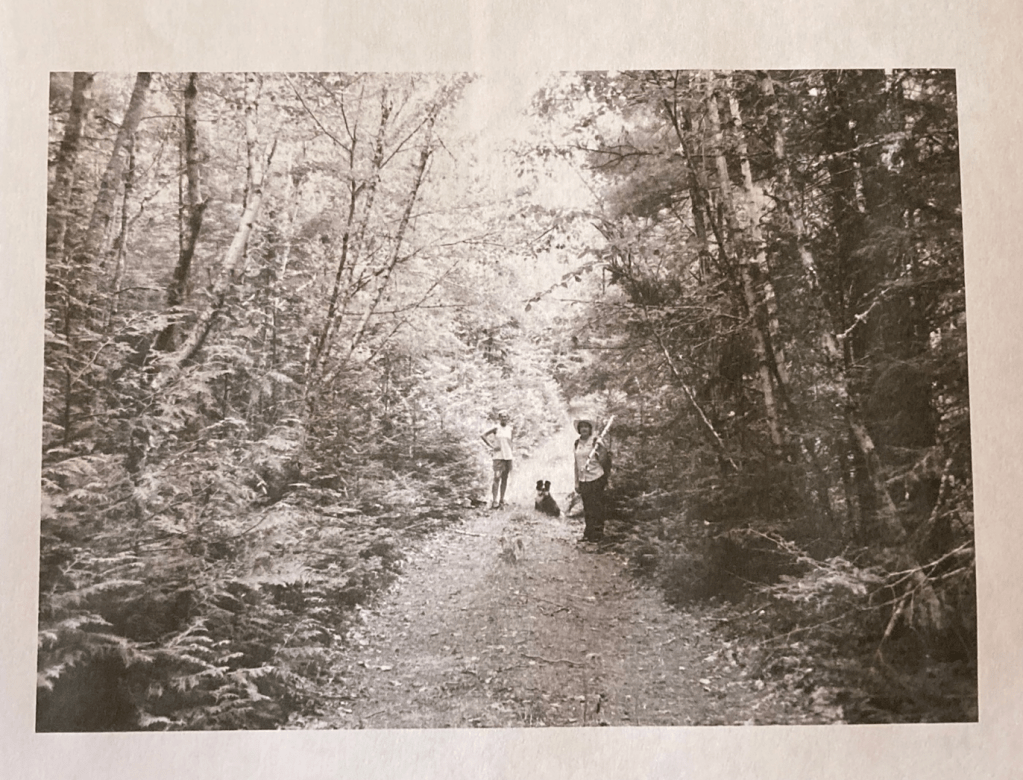
Alaine was inspired to recreate one of the Holbrook photos. She posed her friend, Sara Cameli (a Susee descendant) with herself and her dog Inka in the exact spot Agnes and G.T. stood along the pathway to the picnic area. Sara’s daughter, Lilly, took the picture. “We love the way the past and the present blur in these photos,” Alaine says. “It feels like a ghost story to me. Holbrooks, Hinshaws…the Holbrooks referred to their land as “the homestead,” which is what we call it!”

__________________________________________
- The island’s name invokes a “wing dam,” a river-driving term referring to a barrier that, unlike a conventional dam, extends partway into a river, forcing water into a fast-moving center channel while slowing water flow near the bank. ↩︎

 Vanceboro Historical Society