Part 1: Vanceboro Doctors by Alaine Peaslee-Hinshaw1
Vanceboro, Maine, and McAdam, New Brunswick, Canada have long been good neighbors. There was once a time when Vanceboro was the larger of the two, with village doctors who travelled to McAdam when needed. Then the tides turned.
When McAdam was first settled between 1857 and 1869 as a collective of lumbering camps alongside the Canadian railroad line, there were no roads into the settlement, so if a doctor was needed it was necessary to take a section handcar and pump the six miles to Vanceboro, then a much larger place.2 By 1871 the village of Vanceboro had grown to include thirty-six frame houses, fifteen log dwellings, two hotels, two stores, a schoolhouse and a public hall.3 The population of Vanceboro in 1880 was 381, and 870 in 1890.4
For many years, Vanceboro had resident, medical practitioners. Several doctors’ names have surfaced although their exact dates of practice remain incomplete. An 1881 town map shows Dr. Beatty’s residence on Salmon Brook Road, where Curtis & Cindy (Crandlemire) Scott live today.5 Dr. Gregory Arvide Martin, “Doc Martin,” born 1842 in Quebec, Canada, married to Rachel A. Mitchell, was living and working in Vanceboro in 1910. He died in Massachusetts in 1915, at the age of 85.6 A Dr. Green is also mentioned as a resident doctor of Vanceboro.7
The 1907, the Maine State Legislature Board of Health Secretary’s Report indicates Dr. Melvin L. Young practiced in Vanceboro in 1905. Dr. Young was from Oak Bay, N.B., Canada, and his obituary states that he “came to Vanceboro and at Lambert Lake to practice about 56 years ago, being highly esteemed in this village and at Lambert Lake. He was also interested in public affairs, was a trustee of the Methodist Church, and served capably as superintendent of schools.”8
Dr. Young married Mina Johnston and eventually practiced medicine with her nephew Dr. Stillwell Johnston. Lyn Mikel Brown, grandaughter of Carrie Mansfield Brown, who lived across the street from the Johnston home, has a watercolor of three roses painted by Mina Johnston Young and given to Carrie as a gift.
After Mina’s death, Dr. Young practiced in Wisconsin during his later years. He died in Ashland, Wisconsin at age 85.9 In 1906, Dr. Young was appointed a health/medical related inspector to the inspection station during the 1907 small pox outbreaks in Maine and New Brunswick, Canada.10
Dr. Melvin L. Young is quoted as saying that 300 people a day were crossing the border. Doctor Johnston was cited in the 1907 Maine State Legislature’s annual report as also working in Vanceboro alongside Dr. Young during the small pox epidemic. This meant he and Dr. Johnston were on duty every day. 11
Dr. David Hunter provided medical care to the Vanceboro railroad staff in the 1940s. His office was located beside what was known as Val La Blanc’s garage, on the corner of Water and Salmonbrook Road. As part of his job, he also offered medical care to prisoners that were traveling on the train as requested by Immigration Officers. In addition, Dr. Hunter saw residents living in Vanceboro as needed (personal communication by Joy Leech as communicated by Moe Raye, father, December 2023).
Dr. Hunter is also recorded as having operated a Children’s vaccination clinic in Vanceboro in 1941. Records indicate he moved his family and practice to Mattawamkeag in 1948 but continued patient visits to Vanceboro for a time. He was married to Sarah Smith and died in 1949.12 Former Vanceboro resident, Sandra Clendenning La Brecque, recalls her mother quoting Dr. Hunter as saying, “You take this pill, you see, you see, and if it don’t do you any good it won’t hurt you.”
Dr. Francis O’Keefe began his practice in McAdam in 1952 and was the last local doctor to attend Vanceboro residents on a regular basis. Like those before him, he was respected and provided expert compassionate medical care. Removing fishhooks was a speciality, a valuable skill to both the community and visitors. During one home visit to an elderly person, Dr. O’Keefe asked a family member for two shots of brandy – one to cure the person and one for himself.13
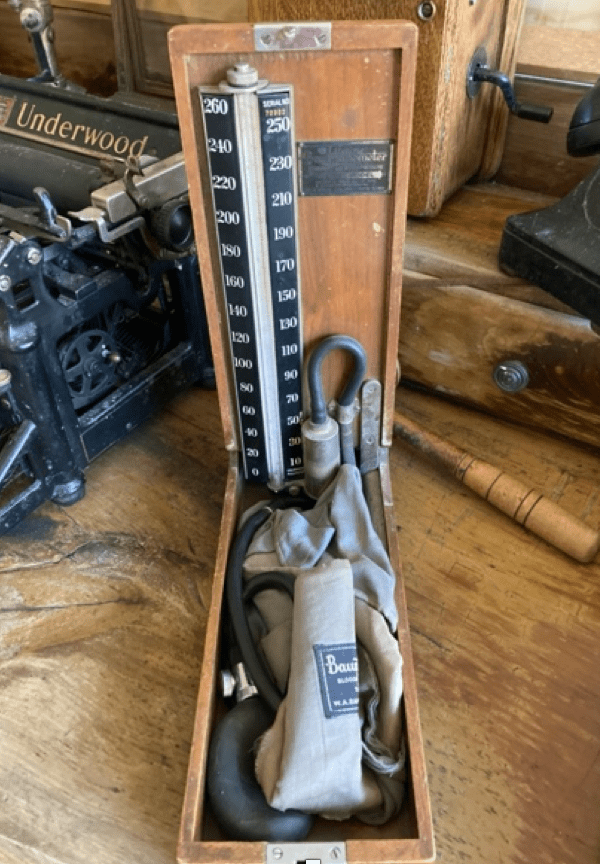
The Society also has a draft of Dr. Keefe’s January 1962 retirement letter announcing the discontinuation of his service visits to Vanceboro and Lambert Lake just after he retired from his McAdam practice and before joining the Department of Health Hospital Service. The letter, transcribed below, expresses what we imagine so many of the doctors before him felt about the good people of Vanceboro:
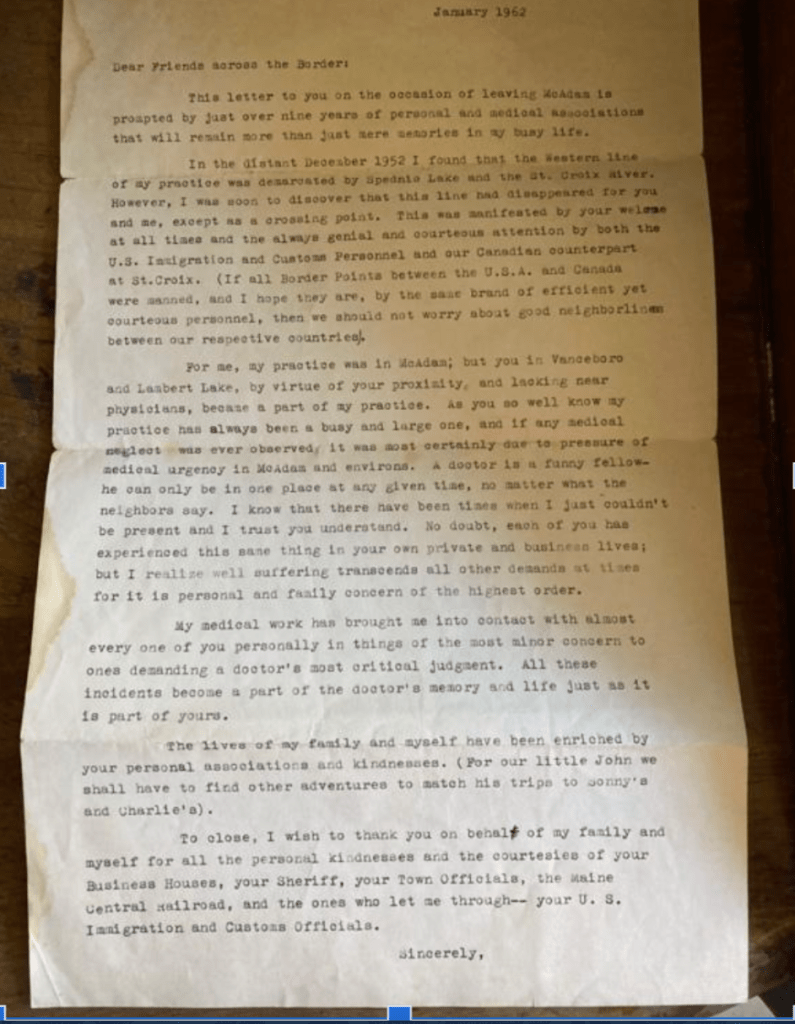
Dear friends across the border,
This letter to you on the occasion of leaving McAdam is prompted by just over nine years of personal and medical associations that will remain more that just mere memories in my busy life.
In the distant December 1952 I found that the Western line of my practice was demarcated by Spednic Lake and the St. Croix River. However, I was soon to discover that this line had disappeared for you and me, except as a crossing point. This was manifested by both your welcome at all times and the aways genial and courteous attention by both the U.S. Immigration and Customs Personnel and our Canadian counterpart at St. Croix. (If all Border Points between the U.S.A. and Canada were manned, and I hope they are, by the same brand of efficient yet courteous personnel, then we should not worry about good neighborliness between our respective countries).
For me, my practice was in McAdam; but you in Vanceboro and Lambert Lake, by virtue of your proximity and lacking near physicians, became a part of my practice. As you well know my practice has always been a busy and large one, and if any medical neglect was ever observed, it was most certainly due to pressure of medical urgency in McAdam and environs. A doctor is a funny fellow – he can only be in one place at any given time, no matter what the neighbors say. I know that there have been times when I just couldn’t be present and I trust you understood. No doubt, each of you has experienced this same thing in your private and business lives; but I realize well suffering transcends all other demands at times for it is personal and family concern of the highest order.
My medical work has brought me into contact with almost every one of you personally in things of minor concern to ones demanding a doctor’s critical judgment. All these incidents become a part of the doctor’s memory and life as it is part of yours.
The lives of my family and myself have been enriched by your personal associations and kindnesses. (For out little John we shall have to find other adventures to match his trips to Sonny’s and Charlie’s).
To close, I wish to thank you on behalf of my family and myself for all the personal kindnesses and the courtesies of your Business Houses, your Sheriff, your Town Officials, the Maine Central Railroad, and the ones who let me through – your U.S. Immigration and Customs Officials.
Sincerely.
THE DOCTORS, MCADAM – HOME VISITS by Joy Leech
My grandfather, Aubrey T. Raye was born in Vanceboro on July 21, 1910. He grew up on a farm on the Farm Road. His family consisted of his parents, Frank and Icy and four other siblings. He told me stories of what living in Vanceboro was like and these two stories have always remained memorable to me.
When my grandfather was a young boy, one of his siblings became ill and was in need of a doctor. He was the one to try to get the doctor from McAdam to come to his home. He hitched up the horse and sleigh, as it was winter, and set off for McAdam, six miles away. He got the doctor who came with him to care for his sick sibling.
The other story was when he was a boy attending school in Vanceboro. In the spring and fall a doctor would come to the school and set up an operating table in a classroom by pushing desks together. The doctor would do minor procedures like tonsillectomies or any other minor surgery. Once the procedure was done, the children would be taken outside to lie on the school lawn to recover. The teachers would help in providing care. He would often say many children would not have survived without the doctors who would come to your home and treat their patients.

Dr. Stillwell Johnston & the “Lying-In” House
Stillwell Johnston was born in Sebec, Maine, December, 23, 1876. He came to Vanceboro with his parents in 1886 when he was ten years old. He died December 2, 1929 (age 52) and is buried in the Vanceboro Cemetery. Stillwell married Annie Geneva White, from Forest City, Maine, in 1901. She was born in 1881 & died in 1919 of influenza. It is not clear if their son, Llewellyn, also died of the flu in 1919. Dr. Johnston remarried Ethel Dewitt in 1920.14
At one time, Dr. Johnston owned and lived in what was, until recently, referred to as The Powell house. The house was sold recently to Bart & Jen Kasten, friends of the Stillsons & Camelis, who are Susee descendants living in the circa 1875 house across the street. The house has two distinctions. One, it has an unusual, curved wall, and two, it was once a “Lying-In” house – a maternity ward of sorts, a house for women who had just given birth to rest and recuperate.
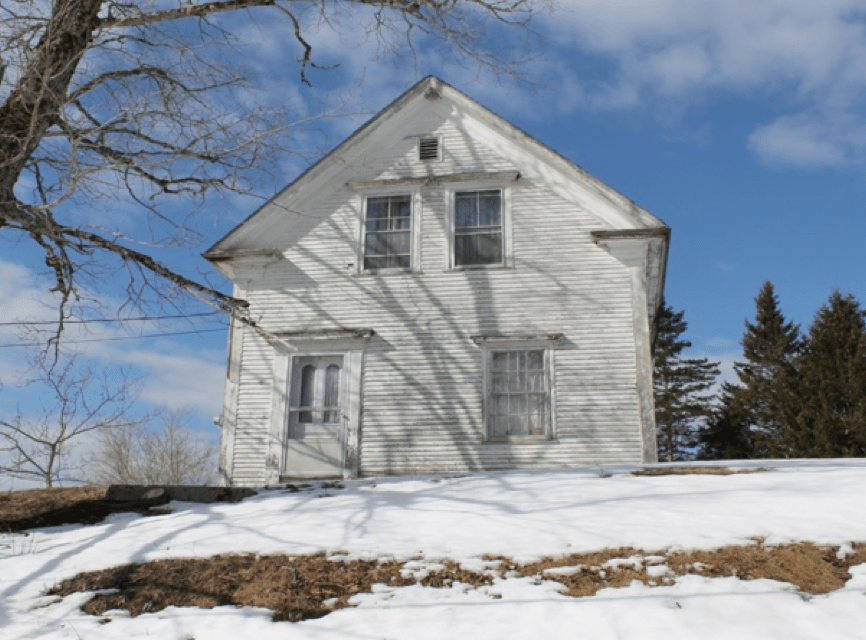
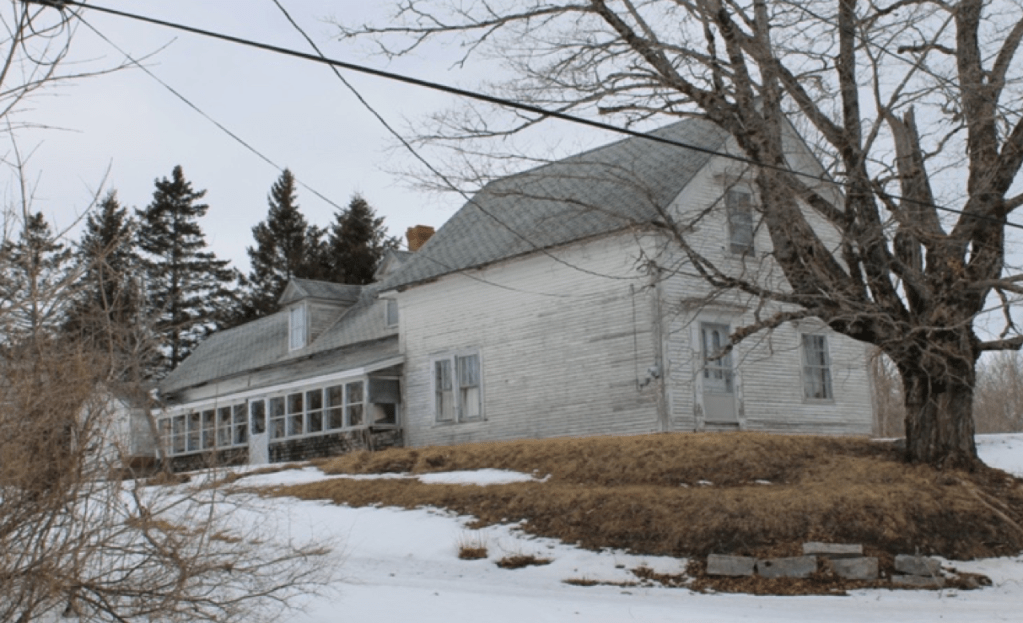
[Photos by Alaine Peaslee-Hinshaw]
Lying-in
The word “midwife” originates from the old English word mid “with” & wife “woman.”15 When labor started, a call went out to summon the midwife and “gossips,” a small group of women who supported the mother and midwife through the birthing process. Nowadays “to gossip” means to make idle talk or spread rumors, but the term originates in the birthing room.
Lying-in time ranged from two weeks to two months. As a practice, a pregnant woman limited her movement before or after birth in order to reduce risk of pregnancy or postpartum complications. Lying-in, or postpartum confinement, was considered an essential component of the postpartum period. We do not know how long Dr. Johnston operated the Lying-In house. We do not know if there was a town midwife.
Christine Sewell Stillson reports that while her mother, Frances Susee, grew up across the street in the older but almost identical “Susee house,” Frances was actually born in the lying-in house across the street. Frances Susee‘s birth certificate was signed by Dr. Stillwell Johnston who may have lived in the house at that time. Dr. Johnston is linked to another house on High Street in Vanceboro at a later date.
Sadly, and tragically, Dr. Johnston and his daughter, Natalie Maxine, 22, both of Vanceboro, died December 2, 1929, in Chipman Hospital, Stephen, N.B. from injuries received when their car was wrecked by a northbound Canadian Pacific freight train at Valley Road crossing near St. Stephen, N.B. Maxine just recently graduated as a nurse from Chipman Hospital. Dr. Johnston was 52, Maxine 22.16 Both are buried in the Vanceboro cemetery. Dr. Johnston’s obituary, Vanceboro, December 16, 1929, reveals how beloved and esteemed he was as a hometown physician:17

The tides had turned. By 1911 McAdam, Canada, was the larger town of 1,111 people. The population peaked in 1956 at 2,803.18 By 1950, Vanceboro’s population was 497 and rapidly decreasing to 300, then 200, then 100 residents at present, 2023. Vanceboro’s nurses became the town’s only medical practitioners and childbirth took place in hospitals in McAdam or in Calais, Maine.19
Footnotes:
- Special thanks to Dorothy Amero Cummings & Lyn Mikel Brown of the Vanceboro Historical Society, and to Gary Beers of V’boro, Maine Community Facebook group. ↩︎
- Redstone, W.A., The History of McAdam (1871-1977), McAdam Senior Citizens Historical and Recreational Club, 1979., p. 85. ↩︎
- Faye E. Luppi, & Marcella L. Sorge. Vanceboro, Maine, 1870-1900: A Hinterland Community, p.132. Maine History 25, 2(1885):88-113. ↩︎
- Donham, Maine Register State Yearbook, No.36-June 1905, p.1005. ↩︎
- George, N. Colby & Co., Atlas of Washington County Maine, 1881, p. 39. ↩︎
- V’boro, ME Community Facebook page obituary section shared by Dorothy Amero Cummings. ↩︎
- Redstone, W.A., The History of McAdam (1871-1977), p. 85. ↩︎ ↩︎
- V’boro, ME Community Facebook page obituary section shared by Dorothy Amero Cummings. ↩︎
- Ancestory.com; an obituary posted by Michelle Johnson. ↩︎
- Maine State Legislature State Board of Health of Maine Office of the Secretary’s Report, 1907, p.30. Maine Legislature(.gov), http://lldc.mainelegislature.org. ↩︎
- V’boro, ME Community Facebook page obituary section shared by Dorothy Amero Cummings. ↩︎
- V’boro, ME Community Facebook page obituary section shared by Dorothy Amero Cummings. ↩︎
- Rootsweb.com: Croix Courier Journey Through Time, Good Times, Hard Times,1926-1945, and, Ancestory.com; an obituary posted by Michelle Johnston. ↩︎
- https://en.wikipedia.org/wiki/Midwife ↩︎
- Rootsweb.com: Croix Courier Journey Through Time, Good Times, Hard Times,1926-1945. St. Croix Courier Journey Through Time…..1926-1945 and 8V’boro, ME Community Facebook page obituary section shared by Dorothy Amero Cummings., and Ancestory.com; an obituary posted by Michelle Johnson. ↩︎
- Ancestory.com; an excerpt of obituary posted by Michelle Johnson. ↩︎
- Wikipedia McAdam, New Brunswick. https://en.m.wikipedia.org. ↩︎
- https://en.wikipedia.org/wiki/Vanceboro,_Maine ↩︎

 Vanceboro Historical Society