by Lyn Mikel Brown
Dr. Thelma Louise Kellogg was born in Vanceboro on January 18, 1894, the youngest of Horace Kellogg’s four children. Her mother was Alice Cobb Kellogg, Horace’s second wife. Like her three siblings, she was likely born in the Kellogg family house on High Street. Her parents later bought and moved the family into what is still regarded as the Thaxter Shaw House, off First Street.
Thelma graduated from Vanceboro High School and, in what was very unusual for young women in 1914, went off to college to study English at the University of Maine at Orono.

At UMaine, Thelma compiled an impressive academic record. She was a member of the prestigious honor society, Phi Beta Kappa and, as a senior, served as an assistant instructor in English. Politically active on campus, she was Secretary of the College Equal Suffrage League, (CESL), an organization founded in 1900 as a way to attract younger Americans to the women’s rights movement. And she had fun as a member of Delta Delta Delta Sorority, Glee Club and Mandolin Club.
Her senior yearbook profile offers hints to her lively personality and political passions: “Who’s that, snickering and giggling? Can’t be any other person than “Kay” Kellogg, our movie friend and disloyal American. Kay averages six trips a week to the movies (only shortness of the week keeps her average so low). O, you may think her a very demure young miss about Campus, but there are people who could tell many a tale of “Tuggy,” “Charlie,” “Jack,” or “Dickie.”

Following her graduation in 1918, Thelma taught for the next five years while enrolled in graduate studies at UMaine–she received her Master of Arts in 1923. Her thesis, “The Life and Works of John Davis 1774-1853,” an English writer known for popularizing the story of Pocahontas, was later turned into a book, “the first to be published of a series of such studies by graduate students in the University of Maine.”1
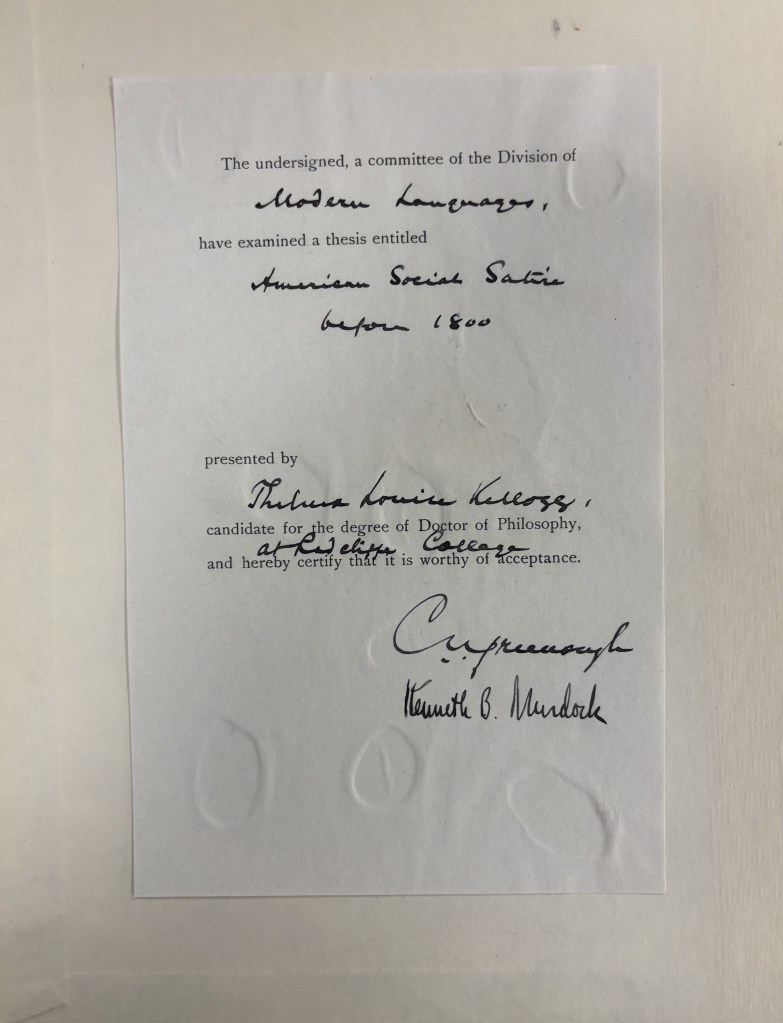
Thelma then attended Radcliffe College where she taught for six years, earned a second A.M. in Philology (the history of languages, especially through literature) and a Ph.D. in English. Her dissertation, “American Social Satire before 1800,” completed in 1929, was an ambitious study of satire in newspapers, magazines and early American almanacs. It was an exhaustive analysis: two volumes and 577 pages. Below is a photo of her dissertation housed in the Harvard archives and, next, the signature of her advisor, Harvard English Professor, Dr. Kenneth Murdock, certifying the dissertation. Both photos are courtesy of the Harvard University Archives.

The summer after graduation from Radcliffe, Dr. Kellogg studied at Oxford University in England. She then accepted an appointment, fall of 1929, teaching English at Southern Illinois Normal University (SINU) in Carbondale, Illinois.
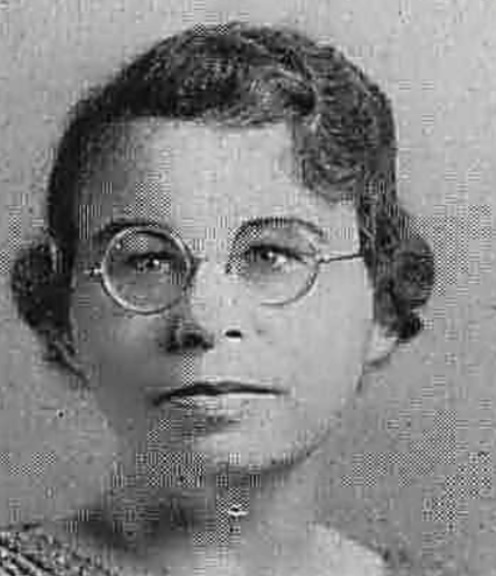
In 1933, according to the SINU school newspaper, The Egyptian, Thelma received her retroactive invitation to Phi Beta Kappa because at the time she was a student at the University of Maine the honor society did not exist on campus. “Dr. Kellogg was elected to the national honorary scholastic fraternity when she returned to UMaine for her fifteen reunion.”
The paper continues, “Her election to membership in Phi Beta Kappa is the second distinction which has been conferred upon Dr. Kellogg…. during the several years she has spent here…as a member of the faculty of the English Department. In 1931 she was chosen to membership in the exclusive organization, All Maine Women. Each year one or two persons are elected to membership in this organization which is composed of members representative of the ideal woman student of the University of Maine….”2
Unfortunately, poor health forced Dr. Kellogg to relinquish her duties as Professor of English in 1946, a year before SINU became Southern Illinois University. She returned home to Vanceboro, spending her final days in her beloved community, living in her family home. She died in the St. Stephen, New Brunswick hospital on December 7, 1946 at the age of 52.
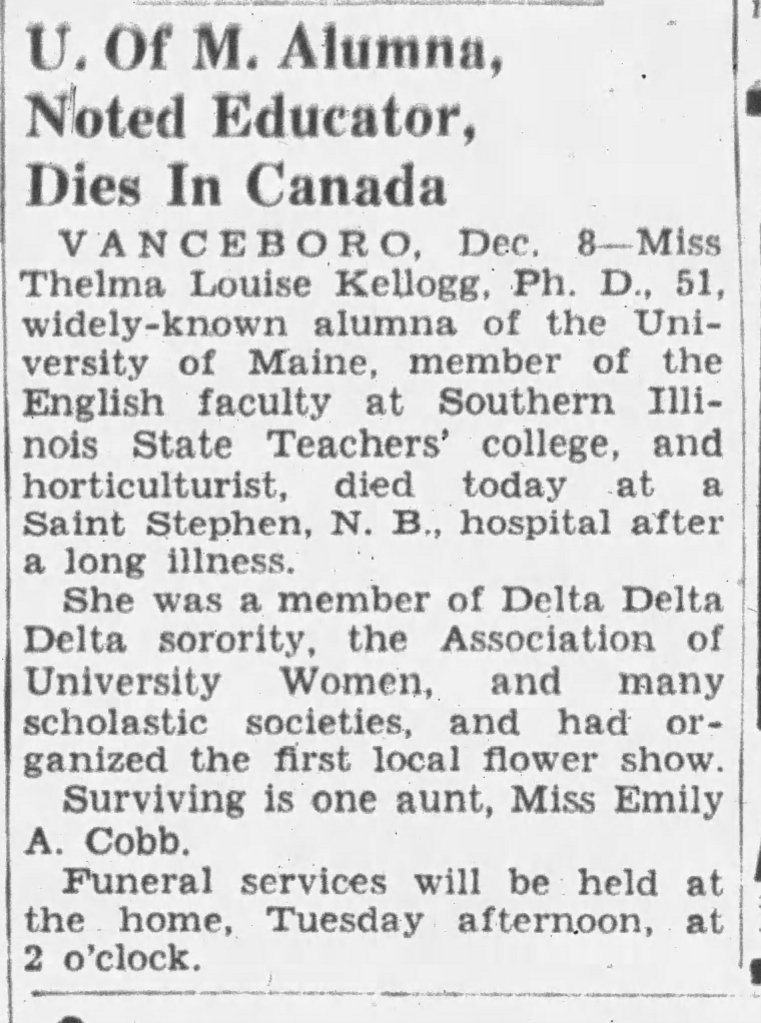
The Bangor Daily News announced Thelma Kellogg’s death, recounting her academic history and activities, including her love of horticulture.
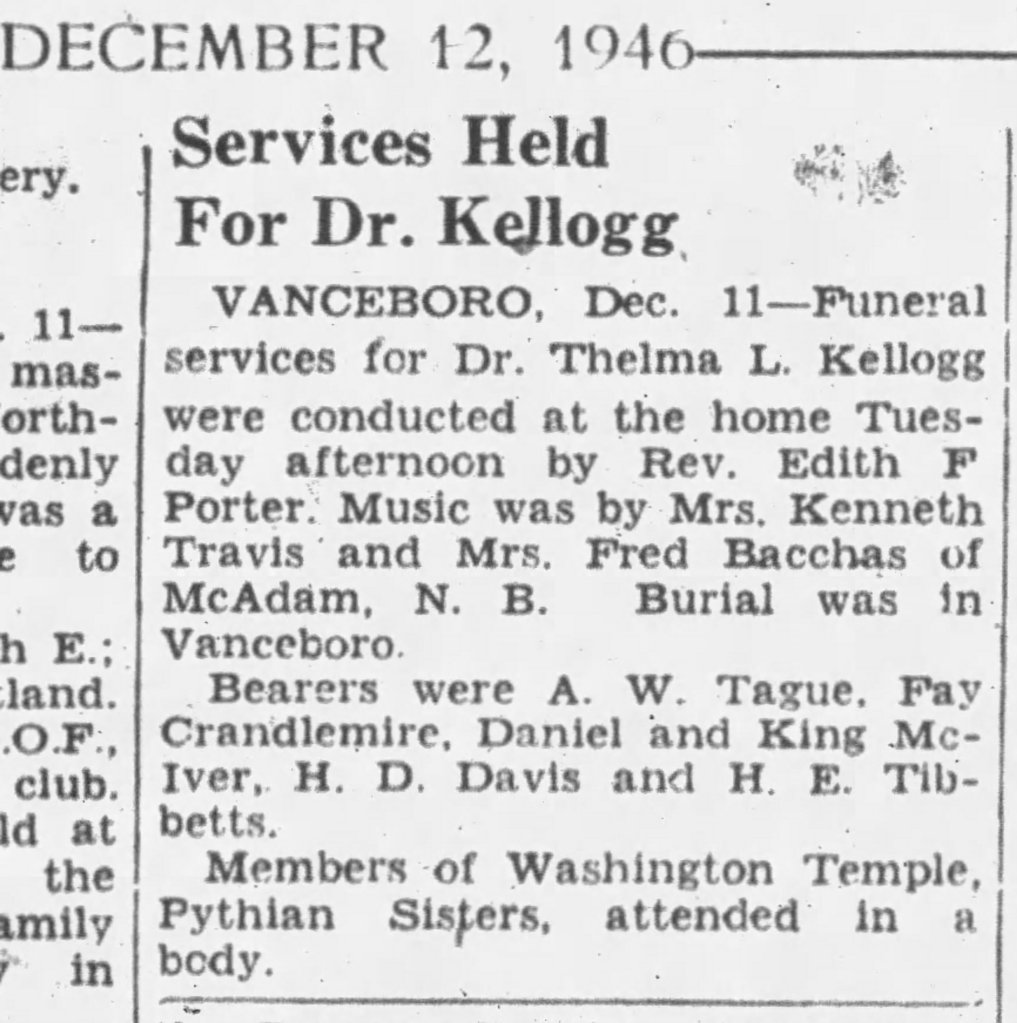
Thelma Louise Kellogg was buried with her brother Harold in the Vanceboro Cemetery.
Dr. Kellogg was described by her colleagues at SINU as a “dynamic, suburb teacher,” interested not only in the welfare of the student, but also of the community.”3
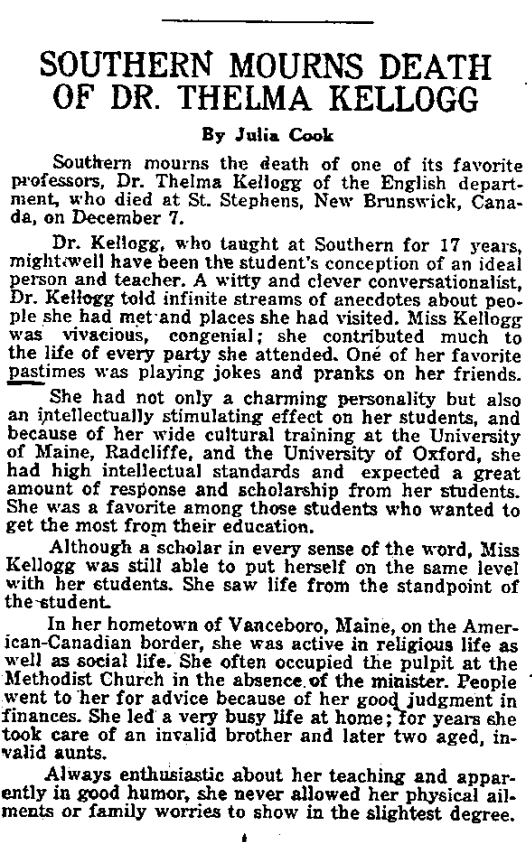
“Southern mourns the death of one of its favorite, professors,” the campus newspaper reports.4 “Dr. Kellogg…might have been the student’s conception of an ideal person and teacher. A witty and cleaver conversationalist, Dr. Kellogg told infinite streams of anecdotes about people she had met and places she had visited. Miss Kellogg was vivacious, congenial; she contributed much to the life of every party she attended. One of her favorite pastimes was playing jokes and pranks on her friends.”
Dr. Kellogg was “intellectually stimulating” and “demanding” and also accessible — a teacher who “saw life from the standpoint of the student.”
Thelma Louise Kellogg was, also, deeply connected to her family and beloved hometown — caring for ill and aging family members over the years, preaching at the Methodist church, a horticulturalist and avid member of the Vanceboro Gardening Club.
After more than 25 years of devoted service as a teacher, It was natural that in disposing of her estate Thelma Kellogg should think of how to support the next generation. Her will provided that each of the three institutions with which she was affiliated would receive almost $30,000 (approximately $500,000 in today’s dollars), to establish scholarships in her name. Her largesse enabled many deserving students and scholars to pursue their educational ambitions. The Thelma Louise Kellogg scholarship to the University of Maine and Southern Illinois University, which specifically designated for “one or more deserving and needy students majoring in English,” continue to this day. Radcliffe merged with Harvard University in 1999. Thelma’s gifts enabled deserving students and scholars to pursue their educational ambitions. What better legacy for a scholar and gardener than planting seeds for the future.
- Kellogg, Thelma Louise. 1926. The Life and Works of John Davis 1774-1853; Forward by editor H.M.Ellis. University Press: Orono, ME. ↩︎
- Dr. Thelma Kellogg Recently Elected to Phi Beta Kappa, The Egyptian, Feb. 22, 1933. ↩︎
- Gifts Administered By SIU Foundation, The Egyptian, August 11, 1964. ↩︎
- Cook, Julia. Southern Mourns Death of Dr. Thelma Kellogg, The Egyptian, January 10, 1947. ↩︎

 Vanceboro Historical Society