When the European & North American Railway Line connecting Maine to New Brunswick was completed in 1871 and the Shaw Brothers Tannery began operations, Vanceboro’s population grew quickly. Scores of enterprising young men and women migrated east to establish new lives and livelihoods on the banks of the St. Croix. This is the story of two of these newcomers who shared a common and arduous history: both were members of the famed 16th Maine Volunteer Infantry Regiment that served in the Union Army during the Civil War.

Henry Mansfield was a Private in Company B. He joined the 16h Maine on September 8, 1863, at age 29. He was a farmer in Greenbush when he enlisted as a “volunteer substitute” for Melvin Grant, Esq. of Eddington. During the spring and summer of 1864, the 16th Maine fought with Grant’s Army of the Potomac in the bloody and brutal “Overland Campaign” in Virginia. Henry was captured in the battle of Weldon Railroad on August 19, 1864, and sent to three of the most infamous Confederate prisons: Libby, Belle Isle, and, finally, Salsbury. He was released in a prisoner exchange on June 21 and honorably discharged on July 21, 1865.

Horace Kellog was a Private in Company C. He joined the 16th Maine on September 3, 1864, at age 18. He was working on his father’s farm in Patten when he enlisted as a volunteer, having finally received his parents’ permission to do so (his older brother, Marcellus, a Private in the 1st Maine Calvary, had died earlier that summer). During the fall of 1864 and spring of 1865, the 16th Maine fought in the final battles of the war in southern Virginia; the regiment (including Horace) was present at Lee’s surrender at Appomattox on April 9, 1865. He was honorably discharged on June 5, 1865.
In spite of the regimental affiliation they shared, Henry and Horace never served in the 16th Maine at the same time. Henry was taken prisoner before Horace joined the regiment, and Horace was discharged before Henry was released. Yet just nine years later they would be neighbors on the west side of High Street in Vanceboro.
After the war, Henry returned to Greenbush, where he discovered that his first wife, assuming he had died in the war, had remarried. They were divorced in 1871. Because of injuries and illness during his imprisonment, he was unable to do manual labor. He became a night watchman for the Eastern & North American Railroad, perhaps first in Mattawamkeag, where he met Julia Kimball.
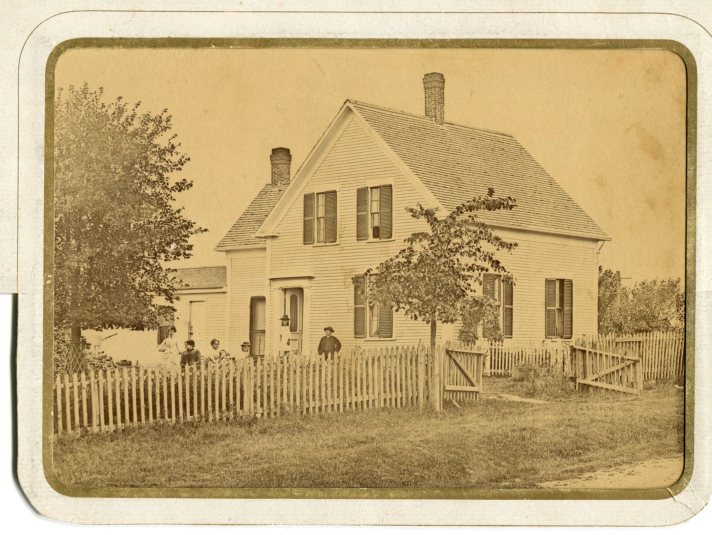
Henry bought their house on High Street in Vanceboro in December 1872 from George Sprague (opposite Second Street); he married Julia in May 1873. They moved to Vanceboro, and their four children, Harry, Carrie, Edith, and George were all born in the house. Henry worked for the railroad until his death on May 19, 1905, at the age of 72; he is buried in the Vanceboro cemetery.
After the war, Horace returned to Patten. He lost interest in farming, and, instead, decided to go into business with his cousin, Ezra Jameson, of Lincoln. They moved to Vanceboro, purchased land, and opened a store in 1872.
Horace married his first wife, Addie Tupper from Topsfield, in 1872. Addie bought their house on High Street in October 1874 from Wallis Works. Addie died in 1882; in 1884 Horace married Alice Cobb (the daughter of his neighbors, Charles and Sarah Cobb). Horace’s four children, Carl, Horace Jr., Harold, and Thelma, were all born in the house. Horace bought out his cousin, his store thrived, and he became one of Vanceboro’s most prominent citizens. He died on March 8, 1917, at the age of 72; he is buried in the Vanceboro cemetery.

We know very little about Henry and Horace’s relationship during the 31 years they were neighbors in Vanceboro. Were they friends? Did they talk about their experiences in the war? We know that Henry attended at least one regimental reunion (in Augusta in 1883); perhaps Horace joined him? Perhaps they attended GAR Post meetings in Calais or Eastport together? Or, perhaps they weren’t interested in reliving the horrors of the war, or their social circles were different enough that their paths rarely crossed, even in a small town. No matter what, they both served the union with distinction and valor and Vanceboro is proud to call them her own.

 Vanceboro Historical Society