by Mark Tappan and Lyn Mikel Brown
We’ve taken a deeper dive into the life of one of Vanceboro’s most adventurous and accomplished “daughters”– Ruth Carolyn Holbrook (1896-1993).
Ruth’s remarkable story is linked, of course, to that of her mother, Louisa Catherine Sprague Holbrook (1863-1937), and Louisa’s father (Ruth’s grandfather), George MB Sprague (1828-1913), one of Vanceboro’s “founding fathers.” Sprague was a farmer living in Princeton, Maine, married to Rhoda Colwell Sprague (1834-1870) when Louisa—their first child–was born. A year after Rhoda’s death in 1870, followed shortly by two of Louisa’s younger siblings, George married Margaret Bishop and accepted a position as Deputy Collector of Customs in Vanceboro. The family relocated to Vanceboro when Louisa was eight. The family lived in a big house on the corner of Second and Shaw Streets, where they raised five children.
In 1887, when Louisa was 24, she married local businessman E. A. Holbrook (1863-1934). They immediately moved into the large Holbrook house on Salmon Brook Road, where E.A. and his brother Harry had been raised by E.T. and Mary Holbrook. E.A. and Louisa raised three daughters in that house: Mary (1888-1941), Margaret (1891-1973), and Ruth. The doting parents had three small white stones, one for each daughter, embedded in the living room stone fireplace.
Louisa’s adult life was comfortable, and she enjoyed the benefits and privileges afforded to her as the spouse of a successful businessman and landowner in Vanceboro during the first decades of the 20th century. For example, on the 1900 census, E.A., Louisa, and their three daughters, along with the widowed E.T., are listed as living in the house along with an 18-year-old servant, Essa Stythan. Louisa’s obituary says that she was “long prominent in fraternal and social life in Vanceboro….[s]he was a charter member of Washington Temple Pythian Sisters…a member of the nonpareil chapter, Order of the Eastern Star…and chairman of the Vanceboro branch of the Calais chapter of the Red Cross.” In addition, “of a social disposition, Mrs. Holbrook was known and esteemed by the entire community personally and in social gatherings.”
We don’t know much about Ruth’s early life. She went to Vanceboro schools, and she likely travelled with her family during holidays. She graduated from Vanceboro High School and entered Colby College in the fall of 1915, at the age of 19 (following in the footsteps of her sister, Margaret, who graduated from Colby in 1912). While there, she was a member of the Delta Delta Delta sorority, the Chi Gamma Theta sophomore society for women, the Ladies Glee Club, and the Guitar Club.

We can only guess why Ruth decided to leave Colby after only two years. She was certainly a gifted artist, and perhaps Colby did not provide her with enough training or academic support in that realm. Maybe Colby’s small campus in Waterville did not feel like a good fit. Perhaps she had bigger dreams. In any case, she spent the 1917-1918 academic year “attending an art school” in Boston, according to the Bangor Daily News; in January 1920, she was reportedly “attending school” in New York City.
We do know that in May 1922, at the age of 25, Ruth applied for a US passport to travel to Belgium, France, and Switzerland, sailing on the Melita out of Montreal. Her passport application lists her address as 266 West 94th St. in Manhattan and her occupation as a “costume designer.” She continued to live and work in New York through the 1920s and 1930s. She is listed on the 1930 Federal Census as living on West 92nd St. in Manhattan as a “roomer.” Her occupation is listed as “buyer for specialty shop.” We don’t know more about her professional life during this period—possibly she was employed in the arts, design, and fashion industry during the difficult years of the Depression.

Ruth was certainly a talented artist. By the mid 1930s she turned her attention to illustrating children’s books, and subsequently, wrote and illustrated her own. Her first illustrated book was Blanche Elliott’s Timothy Titus (Doubleday, Doran, & Co., 1937), followed by a “junior” book she wrote and illustrated herself. Cap’n Benny’s Birdhouses (Doubleday, Doran, & Co.,1938), follows an unlikely friendship between a boy and a lonely retired Northeast Harbor sea captain. She then illustrated Hildreth Tyler Wriston’s Camping Down at Highgate (Doubleday, Doran, & Co., 1939). In 1940, she published her most well-known book, Katy’s Quilt (Doubleday, Doran, & Co., 1940).
Katy’s Quilt tells the story of a young girl and her family living in Washington County, Maine, just after the Civil War. The book is fascinating because, while Ruth clearly took some literary license in telling Katy’s story, it reflects quite accurately real events in Ruth’s family and in the growing towns of Calais, Princeton, and Vanceboro in the 1860s and 1870s.
Katy (clearly modeled after Ruth’s mother Louisa Catherine) is excited when her father (modeled after Ruth’s grandfather, GMB Sprague) takes a new job in Vanceboro. The family packs up their belongings, takes a horse and wagon to Calais, then a train up the Canadian side of the St. Croix River, and walks across the unfinished bridge to Vanceboro and their newly built home “on the top of the hill.” Once the bridge is completed, the whole town celebrates President Ulysses S. Grant’s visit to Vanceboro to commemorate the completion of the European & North American Railway. And Katy even gets to meet the President, who compliments her on her shiny new tassled shoes.
Katy’s Quilt was the Literary Guild’s selection for August 1940. It also received a glowing review from Oscar Shephard in the Bangor Daily News. While this “delightful” book about a family of “Maine pioneers of an earlier and more rugged day” is “intended primarily for little ones,” writes Shephard, “it will appeal also to those adults fortunate enough to have retained a touch of childhood’s idealism in their hearts.” The book is “simply and honestly told,” and “Miss Holbrook has a deft literary touch. Her style is smooth as velvet—or, if you prefer another simile, a flowing crystal stream that carries the reader along with it. She writes with effortless art.”

In spite of the success of Katy’s Quilt and Ruth’s obvious talent as an artist and writer, she published nothing after 1940, either as author or illustrator. Instead, she continued to work in the New York City retail industry. She is listed in the 1940 census as living in Scarsdale, NY with her sister Margaret Titcomb and Margaret’s son Lee Raymond Titcomb (age 11). Margaret is registered as the “owner” of “ladies retail apparel” and Ruth is listed as “saleswoman” of “ladies retail apparel” (it would seem they worked together in the store Margaret owned). Ruth does not appear in the 1950 census; Margaret and Lee, do, however, living together (without Ruth) in Eastchester, NY (a 10-minute drive from their 1940 Scarsdale address).
In 1952, at the age of 56, Ruth upended her life and changed her professional direction completely. She and her nephew, Lee (then age 23) founded Woodbury Pewter in Woodbury CT. According to Lee’s son, Brooks Whitcomb, current CEO of the company (now in its 73rd year of operation), Lee was an electrical inventor and engineer and Ruth was working for major department stores designing window displays. With Ruth’s marketing and design background and Lee’s mechanical skills, they decided to go into business together. What distinguished Woodbury Pewter was craftsmanship — each piece was made by hand, using the tools and methods utilized by pewter smiths in the 1700s and 1800s. When they started the business, according to Brooks, “Dad would make the pewter and my great aunt Ruth would load up her Studebaker station wagon; and like the old-fashioned Yankee peddlers, would zoom around to little stores all over New England, selling the wares they were making.”

Later in life, Ruth moved to Mexico to live, once again, with her sister Margaret. There she studied art, shifting from watercolor to acrylic, and producing colorful portraits of local people and sweeping landscapes in Mexico. In 1973, at the age of 82, Margaret died and was buried in San Miguel de Allende, Guanajuato, Mexico.
The final chapter in Ruth’s remarkable life was spent in Florida, living with family and continuing to paint. Ruth died in Palm Beach on February 20, 1993 at the age of 97.


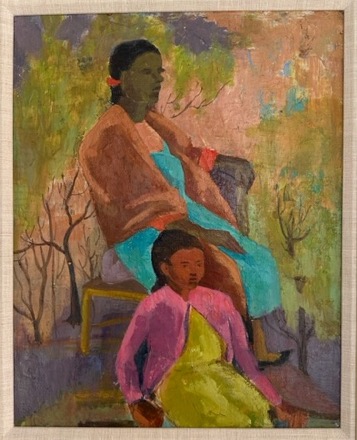


 Vanceboro Historical Society