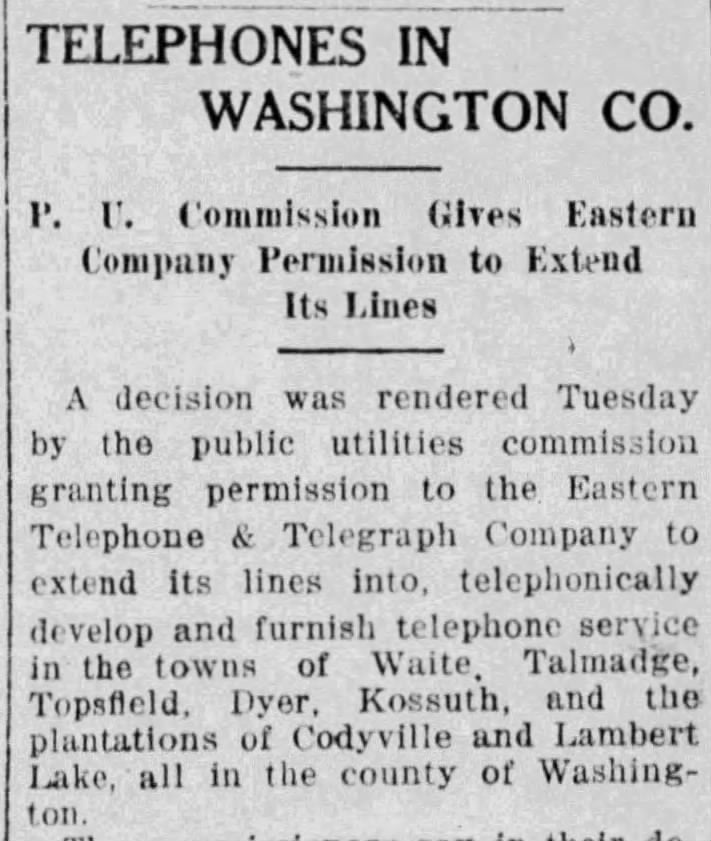
While the railroad station was connected through telegraph pretty much from the town’s beginnings, telephones came to Vanceboro and surrounds in 1919.
Folks remember the old crank telephones and party lines well into the 1950s. As is so often the case in border towns, things, well, operated a bit differently. Calls were directed through Canada and then back to the states.
Philip Palmer, stationed in Quantico, VA in WWII remembers that calling home went something like this:
Me to Virginia operator: “Vanceboro 545 ring 5.”
Operator to DC: “Vanceboro 545 ring 5.”
Repeat to New York, Boston, Bangor, Calais, St. Stephen.
“Sometimes there would be a long delay before the St. Stephen operator would answer and the Virginia operator would get frustrated and wonder out loud what was taking so long,” Mr. Palmer explained. “I told her that we were going from the U.S. to Canada so it had to be inspected, which was causing the delay. She said, ‘Oh.’”
Mary McAleney, then living on Salmon Brook Road with her family, also recalls how the connection downstate went through Canada. Her family didn’t have a phone until 1960, so she walked into town to make a call.
“To call my Grandfather in Brooks we would go to Tid Sears’ store to use the phone. I remember when I was entrusted with this task. After clearing things with Tid, I called the McAdam operator who connected to St. Stephen to Calais, then to an operator in Bangor then Belfast then Brooks, where I would ask for my Grandpa.”
Bill Brown remembers the sense of awe he felt with their first family phone.
“Definitely an ‘…everything’s up to date in Kansas City…’ moment for me when it was installed. It was a two piece crank phone, with a wooden box that had the ringer, attached to the living room wall. You “dialed” the phone by picking up the black receiver/mouthpiece and then turning the crank on the side of the box. One long crank to get an operator and an out of town line. People were given a two or three ring “number.” Ours was two longs and a short. There were two and four party lines. If someone was talking on your line, you had to wait your turn. And you could hear a click from someone else’s phone or hear them breathing when they would pick up to listen in on your conversation.”
Operators, of course, and sometimes a nosy neighbor or two on the party line had the full scoop on town gossip. Some folks remember grouchy operators, no doubt annoyed at those who didn’t follow protocol. Harold Little from McAdam, whose mother Dorothy (Brown) Little grew up on High Street, recalls his Uncle Lindy visiting from Vanceboro.
“He’d call Kenny Essensa to see if he was home. He would grab that handle and give it about two complete turns. He knew he would get hell and the supervisor would come on the line to give it to him. But he knew that supervisor all his life and he would say, “Is that pretty little Annie Egan?” Annie would say, “Oh my God, Lindy Brown!” and they would have a great chat.”
Party lines remained through the 1970s and early 80’s and many can recite their numbers to this day. Among the artifacts at the Vanceboro Historical Society is an original crank phone as well as its successor, itself a relic of the past, the rotary phone.

 Vanceboro Historical Society